We’re closing out March with a strong set of moves. Here’s what’s been driving crypto this week.
Bitcoin finance protocol Hashi launches on Sui, Major League Baseball inks deal with Polymarket, and a dormant Bitcoin whale wallet wakes after 13 years. AI agents are coming to XRP Ledger, Afroman’s crypto token pumps 4,685% after a defamation trial victory, and Zypto highlights its crypto payment gateway for global businesses.
Let’s dive in.
Bitcoin finance protocol Hashi launches on Sui
A new Bitcoin-based finance protocol called Hashi has been introduced on the Sui blockchain, with early participation commitments from crypto institutions including BitGo and FalconX ahead of its planned launch later this year, per this press release.
Hashi is designed to let Bitcoin holders earn yield on native Bitcoin (BTC) through on-chain lending and borrowing, targeting a segment that currently represents a small share of Bitcoin’s overall market.
The protocol, developed primarily by Mysten Labs, the core contributor to the Sui blockchain, will initially focus on BTC-backed lending, enabling users to borrow stablecoins against their holdings while institutions are expected to supply liquidity at launch.
The system introduces on-chain verification and programmatic collateral management aimed at making BTC lending more suitable for institutional use. Although Bitcoin-backed lending markets shrank sharply following the 2022 collapse of crypto lenders BlockFi and Celsius Network, interest has begun to recover in recent years.
Bitcoin remains largely unused in decentralized finance, with about 0.22% of its supply, or roughly $3.07 billion, currently deployed in DeFi protocols, according to the announcement and on-chain data from DefiLlama.
The rollout also includes participation commitments from custodians and infrastructure providers such as Ledger and Cubist, along with Sui-based DeFi protocols expected to support lending, custody, and collateral management once the platform launches.
Hashi said it will rely on a combination of multi-party computation custody and smart contracts on Sui to manage collateral and facilitate lending, with audits and formal verification planned before launch.
Additional features outlined include insurance coverage for BTC collateral and plans for issuing Bitcoin-backed bonds. The project is currently in development, with a devnet expected soon and a mainnet launch planned for later this year.
Major League Baseball inks deal with Polymarket
Major League Baseball (MLB) announced that it signed an “integrity protection” agreement with the US Commodity Futures Trading Commission (CFTC) as it separately inked a deal with prediction market platform Polymarket.
In an announcement, MLB said that its commissioner, Robert Manfred, signed a memorandum of understanding with CFTC Chair Michael Selig following the league’s request for “strong integrity protections in the rapidly evolving prediction market space.”
Similarly, in another deal, the league said it had reached an agreement for prediction market platform Polymarket to be its Official Prediction Market Exchange. Manfred said, “The new agreements that we formed with Polymarket and the CFTC are imperative steps in proactively managing the new and rapidly growing prediction market space.”
In August, MLB sent a memo to players and clubs warning them about prediction markets, reminding them that the league’s gambling rules apply to those platforms. In November, two Cleveland Guardians pitchers were charged with sharing inside information about their play with sports bettors.
The deals were announced amid scrutiny from federal and state lawmakers on prediction market platforms like Polymarket and Kalshi. In the US Congress, lawmakers have named Polymarket in proposed laws to crack down on bets related to military conflicts, while at the state level, both platforms are facing lawsuits related to betting on sporting events without a license.
Although prediction market platforms offer event contracts on a variety of topics such as US politics, weather, and pop culture, authorities in many US states have been challenging companies like Kalshi or Polymarket over sports bets and, in Arizona, election wagering.
Selig, as the sole commissioner at the CFTC, has been publicly pushing for the agency’s “exclusive jurisdiction” over prediction markets, including through the proposal for a rule that could amend or issue new regulations for overseeing the companies.

Dormant Bitcoin whale wallet wakes after 13 years
A long-dormant Bitcoin whale wallet has reactivated after 13 years and seven months of inactivity, shifting 0.00079 BTC ($56), a tiny fraction of a fortune now worth around $147 million.
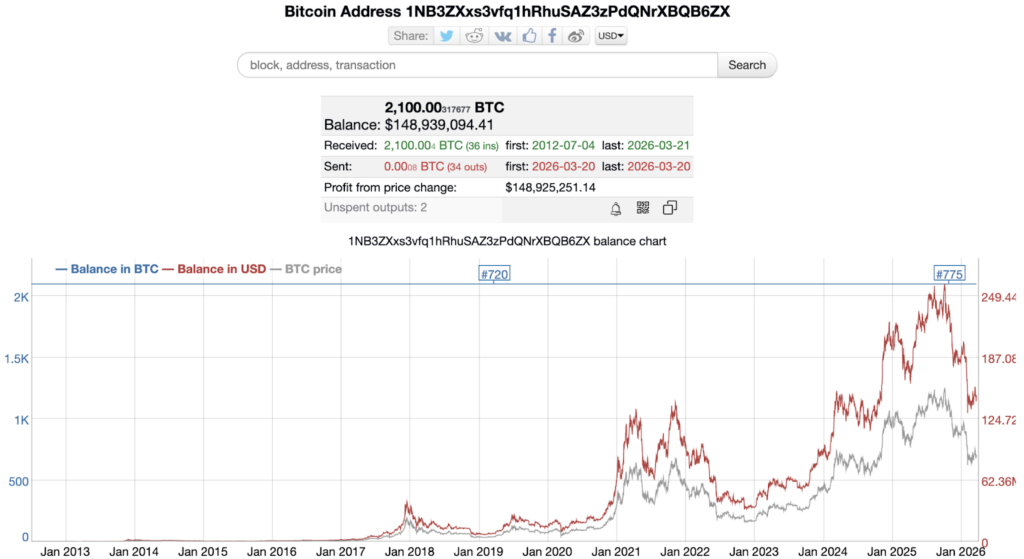
On-chain data from BitInfoCharts shows that the legacy address “1NB3ZX…” received 2,100 BTC on July 5, 2012, when BTC traded at about $6.59 per coin. At today’s prices, that stash is valued at roughly $147 million, turning an initial outlay of about $13,800 into an unrealized gain of more than 10,000x.
The move caught the eye of on-chain trackers like Whale Alert and LookonChain that monitor so-called Satoshi-era addresses, a term often used for coins acquired in Bitcoin’s early years. BitInfoCharts shows the address was funded in a single large inflow on July 5, 2012, and then left untouched for almost 14 years.
Bitcoin traders are split between reverence and speculation. Some praised the HODLer’s apparent discipline for holding through multiple boom-and-bust cycles without selling. Others argued that a more likely explanation was that the owner recently recovered their seed phrase or private key, and was sending a test transaction before cashing out a meaningful amount.
Test transactions of a few tens of dollars are common practice among long-inactive holders, who often move a tiny amount first to confirm they still control the wallet and that the destination address is correct. Traders will now watch closely to see whether the wallet sends more of its 2,100 BTC to exchanges or fresh addresses in the coming days.
The reawakened 2012 wallet follows another recent move by a Satoshi-era BTC holder in January. On that occasion, a separate address that first accumulated Bitcoin in 2013 transferred its entire balance of about 909 BTC (worth roughly $85 million) to a new wallet after more than 13 years of dormancy. The whale locked in a gain of around 13,900x on coins originally bought for less than $7 each.

AI agents are coming to XRP Ledger
t54 announced that autonomous AI agents can now pay for services natively on the XRP Ledger (XRPL) using XRP and Ripple USD (RUSD). The system relies on t54’s x402 facilitator.
T54, founded by Chandler Fang, is a San Francisco-based startup building trust infrastructure for the agentic economy. The company raised $5 million in a seed round in February, co-led by Anagram, PL Capital, and Franklin Templeton. Ripple joined as a strategic investor alongside Virtuals Ventures, Blockchain Coinvestors, and ABCDE.
AI-driven “agent commerce” on the XRP Ledger could strengthen the long-term case for XRP, especially if autonomous systems begin using it for payments and settlement. It gives XRP a credible story in the AI + crypto intersection.
But whether it translates into enough on-chain volume to meaningfully impact XRP’s price depends on whether agent commerce actually takes off at scale, and that’s still an open question. Meanwhile, the development comes as XRP continues to face market volatility.
In other news, a recent survey by Ripple showed that 72% of more than 1,000 global finance leaders believe companies must offer digital asset solutions to stay competitive. The survey found stablecoins were the most prominent use case, with 74% of respondents saying they can boost cash flow and unlock trapped capital.
The report polled around 1,000 finance firms globally, including banks, asset managers, fintechs, and corporates, on adoption, stablecoins, tokenization, and custody priorities. The findings suggest many financial firms are focusing less on whether to engage with digital assets and more on how to buy, build, or partner for the infrastructure needed to support them.
Ripple said the shift toward digital assets is being driven by evolving regulation, growing interest from large banks, increased use of fintech services, and the rise of stablecoins. Respondents showed the strongest interest in stablecoins, while institutions increasingly view them as tools for treasury management.
Afroman’s crypto token pumps 4,685% after defamation trial victory
Afroman ($FRO), the crypto token launched by “Because I Got High” rapper Afroman, has skyrocketed in price after police in Ohio failed to sue him over a series of music videos he made mocking officers who raided his home.
A jury sided with the rapper, whose real name is Joseph Foreman, concluding a defamation lawsuit launched by police in Adams County. The legal action stemmed from a police raid on Foreman’s home back in 2022 that resulted in a broken door, confiscation of cash, and a search that failed to find any evidence of suspected drug trafficking and kidnapping.
The Pump.fun cryptocurrency $FRO was launched six months ago, right before Foreman promoted the token on his Instagram account in a livestream that showed when he was dining out. Across the two days leading up to Foreman’s defamation trial victory, the crypto market cap pumped 4,685% to a high of $335,000.
Foreman was able to capture footage of the raid with his home security cameras, and in response, he created a series of music videos mocking the police deputies in various outlandish ways.
One song called “Lemon Pound Cake” mocked an officer who was recorded looking for a split second at Foreman’s lemon pound cake on the kitchen counter. A second one called “Why You Disconnecting My Video Camera” focused on the officers disconnecting his cameras during the raid. Then, there were some other graphic ones.
The officers claimed the videos caused them humiliation, ridicule, mental distress, and led to a loss of reputation. In deposition footage, one officer claimed the videos partly caused his ex-wife to leave him. However, when his ex-wife testified in court as the only defense witness brought by Foreman, she said the music videos never affected her marriage or life.
Foreman also argued that the officers wouldn’t pay for the damages they caused during the raid, and so he created the music videos in an attempt to recoup those losses. He argued his right to free speech while dressed in a red, white, and blue suit adorned with the American flag.
After the verdict was handed down, Foreman filmed himself celebrating and shouting, “Yeah! We did it, America!…Freedom of speech! Right on, right on, God bless America!” The rapper had already uploaded a song before the trial’s last few days, singing his own rendition of “The Battle Hymn of the Republic.”
Zypto highlights crypto payment gateway infrastructure
Zypto, the blockchain payments company, continues to increase focus on its crypto payment infrastructure, Zypto Pay, as a solution for businesses looking to accept digital assets in everyday transactions.
Zypto Pay operates as a full-service crypto payment gateway, enabling merchants to accept payments in cryptocurrencies and stablecoins while settling funds in either digital assets or local fiat currencies.
The platform is designed to simplify crypto adoption for businesses through fast onboarding, minimal setup requirements, and flexible integration options across both online and physical retail environments. Businesses can deploy the gateway through website APIs or point-of-sale systems, allowing them to accept crypto payments in-store or online.
A key feature is its pricing model. Zypto Pay charges no merchant-side processing or setup fees, with transaction costs instead applied on the customer side. The gateway supports payments in more than 100 cryptocurrencies, reflecting growing demand for flexible, cross-border payment options.
The system uses on-chain verification to confirm transactions and multi-party computation vault technology to secure funds before settlement. Payments are processed quickly, with funds typically available for withdrawal shortly after confirmation.
Zypto’s continued development of its payment infrastructure forms part of a broader strategy to expand real-world crypto use. Through its wider ecosystem, including a self-custodial wallet, crypto cards, and bill payment services, the company is positioning digital assets as a practical medium of exchange.
Find out more here.

Closing remark
Hashi will enable native BTC to be used directly in on-chain financial services without relying on wrapped or synthetic assets, bringing transparency and automated collateral management to Bitcoin finance.
The baseball season kicks off on March 26 with 22 teams playing across the US. As of last week, Polymarket has listed several event contracts for the league’s spring training games.
The reactivation of a dormant Bitcoin whale wallet highlights the staggering long-term gains early adopters achieve and the uncertainty such movements introduce into the crypto market.
Ripple’s survey suggests fintech firms are leading the adoption of digital assets, and t54 is living proof of this. Around 47% of fintech respondents plan to build their own digital asset solutions, compared to 14% of corporates.
Afroman’s defamation trial victory and the subsequent rise of the $FRO token emphasize how viral narratives and real-world events can rapidly influence crypto markets.
Zypto says its payment infrastructure is designed to address common pain points in traditional payments, including high fees, slow settlement times, and geographic restrictions. By leveraging blockchain rails, the company is targeting merchants, freelancers, and enterprises looking to transact without relying heavily on legacy banking infrastructure.
What’s your favorite development this week? Let us know in the comments section.
FAQs
Which blockchain was Hashi launched on?
Bitcoin-based finance protocol, Hashi, was launched on the Sui blockchain.
Why did MLB sign a deal with Polymarket?
Major League Baseball (MLB) reached an agreement for prediction market platform Polymarket to be its Official Prediction Market Exchange.
How much did the dormant Bitcoin wallet move?
The 13-year-old dormant Bitcoin whale wallet shifted 0.00079 BTC ($56 now worth around $147 million.
Which blockchain can AI agents now pay for services on?
t54 announced that autonomous AI agents can now pay for services natively on the XRP Ledger (XRPL) using XRP and Ripple USD (RUSD).