Gm frens, April is off to a strong start.
Polymarket trader makes $67K after a UFC fight, a Japanese war orphan donates $145K in XRP, Pi Network hits its second migration milestone, and X hires an ex-Aave product chief to lead design. Ethereum stakes $46.2M in ETH, Ripple launches an AI security initiative, and Zypto’s rewards ecosystem continues to grow through user activity.
Let’s dive in.
Polymarket trader makes $67K after UFC fight
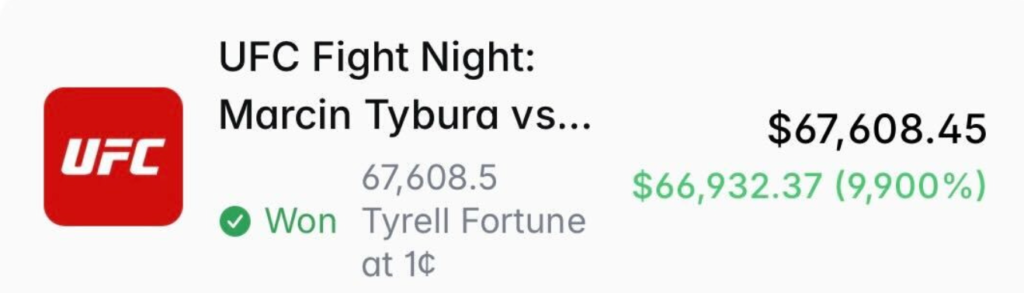
A Polymarket trader turned $676 into $67,608 on Saturday by capitalizing on a rare mistake during a UFC heavyweight bout, where the wrong fighter was initially announced as the winner.
The trader, known as LlamaEnjoyer on Polymarket and Verrissimus on X, watched the live fight between Tyrell Fortune and Marcin Tybura and suspected that a mistake may have been made when UFC presenter Bruce Buffer announced Tybura as the winner.
During that time, Polymarket shares for Fortune fell to one cent, and LlamaEnjoyer was able to place the $676 bet moments before Buffer corrected himself and declared Fortune the winner.
LlamaEnjoyer profited roughly $67,000 from the UFC’s brief blunder, allowing him to capture a near 100x return. The incident shows the speed at which odds on prediction markets can whipsaw during live events.
Speaking about the incident, the Polymarket trader said they almost put $100,000 on Tybura at 99 cents, presumably once the initial decision was made before realizing that something “was off.”
The trader said they placed the trade before a UFC commentator said “We have a mistake,” meaning that they made the bet within 50 seconds of Tybura being incorrectly declared the winner.
Over 865,000 users have placed bets on prediction markets like Polymarket, Kalshi, and Opinion so far in March, spanning a wide range of events, from sports and politics to financial results, culture, and more.

Japanese war orphan donates $145K XRP
Seoul National University Hospital said it received 100,000 XRP tokens from individual donor Kim Geo-seok. The donation, made on March 26, is worth approximately 210 million won ($145,000) at current prices. It marks the hospital’s second cryptocurrency gift following a one-Bitcoin donation Kim made last November.
Kim’s crypto philanthropy is part of a quiet revolution in how South Koreans donate. Kim was four years old when the 1950-53 Korean War tore his family apart. He was sent to an orphanage on Jeju Island, carrying scars from a partisan attack on his face. After returning to Seoul, he drifted through odd jobs to survive.
At 19, he climbed Namsan Tower, the Seoul landmark Netflix fans now know from K-pop Demon Hunters, then the city’s highest point. He gazed at the glittering buildings below and vowed to own a home among them.
He taught himself investing through decades of reading financial newspapers cover to cover. Warren Buffett and Peter Lynch became his intellectual guides. Success did not come in a straight line, as a failed stock bet cost him a lot. Eventually, he rebuilt his portfolio and joined the ranks of successful individual investors.
In a May 2025 interview with Maeil Business Newspaper, Kim said spending money wisely matters more than earning it. He added that those who know how to give are the truly wealthy.
The 79-year-old retail investor has now given a cumulative 1.27 billion won to the hospital alone. Beyond the hospital, he has funded free clinics at Red Cross hospitals and given them to the Community Chest of Korea.
Kim began high-value philanthropy in 2018 through the Community Chest of Korea. He became the first individual member of the Red Cross “Super High-Value Donors Club” last year. His total pledge to the Red Cross stands at one billion won, funding free clinics for uninsured workers and multicultural families.
When South Korea’s Financial Services Commission allowed nonprofits to liquidate crypto donations in mid-2025, Kim was among the first to act. His Bitcoin gift to the Red Cross in August 2025 became the country’s first recorded individual crypto donation to a nonprofit.
Since then, he has repeated the gesture four times across two institutions. Both Seoul National University Hospital and the Red Cross convert his crypto gifts to fiat immediately.
Pi Network hits second migration milestone
According to Pi Network, over 119,000 Pioneers have completed the second migration, transferring their additional balances and referral mining bonuses.
The milestone arrives shortly after Pi Network started gradually rolling out the second migration to Mainnet from Pi Day 2026. The team noted that this opens up a path for users to migrate more Pi to the Mainnet and deepen their participation in the network’s ecosystem.
The blog read, “Second migrations require extensive technical preparations due to the complexity in computing referral bonuses, which incorporate Referral Team members’ KYC statuses and vary per mining session for each individual.”
Meanwhile, the second migration rollout coincides with broader ecosystem developments. Pi Launchpad is now live on Testnet. Pi App Studio applications also gained Mainnet functionality on Pi Day 2026.
However, migrations also have supply implications. When Pi balances undergo a second migration, it opens the door for ecosystem use or potential trading. This may gradually add to the circulating Pi supply.
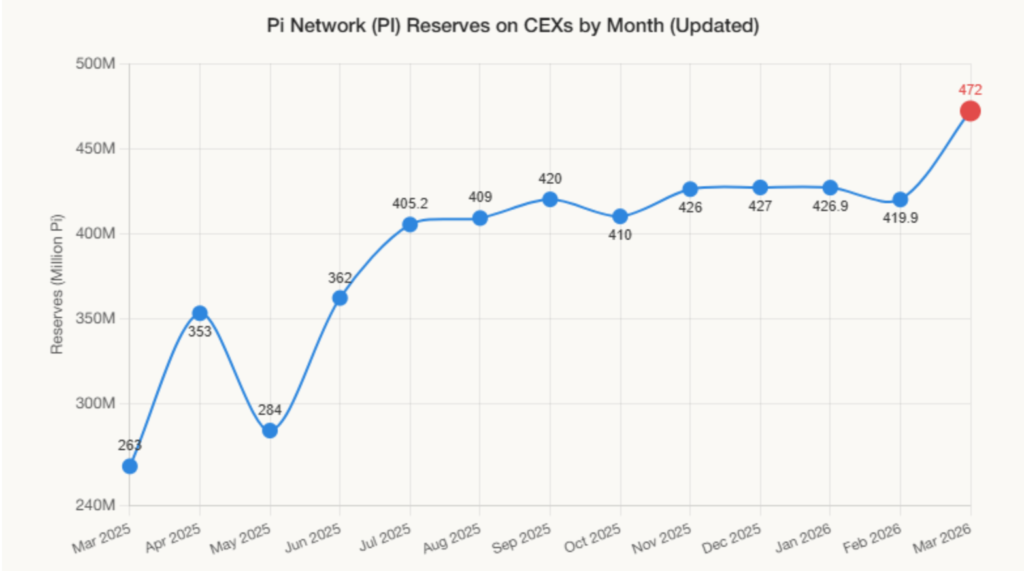
On-chain data shows Pi holdings on centralized exchanges have climbed steadily. Exchange reserves reached 472 million Pi in March, setting a new all-time high. That figure represents a 79.5% rise from 263 million Pi in March 2025.
Rising exchange reserves typically signal that holders are moving tokens onto trading platforms to sell. When the supply on exchanges grows faster than buyer demand, it puts downward pressure on prices.
With token unlocks ongoing and second migrations adding to the supply, the gap between new Pi entering circulation and organic buying remains the major factor for price direction.

X hires ex-Aave product chief to lead design
Elon Musk’s X has hired crypto-native product designer Benji Taylor as its new head of design, ahead of a wider rollout of the platform’s X Money payments product next month.
Taylor announced the move on X, saying he was honored to join the company and looking forward to working with the team. His crypto-native background is notable, previously founding Los Feliz Engineering, then working at decentralized lending protocol Aave Labs and Base, holding leadership roles.
Nikita Bier, Head of Product at X, said that he had followed Taylor’s work for years, and it took roughly six months of persuasion before the designer agreed to come aboard. With Taylor now in the fold, Bier expressed ambitious plans, saying the goal is to build what he called “the greatest design team in the industry.”
The timing also stands out. X is reportedly set to expand X Money, an integrated payments and financial services layer that will introduce peer-to-peer payments, wallet services, and a debit card tied to user accounts.
In early March, Musk announced that X Money would begin public access next month, as an integrated payments and financial services layer for the social platform. The product is currently in limited external beta and offers users a 6% annual percentage yield on cash balances held in an X Money wallet, a personalized metal Visa debit card engraved with the user’s X handle, and peer-to-peer payments linked directly to the X app.
Musk has described X Money as part of his plan to turn the platform into an “everything app” that combines social networking, messaging, and financial services.
Ethereum Foundation stakes $46.2M in ETH
The Ethereum Foundation (EF) staked roughly $46.2 million worth of Ether (ETH), according to on-chain data from Arkham Intelligence. The deposit is the organization’s single-largest staking event.
The transaction marks a sharp acceleration in the Foundation’s treasury staking initiative, which launched in late February with an initial deposit of just 2,016 ETH worth approximately $3.8 million.
The EF announced its staking plans on February 24, 2026, outlining a target of approximately 70,000 ETH. That initial deposit was modest, but the Foundation signaled from the start that further allocations would follow.
At current prices near $2,000 per ETH, the full 70,000 ETH target represents more than $140 million in staked capital. The $46.2 million deposit reported by Arkham today brings the program significantly closer to that goal.
On-chain tracker Lookonchain also flagged the transaction, noting it surpassed all previous EF staking events by a wide margin. For years, the EF relied on periodic ETH sales to fund operations, a practice that drew consistent criticism from the community.
Every sale created downward price pressure and sparked speculation about the organization’s long-term commitment. The shift to staking addresses both concerns:
- By locking ETH into validators, the Foundation generates yield without reducing its treasury balance.
- Staking rewards flow back into the treasury to fund protocol research, ecosystem development, and community grants.
Ethereum currently has more than 38 million ETH staked across roughly 1.17 million validators, representing about 30% of the total circulating supply. The record deposit arrives during a chaotic stretch for ETH.
Co-founder Vitalik Buterin sold millions in personal ETH holdings during that period, amplifying community anxiety. Against that backdrop, the Foundation’s willingness to commit its largest single staking deposit sends a different signal.

Ripple launches AI security initiative
Ripple is embedding artificial intelligence (AI) into the XRP Ledger (XRPL) development lifecycle to detect and address vulnerabilities before they reach production. The move comes as the network scales in complexity and institutional relevance, raising the bar for security.
The firm outlined the initiative in a recent blog post, detailing a strategy built around several key pillars. These include adversarial code scanning, AI-assisted reviews, and threat modeling and attack surface mapping across both new and existing interactions.
Also, Ripple has established a dedicated AI-assisted red team to test how features interact in real-world scenarios. Some additional measures include:
- Modernizing and better aligning the XRPL codebase.
- Strengthening collaboration with ecosystem partners.
- Openly sharing security disclosures to enhance transparency.
- Defining security benchmarks for development on XRPL.
- Introducing stricter security requirements for protocol amendments.
- Expanding bug bounty programs to incentivize broader vulnerability discovery.
The blog revealed that the forthcoming XRPL release would focus solely on bug fixes and various improvements, rather than new features.

Zypto expands rewards ecosystem
Zypto is doubling down on user engagement through its ZYP rewards system, positioning in-app activity as a central driver of value across its ecosystem. At the core of the initiative are ZYPs (Zypto Points), a non-transferable internal rewards currency that users earn through everyday activity within the Zypto App.
These points can be redeemed for a range of services, including bill payments, gift cards, and crypto card funding, effectively linking digital asset usage to real-world spending.
The company describes ZYPs as “the heartbeat” of its Rewards Hub, where users accumulate points through actions such as holding the platform’s native Zypto token, completing in-app quests, making swaps, or referring new users. A fixed conversion rate, 1,000 ZYPs to $1, provides a predictable value system aimed at simplifying rewards for users navigating volatile crypto markets.
Zypto’s model emphasizes usage over speculation. Users earn ZYPs through multiple touchpoints, including:
- Cashback on transactions and purchases within the app.
- Participation in referral programs offering ongoing percentage rewards.
- Completing “quests” tied to ecosystem engagement.
- Holding Zypto tokens (issued and managed by the Zypto Foundation, not a company asset) and registering wallets in the Rewards Hub.
The referral system is a key growth lever, offering users lifetime rewards on referred transactions alongside upfront bonuses when onboarding steps are completed. The broader ecosystem positions users (Zyptonians) as active participants in governance, referrals, and product engagement, reinforcing a community-led growth model.
As competition intensifies in crypto payments, Zypto’s ZYP system signals a shift toward loyalty-driven ecosystems where utility, rather than speculation, underpins user retention.
Find out more here.

Closing remark
Prediction markets have become one of the fastest-growing use cases in crypto, with trading volumes exceeding more than $10.4 billion so far in March, marking a tenfold increase from March 2025.
Kim Geo-seok’s donation is seen as a meaningful example of digital-asset philanthropy. He still dreams of becoming Korea’s greatest individual donor, and hopes crypto-based giving becomes so common that it stops making headlines. At 79, the war orphan-turned-investor shows no sign of slowing down.
Taylor’s inclusion as Head of Design at X has led market watchers to speculate that his onboarding signals potential crypto integration.
Rather than preserving maximum liquidity, the Ethereum Foundation is tying up capital directly in network security. Whether additional deposits follow at this pace will determine how quickly the EF reaches its 70,000 ETH target and how much yield it can generate going forward.
Zypto’s rewards strategy reflects a wider trend in crypto platforms seeking to bridge decentralized finance with everyday financial behavior. By tying incentives directly to usage rather than passive holding alone, the company is betting on sustained engagement as a path to long-term adoption.
There’s so much to unpack this week. What are your thoughts on the headlines?
FAQs
How much did the Polymarket user win?
The Polymarket trader turned $676 into $67,608 by capitalizing on a rare mistake during a UFC heavyweight bout.
How much did the Japanese orphan donate?
Kim Geo-seok donated 100,000 XRP tokens worth approximately 210 million won ($145,000) to Seoul National University Hospital.
Which milestone did Pi Network cross?
According to Pi Network, over 119,000 Pioneers have completed the second migration, transferring their additional balances and referral mining bonuses.
How much did the Ethereum Foundation stake?
The Ethereum Foundation (EF) staked roughly $46.2 million worth of Ether (ETH).