Gm frens, it’s a new day and a new cryptosphere round-up.
Polygon reduces block time to 1.75 seconds, Tether’s AI model excels in medical evaluation, and Polymarket’s ‘Alien Disclosure’ bets hit $33 million. An outage hit Coinbase due to AWS issues, while AI agents can now pay for APIs on Solana, as HANTA Solana memecoin exploded 100x. Finally, Zypto expands smooth cross-chain swaps within its multichain wallet.
Are you ready?
Polygon reduces block time to 1.75 seconds
Blockchain layer-2 (L2) network Polygon reduced its average block time by 250 milliseconds to 1.75 seconds, marking its first block-time reduction since genesis as the network pushes deeper into stablecoin payments and settlement infrastructure.
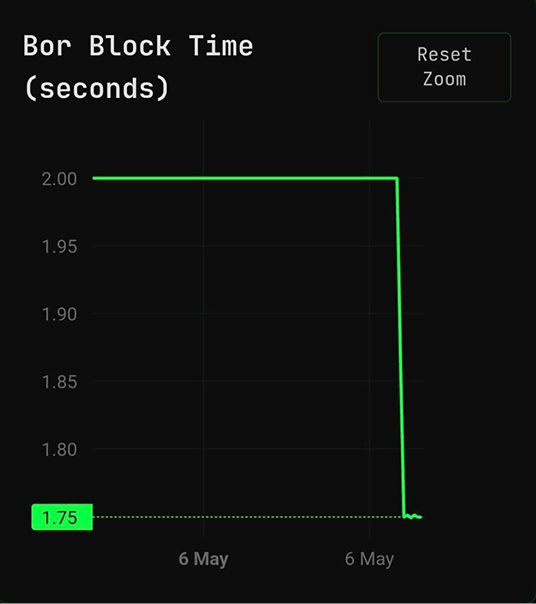
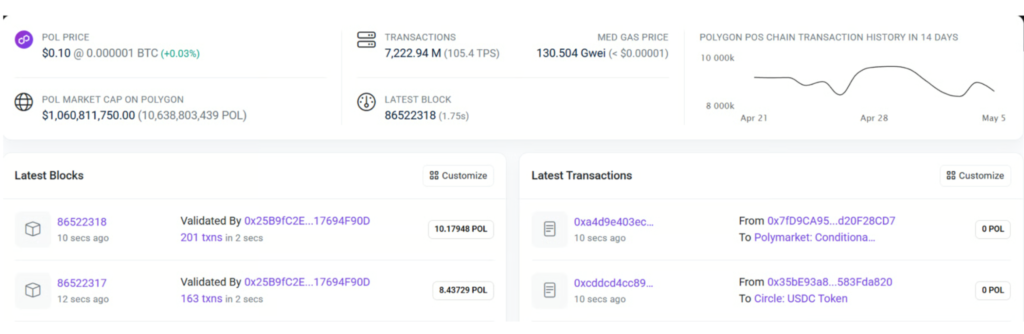
Polygonscan shows that the latest blocks on the network were created in 1.75 seconds. The upgrade means that Polygon can process around 14% more payments per second, reaching a maximum theoretical throughput of about 3,260 transactions per second (TPS), according to Polygon software engineer Lucca Martins.
Shorter block times can help transaction backlogs clear faster, reducing the duration of network congestion and subsequent transaction fee spikes, which is particularly important for high-frequency use cases such as payments, stablecoins, or DeFi trading.
The upgrade comes as Polygon seeks to position itself for use cases that target greater institutional adoption, such as private stablecoin payments. Polygon introduced a new wallet feature that enables users to privately route stablecoin transactions through a shielded pool verified by zero-knowledge proofs.
The upgrade is part of the Polygon Improvement Proposal PIP-86. This two-step motion seeks to reduce block time to 1.5 seconds further and scale down checkpoint rewards to maintain Polygon (POL) token emissions at the target 1% after the block time reduction.
Polygon’s new wallet feature is part of an aim to onboard more institutional users as it hides senders. Receivers and amounts on-chain while maintaining compliance through Know Your Transaction (KYT) screening and auditable files. The feature introduces more privacy for businesses transacting with stablecoins, according to Polygon community lead Smokey.
Tether’s AI model excels in medical evaluation
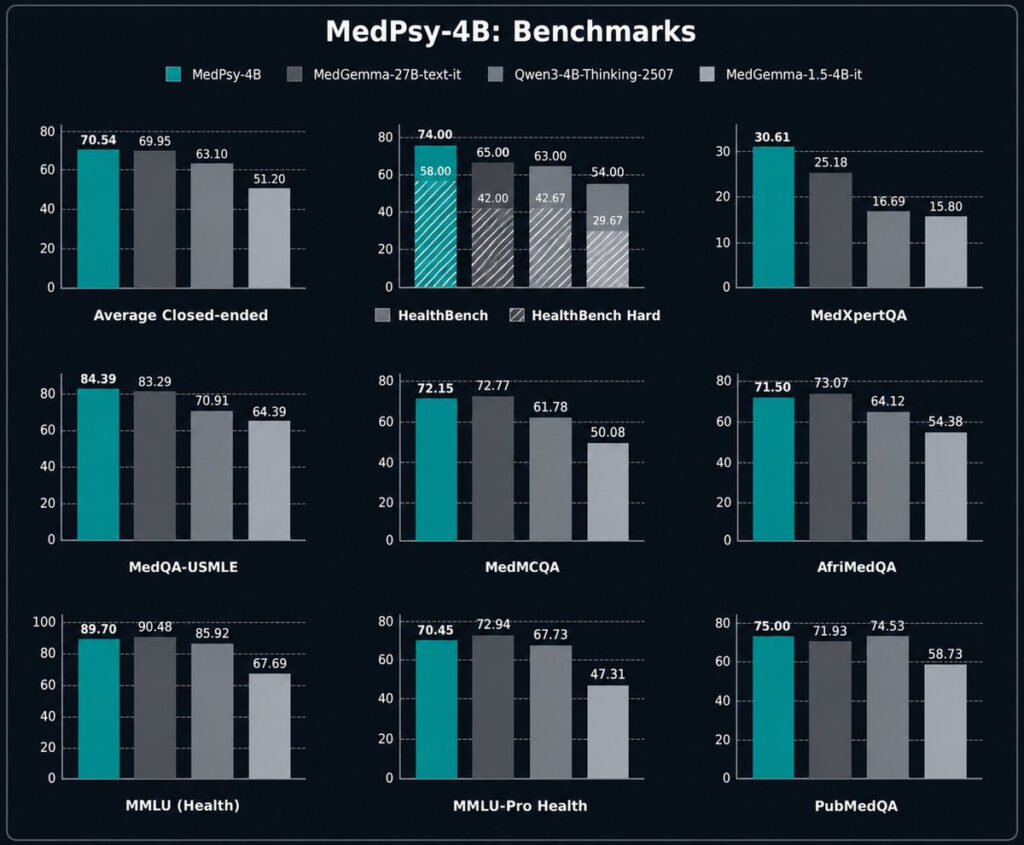
Tether just released a medical AI model that fits in your pocket and may outperform rivals more than a dozen times its size. QVAC MedPsy launched today from Tether’s AI Research Group as a new class of medical language models designed to run on smartphones, wearables, and edge devices.
On HealthBench Hard, OpenAI’s benchmark that evaluates AI on realistic, multi-turn clinical conversations graded by 262 physicians, QVAC MedPsy’s tiny 1.7 billion-parameter model outscores Google’s MedGemma-27B on medical benchmarks despite being smaller.
Also, the 4 billion model averages about 909 tokens per response, compared with 2,953 for comparable systems, a 3.2x reduction. Fewer tokens mean lower compute cost, faster responses, and the ability to run locally without a cloud backend.
The models ship as quantized GGUF files: 1.2GB for the 1.7 billion-parameter model and 2.6GB for the 4 billion-parameter model, with compressed versions retaining most benchmark performance while fitting on standard consumer hardware. That means a hospital system, rural clinic, or individual clinician could run the model entirely on-device, keeping patient records out of third-party cloud infrastructure and away from HIPAA exposure.
The privacy pitch may be a major plus for some people, but using AI for medical opinions is far from ideal even by today’s standards. An Oxford study published in February found that LLMs routinely give dangerous medical advice, including incorrect answers, confused guidance, and poor handling of nuanced symptoms. The compliance problem compounds it as most medical AI today routes patient data through cloud servers, creating HIPAA exposure every time a doctor types a query.
The release fits Tether’s pattern over the past year. Last month, it shipped the QVAC SDK, an open-source toolkit for building local, offline AI apps across iOS, Android, Windows, and Linux. Before that, it launched QVAC Health, a consumer wellness app that keeps biometric data entirely on-device. MedPsy is the first QVAC model specifically trained for clinical reasoning. The medical AI market is roughly $36 billion today, with projections exceeding $500 billion by 2033.
Polymarket bets hit $33 million
Crypto-native prediction markets reacted within minutes after the Pentagon released its first declassified UAP files last week, more famously labeled as the ‘Alien Files.’ Polymarket’s flagship alien disclosure market has now reached a cumulative volume of over $33 million.
The Department of War launched the Presidential Unsealing and Reporting System for UAP Encounters (PURSUE) on Friday. Officials posted Release 01 to a public WAR.GOV/UFO portal, with rolling tranches promised every few weeks.
Traders on Polymarket have wagered roughly $33 million on whether a senior U.S. official will confirm extraterrestrial life by year-end. The crypto-native prediction platform sat at 19% on May 8 after Release 01 dropped.
A separate market on whether Trump declassifies new UFO files this year, priced at 83% on December 31. Bettors appear positioned for more rolling tranches rather than a single dramatic event. A separate $16 million market asking whether the administration would declassify UFO files in 2025 resolved “Yes” earlier this year.
No formal presidential declassification took place at the time. Late-session bids near 00 cents and a contested UMA oracle vote pushed the outcome through. Comment threads on the platform labelled the call a scam. Critics dubbed the dispute mechanism ‘proof-of-whales,’ reigniting questions about token-weighted oracles overriding trader consensus.
The Department of War welcomes private-sector analysis of the unresolved cases. Each new tranche could move disclosure odds and revive the dispute around how oracles call ambiguous outcomes. If headline catalysts keep arriving, the prediction-market lens may become the cleanest gauge of how seriously market participants take price-disclosure narratives.
Coinbase hit by outage due to AWS issues
Coinbase users faced hours of service transformions last week after failures tied to Amazon Web Services (AWS) infrastructure disrupted core trading systems. In a post on X, Coinbase said the outage began around 8 pm ET on Thursday, after its system detected elevated error rates across multiple services.
The outage follows another AWS-related transformion in October that temporarily knocked Coinbase and Robinhood offline and prevented some users from accessing their accounts or executing trades.
Coinbase said its systems are designed to recover from a single availability zone outage. In this case, however, the company said failures affected multiple AWS zones, causing what it described as an ‘extended outage’ of core trading services. At the same time, AWS worked to restore temperature controls and other managed services.
Amazon disputed Coinbase’s description of the outage, affirming that only a single availability zone was ultimately impacted. Users reported problems accessing the Coinbase app, transferring funds, and executing trades.
Downdetector reports spiked around 6 pm ET and remained elevated overnight before declining on Friday. After 33% of reports involved fund transfers, another 33% involved trading issues, and roughly 29% involved the Coinbase mobile app.
Coinbase said the primary issue has been resolved, and directed users with account-related questions to Coinbase Support. The outage comes as Coinbase deepens its cloud-based AI and stablecoin infrastructure through partnerships with multiple companies, while also restructuring around what CEO Brian Armstrong has described as an AI-first operating model.

AI agents can now pay for APIs on Solana
AI agents can now autonomously pay for Google Cloud services and dozens of other APIs using stablecoins on Solana, following the launch of Pay.sh by the Solana Foundation and Google Cloud.
The gateway service runs an API proxy on Google Cloud Platform, connecting agents to backend services through the x402 protocol, an OpenAI payments standard incubated by Coinbase and now under the stewardship of the Linux Foundation. The system also supports the Machine Payments Protocol (MPP).
Agents pay fractions of a cent per API call instead of monthly subscriptions, and work with services like Google Cloud and Gemini, Anthropic’s Claude Code, OpenAI’s Codex, OpenClaw, Hermes, and more. The platform connects to blockchain infrastructure providers Helius and Alchemy, as well as data services from Dune Analytics and Nansen.
Pay.sh arrives as major tech and crypto companies race to build payment infrastructure for autonomous AI systems. These platforms target enterprise developers seeking programmable money for new business models that traditional payment rails can’t support.
Google has been expanding its crypto payment infrastructure work, revealing an AI agent payments protocol backed by the Ethereum Foundation earlier this year.
HANTA Solana memecoin explodes 100x
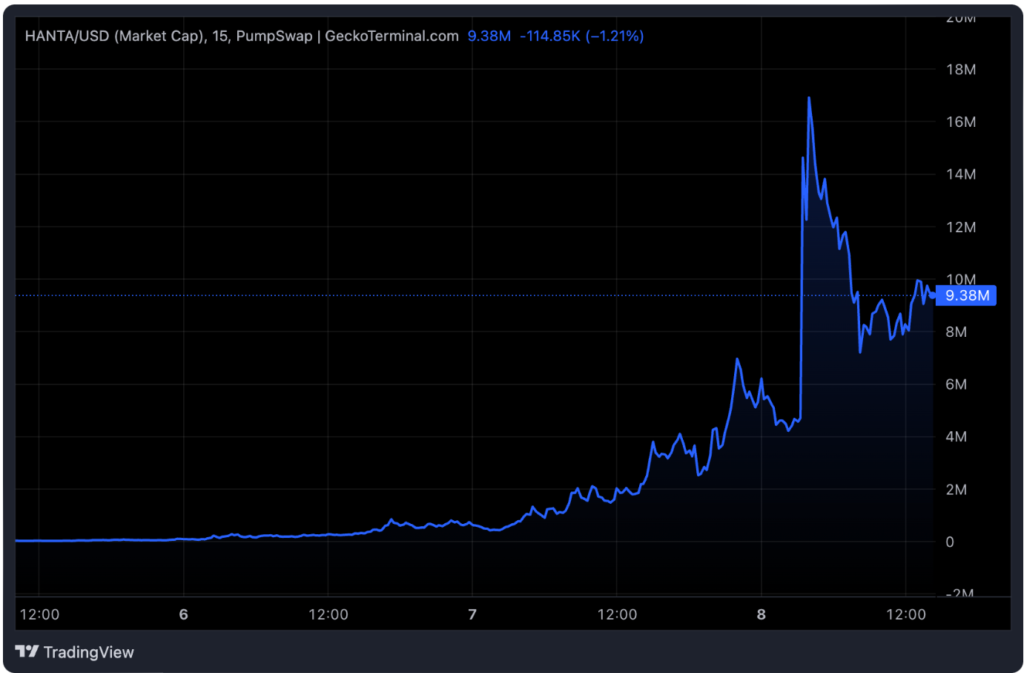
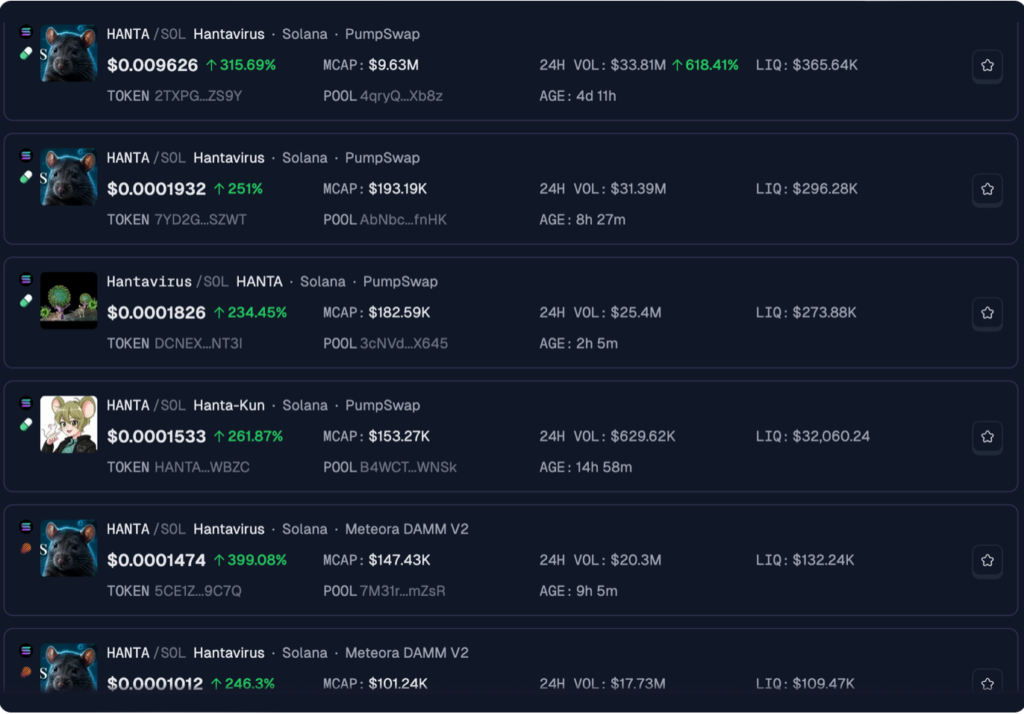
Hantavirus (HANTA), a Solana-based memecoin, surged more than 10,000% and briefly reached a market capitalization above $17 million, while generating nearly $30 million in daily trading volume.
Unlike most memecoins, the Hantavirus memcoin wasn’t built solely around internet jokes. It was based on a real-world disease outbreak aboard the MV Hondius cruise ship after it departed from Argentina.
Early buyers who minted the token on Pump.fun reportedly secured life-changing gains within hours. Shortly afterward, Moonshot verified the token, thereby increasing its visibility and triggering aggressive retail buying.
The HANTA token (2tXpgu…7hzs9y) was launched in early May. Solscan data showed the token’s holder base jumping from 2,640 to 17,589 within a single day. The rally extended across more than half a dozen similar issuances.
A separate HANTA token rose 251% to a market cap of $193,190. A Hanta-Kun variant climbed 261.87%, while two Hantavirus listings on Meteora DAMM V2 added 399% and 246%.
At that point, the rally turned vertical as the memecoin surged from a $170,000 market cap to over $17 million. Several prominent crypto traders began pushing a highly speculative theory online that another global health scare (like COVID-19) could spark a memecoin supercycle similar to the pandemic-era retail trading boom.
There were reported net inflows of $50,000 from Key Opinion Leaders (KOLs) and crypto influencers within hours on May 7. That inflow helped trigger a secondary rally phase, pushing HANTA much higher after its initial breakout. Combined with the original launch move, the token eventually surged more than 100x from inception.
Yet, it is important to exercise caution with speculative tokens. History shows hype-linked meme coins are likely to collapse sharply once attention shifts, leaving late buyers exposed to steep drawdowns.
Zypto expands smooth cross-chain swaps within its multichain wallet
Zypto has expanded its multichain wallet functionality with further native cross-chain swap capabilities, allowing users to trade more assets across different blockchain networks directly within its crypto app.
The technology enables users to swap tokens between multiple chains without relying on external bridges, centralized exchanges, or third-party interfaces, reducing complexity and execution risk typically associated with cross-chain transactions.
By increasing cross-chain swap capabilities in its wallet infrastructure, Zypto is advancing its position as a unified crypto platform that combines asset storage, payments, access to decentralized finance, and interoperability into a single application.
The system aggregates liquidity from multiple decentralized exchanges and routing protocols to identify optimal swap paths across chains, helping users achieve competitive rates while maintaining full custody of their assets throughout the process.
Zypto said the cross-chain functionality currently supports over 20 blockchain networks and over 1 million crosschain routes, enabling users to move value smoothly between ecosystems without needing to bridge or manually wrap tokens.
The extensive infrastructure reflects a broader industry trend toward simplifying multichain interactions, as crypto platforms compete to eliminate friction caused by fragmented blockchain environments and complex user workflows.
Within the app, users can review transaction details, including routes, fees, expected output, and execution time, before confirming swaps, improving transparency and user control over cross-chain operations.
Find out more here.
Closing remark
Polygon reducing its average block time from 2 seconds to 1.75 seconds boosts theoretical throughput to roughly 3,260 TPS and helps clear transaction backlogs for payments, stablecoins, and DeFi activity faster.
MedPsy aligns with Tether’s broader push into privacy-preserving local AI. However, medical LLMs still pose safety and compliance risks, given evidence that they can provide dangerous or incorrect clinical advice.
Polymarket’s flagship alien-disclosure market surpassed $33 million in cumulative volume as traders bet on whether a senior U.S. official will confirm extraterrestrial life by year-end.
While Coinbase framed the incident as a multi-zone AWS failure and AWS said only a single availability zone was affected, the episode emphasized the exchange’s dependence on cloud infrastructure.
The Solana Foundation and Google Cloud have launched Pay.sh, an API gateway that lets AI agents autonomously pay for Google Cloud and other API services in stablecoins on Solana.
HANTA surged from about a $170,000 valuation to over $17 million in market cap, delivering 100x-plus gains to early Pump.fun minters. Zypto has expanded its multichain wallet with native cross-chain swap functionality, letting users move and swap assets on over 1 million routes.
There’s so much to unpack this week, so what do you think about the developments?
FAQs
What did Polygon reduce?
Polygon reduced its average block time by 250 milliseconds, bringing it to 1.75 seconds.
How did Tether’s AI model excel?
Tether’s QVAC MedPsy’s tiny 1.7-billion-parameter model outscored Google’s MedGemma-27B on medical benchmarks despite its smaller size.
What is the latest on Polymarket?
Traders on Polymarket have wagered roughly $33 million on whether a senior U.S. official will confirm extraterrestrial life by year-end.
What is the latest on Solana?
AI agents can now autonomously pay for Google Cloud services and dozens of other APIs using stablecoins on Solana.
What is Zypto App’s latest feature?
Zypto has expanded its multichain wallet functionality with added native cross-chain swap capabilities.