Gm frens, we’re closing out the month with a big round-up of crypto news.
AWS adds Chainlink crypto oracle services. Morgan Stanley debuts a market fund for stablecoin issuers. Fold launches a Bitcoin Bonus program, while Pi Network brings smart contracts to Testnet.
At the same time, Bitcoin eyes a potential new high as key indicators flip bullish. A new BTC hard fork, eCash, is announced, and Zypto App expands its cross-chain capabilities.
Amazon Web Services adds Chainlink crypto Oracle services
Amazon Web Services has launched Chainlink’s data standard on the AWS Marketplace, making the oracle provider’s data feeds, data streams, and proof-of-reserve services available to enterprise developers.
The AWS Marketplace integration includes three core Chainlink services designed for enterprise blockchain applications. Chainlink data feeds provide decentralized price and market data for asset valuation, settlement, and risk management.
The oracle provider’s data streams deliver fast, secure data that enable on-chain systems to respond to market movements in real time. The service targets applications requiring low-latency market data integration.
Lastly, Chainlink’s proof-of-reserve feature provides secure, verifiable on-chain reserve attestations for stablecoins and other tokenized assets, allowing institutions to verify asset backing without compromising security protocols.
Amazon Web Services commands approximately 31% of the global cloud infrastructure and serves millions of enterprise customers worldwide. Chainlink operates one of the largest decentralized oracle networks, connecting smart contracts, which hold the code that powers autonomous crypto apps, to off-chain data sources across multiple blockchains.
Since launching on mainnet in 2019, Chainlink’s decentralized oracle networks have secured $29 trillion in transaction value across 80+ public and private blockchains. The protocol’s infrastructure emphasizes security in a landscape where cross-chain bridge hacks have resulted in $3 billion in losses.
Morgan Stanley debuts a market fund for stablecoin issuers
Morgan Stanley has launched a money market fund for stablecoin issuers, positioning it as a way for companies like Circle to manage their reserves.
The Stablecoin Reserves Portfolio (MSNXX), available on days when the New York Stock Exchange is open for business, will enable companies to invest the proceeds backing their tokens, the investment bank with $9.3 trillion in assets said in an announcement.
Although stablecoin issuers often back their tokens with a mix of cash and U.S. Treasuries, Morgan Stanley indicated that MSNXX will also allocate to notes and bonds, as well as certain overnight repurchase agreements collateralized by liquid assets.
The product was specifically designed to comply with the GENIUS Act, a federal framework for stablecoins enacted last year that mandates reserve requirements.
In a statement, Morgan Stanley’s co-head of Global Liquidity, Fred McMullen, noted the sector’s growth, specifically a “significant increase in stablecoin issuers as well as the growing number of assets held in stablecoins.”
Whether it’s new use cases in traditional finance or AI-agent payments, stablecoins are expected to become a $2 trillion market by the end of 2028, or in roughly 32 months, according to a recent note from investment bank Standard Chartered.
At the time of writing, the total value of stablecoins is $320 billion, with Tether’s USDT as the largest issuer. Circle, the second one, currently holds the majority of its USDC reserves in the Circle Reserve Fund (USDXX), a BlackRock-managed money market fund.
Decentralized finance projects like Ethena, which offers a synthetic dollar dubbed USDe, have forged a different path: using BlackRock’s tokenized money market fund, BUIDL. The product issued on nine blockchains was valued at $2.5 billion.
Earlier this month, Morgan Stanley debuted a spot Bitcoin ETF, which dovetails with the firm’s army of roughly 16,000 financial advisors. Since the product debuted just over two weeks ago, it has generated $173 million in net inflows.

Fold launches ‘Bitcoin Bonus’ program for employers
Bitcoin financial services company Fold Holdings, Inc., launched a program that allows companies to pay recurring BTC bonuses to employees, following an initial rollout from restaurant chain Steak ‘n Shake earlier this year.
The Bitcoin Bonus Program represents the first product from Fold Business, the company’s new enterprise division. Under the program, Steak ‘n Shake’s 10,000-plus hourly workers across the U.S. can receive Bitcoin bonuses, as announced in January and implemented on March 1. The restaurant chain pays $0.21 per hour worked into the bonus program for hourly employees, and it vests in full after two years.
“We launched our Bitcoin Bonus Program because we saw a gap that no one was filling. We’ve created a recruiting story that didn’t exist before,” said Fold co-founder and CEO Will Reeves, in a statement.
The program handles all custody and compliance requirements, Fold said, allowing traditional businesses to offer cryptocurrency incentives without managing the technical infrastructure. Employers set bonus terms in dollars, and Fold converts and manages the Bitcoin distribution. Bitcoin mining firm Simple Mining has also adopted the program, offering a bonus to salaried employees based on their tenure.
The company plans to expand its Business platform to include payroll, corporate Bitcoin treasury management, corporate cards, and additional enterprise financial tools. Fold previously focused on consumer Bitcoin rewards and spending solutions, including a debit card that offers Bitcoin rewards on purchases, before developing these corporate services aimed at bringing cryptocurrency benefits to mainstream workplaces.

Pi Network smart contracts go live on Testnet
Pi Network has activated its first smart contract on Testnet, bringing subscription functionality to the blockchain. The rollout introduces recurring-payment logic for e-commerce, streaming, and other services. Community sentiment has turned cautiously optimistic, yet the daily chart still shows a neutral structure after months of decline.
The smart contract capability focuses on subscription support, a model most chains have struggled to deliver cleanly. Subscribers can approve a defined budget that the contract draws from over a set billing horizon. Funds remain in the wallet until a charge is processed.
The design avoids the full pre-funding required by account-abstraction standards such as ERC-4337. It also removes repeat signatures used in earlier Ethereum proposals, such as EIP-1337. Pi frames this as a cleaner path for on-chain recurring payments.
Pi Request for Comment 2 (PiRC2) is now open for developer review on GitHub. External auditors are also reviewing the contract before any Minnet rollout. Community voices have mapped the release to real use cases.
One post listed streaming, AI tools, digital memberships, e-commerce, and local commerce as targets. The list reflects a broader push to anchor Pi demand to recurring real-world services rather than speculative activity.
The pitch to builders leans on scale. Pi claims to have more than 18 million KYC-verified users, which bolsters its image as a ready customer base. Warnings about staking, DeFi, and dApp risks in any young ecosystem temper that optimism. Education and external audits will shape how safely the rollout proceeds.
The contract remains in Testnet. A Mainnet launch will depend on audit outcomes and PiRC2 feedback, which sets the near-term expectation bar.
Possible Bitcoin ATH as risk indicator flips bullish
Bitcoin’s sustained bullish market structure over the past three weeks has triggered a clear risk landscape signal that could hint at an extension of the ongoing rally. The Risk Index, Glassnode’s proprietary metric that quantifies systemic risk on a scale of 0 to 100, is hovering at zero, the lowest possible level, according to a Telegram post.
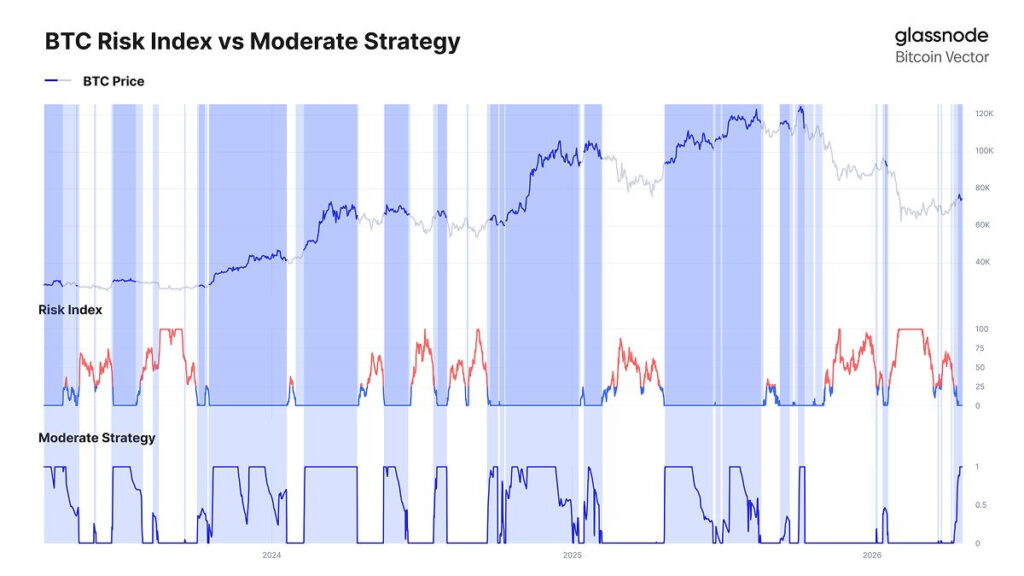
It indicates a ‘cleared risk landscape’ and serves as a primary gauge of market health, with a 25 threshold that distinguishes between low and high-risk regimes. The Moderate Strategy, which captures upside momentum and exits when conviction fades, has flipped from ‘Moderate’ to ‘High Confidence.’
The alignment of these models signals a bullish regime, underscored by sustained inflows into Bitcoin ETPs and aggressive demand from spot buyers. As a result, Bitcoin hit $79,388 last week, its highest level in over three months.
Lacie Zhang, a research analyst, thinks this is an excellent window for strategic accumulation rather than chasing deeper dips, maintaining “a strong conviction for a positive close to 2026, supported by improving market structure and institutional conviction that should drive Bitcoin to a new all-time high.”
Investor sentiment has also seen considerable improvement, resulting in the Fear and Greed Index jumping from ‘extreme fear’ at the start of April to ‘fear.’ Likewise, users on the prediction market Myriad see a 74% chance that Bitcoin will extend its rally toward $84,000 next. Similarly, for Ethereum, users assign a 54% chance that the crypto will pump to $3,000 next.
“Breaking and holding above $80K would act as a major technical and psychological catalyst, clearing the path for further recovery toward $90K and potentially $100K,” Zhang said.
Additionally, the recent uptrend has pushed 54% of recent buyers into profitable territory, according to Glassnode’s latest report. These buyers are now at a threshold that has historically exhausted bear market rallies. Short-term holders’ realized profit has spiked to $4.4 million, three times the $1.5 million threshold that has marked every local top year to date.
The missing piece remains a fundamental catalyst, whether it’s the CLARITY Act, Fed rate cuts, or a lasting Middle East truce. Until then, the risk landscape may be cleared, but the path above $80,000 is not.

Blockchain developer announces BTC hard fork eCash
Bitcoin developer Paul Sztorc announced that a new hard fork of the Bitcoin network called eCash will be deployed in August. Bitcoin holders will be able to exchange their BTC for eCash at a 1:1 ratio once the hard fork is live, Sztorx said in an X post.
He added that the layer-1 node software for the chain will be a ‘near-copy’ of the BTC Core client software and will use the SHA-256 hashing algorithm used by the Bitcoin blockchain, with a reduced initial mining difficulty to make it easier for participants to mine blocks.
The new layer-1 hard fork will also include seven layer-2 scaling networks called “drivechains” to increase transaction throughput and enable optional on-chain privacy, he said.
Sztorc distances the eCash hard fork from previous attempts to fork hard the Bitcoin protocol, including Bitcoin Cash (BCH), which was created in 2017 but failed to become the dominant chain. However, the announcement drew mixed reactions.
“Unlike BCH, the 2017 fork, there is no ‘Bitcoin’ in the name,” Sztorc said, adding, “This is a permanent and sustainable fix to Bitcoin’s problems.”
He added that the forked chain would manually reassign a portion of Satoshi Nakamoto’s 1.1 million BTC stash to early investors. However, some critics weren’t pleased.
“Taking Satoshi coins is theft and disrespectful, and eCash is already used for Lightning payments with Cashu and Fedi. Those are poor choices,” Bitcoin advocate Peter McCormack said in response.
“I give you two or three years to fold completely,” Bitcoin advocate PakoVM said about the planned hard fork.
The announcement came amid a growing debate about Bitcoin’s tech stack and whether the protocol should introduce privacy-preserving features and post-quantum resistance.

Zypto App expands cross-chain capabilities with CCIP integration on Solana
Zypto has announced the integration of Chainlink’s Cross-Chain Interoperability Protocol (CCIP) for Solana within its wallet application, marking another step in the platform’s push to simplify cross-chain asset transfers for users.
The update introduces CCIP-powered swaps involving Solana, allowing users to move digital assets between Solana and other supported blockchains directly inside the Zypto App environment. The feature builds on Zypto’s broader strategy of embedding cross-chain infrastructure natively on its self-custodial wallet, rather than relying on external bridges or decentralized applications.
CCIP, developed by Chainlink, is designed to enable secure and standardized communication between blockchains, addressing long-standing challenges associated with fragmented networks and bridge vulnerabilities. By integrating this protocol alongside many others, Zypto continues to position its app as a more unified interface for multi-chain activity.
Zypto’s approach reflects a broader trend in the crypto ecosystem, where wallet applications are evolving into full-service platforms that combine storage, decentralized finance (DeFi) access, and cross-chain interoperability in a single interface. Rather than acting solely as transaction signers, crypto wallets are increasingly embedding core infrastructure to streamline user experience.
The company noted that the new capability is now live, enabling users to access CCIP-based Solana swaps directly within the app without leaving the self-custodial environment. The rollout underscores Zypto’s ongoing focus on reducing friction in cross-chain transactions, as demand grows for smooth movement of assets across an increasingly multi-chain crypto landscape.
Find out more here.

Closing remark
AWS has developed reference architectures that demonstrate integration patterns for proof-of-reserve monitoring and real-time prediction-market trading. These templates provide enterprises with pre-built frameworks for deploying Oracle services within existing cloud infrastructure.
Morgan Stanley’s new Stablecoin Reserves Portfolio (MSNXX) offers issuers a regulated vehicle for holding reserve assets in U.S. Treasuries, facilitating regulatory compliance, capital preservation, and daily liquidity.
Unlike previous corporate Bitcoin initiatives that focused on treasury management or executive compensation, Fold’s program specifically targets rank-and-file employees in sectors such as food service and manufacturing, where retention and recruitment challenges have intensified since the Covid-19 pandemic.
Pi Network’s first smart contract launch on Testnet enables developers to test on-chain subscription models for future ecosystem utility. Bitcoin’s Risk Index hitting zero and strong institutional demand indicate a ‘bullish regime’ and a strategic window for accumulation, though analysts warn that geopolitical uncertainty and profit-taking could still hinder a move above $80,000.
The Solana integration expands Zypto’s existing cross-chain functionality, which already supports a wide range of blockchain networks and liquidity routes.
What do you think about this week’s developments? Let us know in the comments section.
FAQs
Why did AWS integrate Chainlink services?
Chainlink provides market data for enterprise blockchain applications.
What is the Morgan Stanley market fund for?
Morgan Stanley’s money market fund was launched to help stablecoin issuers manage their reserves.
Why did Fold launch the Bitcoin Bonus program?
Fold Holdings, Inc. launched the Bitcoin Bonus program to pay recurring BTC bonuses to employees.
What is the latest on the Pi Network?
Pi Network has activated its first smart contract on Testnet.
What is the latest update on Zypto?
Zypto has announced the integration of Chainlink’s Cross-Chain Interoperability Protocol (CCIP) for Solana within its wallet application.