Welcome to this week’s crypto news roundup, and it’s been a busy one across the space.
A solo Bitcoin miner bags a $210K BTC block reward, Polymarket expands into equities and commodities, and the Ethereum Foundation almost reaches its 70,000 ETH target.
Jack Dorsey signals the return of Bitcoin Faucets, FIFA partners with ADI Predictstreet ahead of the 2026 World Cup, Bitcoin leads $400M liquidity wave as bulls get squeezed, and Zypto App introduces private key import and export features.
Let’s get to it.
Solo Bitcoin miner bags $210K BTC block reward
A solo Bitcoin miner secured a roughly $210,000 block reward, proving that the so-called “mining lottery” is still paying out even if industrial operators dominate the network.
The miner, connected to CKPool’s solo service, found block 943,411 and earned 3.139BTC in subsidy and transaction fees, according to data from block explorer mempool space.
Solo mining remains rare. Statistics compiled by Bennet’s tracker show that solo mining pools have given up just 20 Bitcoin blocks over the last 12 months, paying out a total of 62.96 BTC, roughly one win every 18.7 days on average. The longest “drought” between blocks was 58 days, and the previous solo win came on February 28.
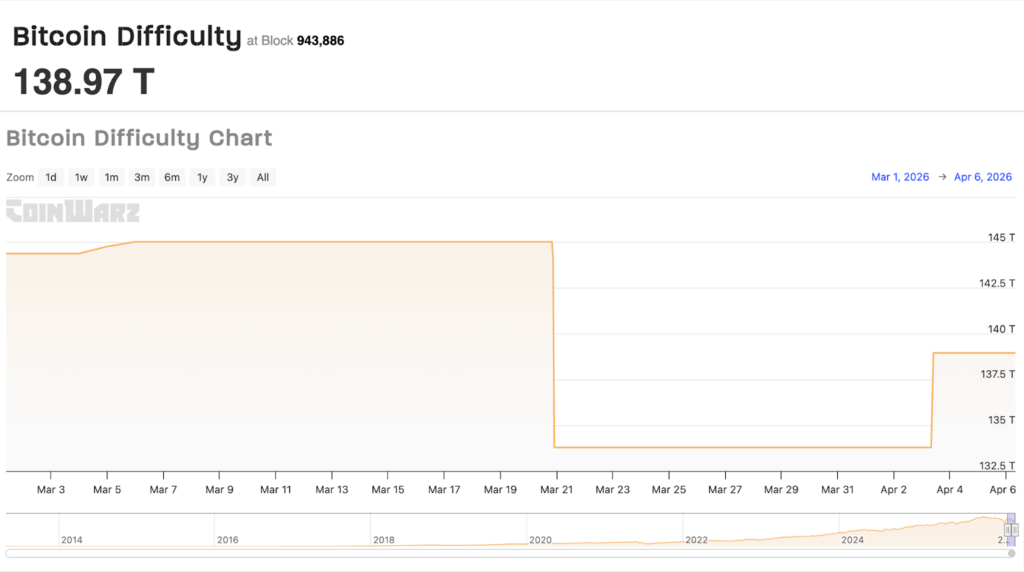
The win comes as Bitcoin mining grows increasingly competitive. Network difficulty, the measure of how hard it is to find a block, recently recorded its steepest adjustment since February, falling about 7.7% before rebounding 3.87% in the past 24 hours, reflecting weaker hashrate and briefly improving miners’ odds.
Even so, current difficulty levels remain near historic highs, meaning the probability of any single solo miner discovering a block is still vanishingly small. Public trackers like CoinWarz show Bitcoin’s difficulty has climbed orders of magnitude over the past decade, with only brief downward adjustments when miners switch off rigs or redirect machines to other workloads like artificial intelligence.
Major listed Bitcoin miners are responding by reshaping their balance sheets and fleet strategies rather than betting on luck. Riot platforms sold 3,778 during the first quarter of 2026, according to a Thursday release, adding to a number of crypto miners and firms that have sold Bitcoin recently, including MARA Holdings, Genius Group and Nakamoto Holdings.
Polymarket expands into equities and commodities
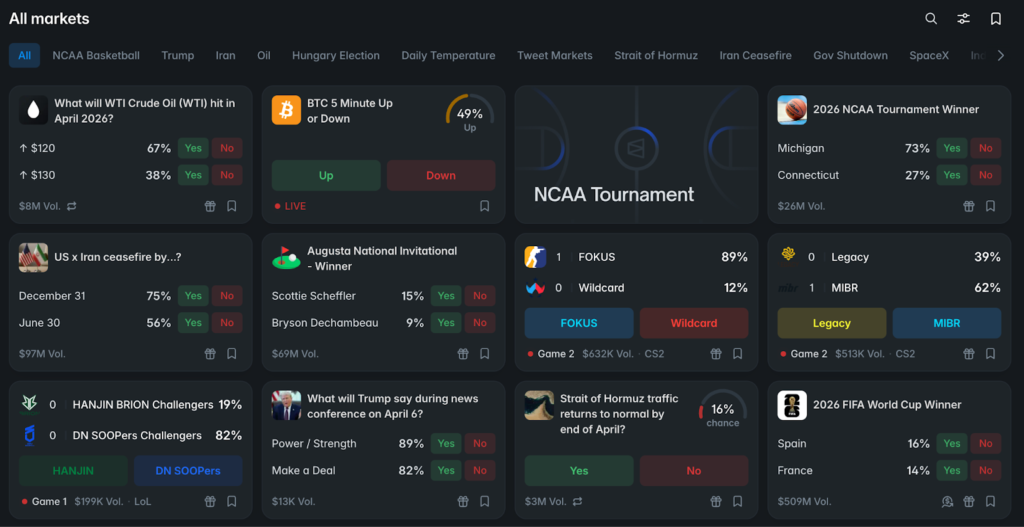
Polymarket has added markets tied to equities, commodities and exchange-traded funds, using price data from blockchain oracle provider Pyth Network as the resolution source to determine outcomes for daily contracts.
The new markets include daily up-or-down and closing price contracts for major equity indexes, commodities such as gold and oil, and a range of US-listed stocks, with outcomes settled automatically based on Pyth’s real-time price feeds. The contracts reset at the end of each trading session.
According to the announcement, the offering includes more than a dozen US-listed stocks, including Tesla, Nvidia and Apple, alongside commodities and equity indices. By making Pyth the resolution layer for these markets, Polymarket is supplanting manual or exchange-specific references with a standardized data source aggregated from trading firms and market makers.
Zug, Switzerland-based Pyth said it also launched a data interface called Pyth Terminal where users can track live feeds and the reference value used to settle markets on Polymarket. Traders can follow a live “price to beat” that updates continuously as markets move.
Polymarket allows users to take positions on the outcomes of real-world events, such as sports, elections, financial markets and weather, with contracts resolving based on whether specific conditions are met.
Last week, Intercontinental Exchange, the parent company of the New York Stock Exchange, said it had completed a $600 million cash investment in Polymarket and plans to acquire up to an additional $40 million in shares from existing holders as part of a broader multibillion-dollar commitment to the platform.
Ethereum Foundation almost reaches its 70,000 ETH target
The Ethereum Foundation staked roughly $93 million in ETH last Thursday in several batches, bringing its total stakes position to approximately $143 million and nearly completing the 70,000 ETH stake target it announced in February.
The total deposit of 45,034 ETH was split into uniform chunks of 2,047 ETH, each worth roughly $4.23 million, sent from the foundation’s treasury multisig to the Eth2 Beacon Chain deposit contract. At roughly $2,059 per ETH, the $143 million total staked position works out to approximately 69,500 ETH, nearly the full 70,000 ETH commitment.
The Foundation has been building toward the target incrementally since February, starting with an initial 2,016 ETH deposit and adding roughly 20,470 ETH on Monday. Thursday’s batch covered the remaining balance in one shot.
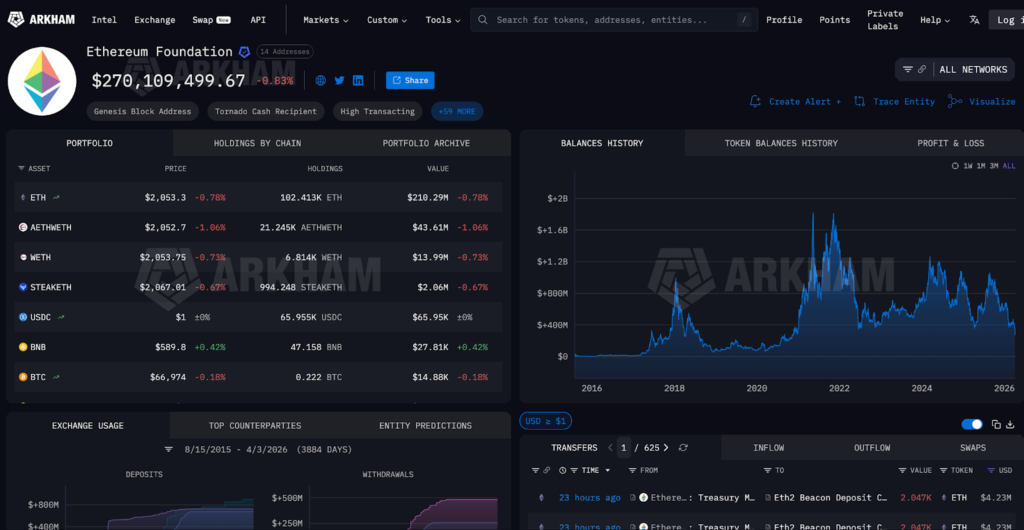
The Foundation’s Arkham-tracked portfolio shows approximately $270.1 million in total assets across 14 addresses, with ETH as the dominant holding at roughly 102,400 ETH ($210.29 million). Smaller positions include USDC, BNB, and a fraction of a Bitcoin.
The Ethereum Foundation is putting its ETH to work through staking, earning rewards that help fund research, grants and operations – all without needing to sell its coins, creating a long-term, self-sustaining treasury.
This replaces the earlier model where the foundation resorted to ETH sales that weighed over valuations.The Foundation faced criticism for the same through 2024 and early 2025. With staking, the Foundation earns yield. The shift, however, does not fully eliminate the need to sell entirely.
At the same time, completing the 70,000 ETH target does not mean staking is done . The Foundation still holds over 10,000 unstaked ETH. Whether it expands the program beyond the initial commitment or holds the rest as liquid reserves has not been announced.

Jack Dorsey signals return of Bitcoin Faucets
Jack Dorsey, co-founder of Twitter (now X) and CEO of Block, has hinted at the return of a Bitcoin Faucet. The announcement has quickly drawn attention across the crypto community. It raises a simple question: could users once again earn small amounts of Bitcoin for free?
A Bitcoin Faucet distributes small amounts of BTC in exchange for simple actions, such as solving captchas, watching ads, or signing up. These tools were originally designed to introduce new users to Bitcoin. They helped people experiment with wallets and transactions without needing to invest money upfront.
To understand the significance, it helps to look back. Satoshi Nakamoto launched Bitcoin in 2009, when it had little to no market value. In 2010, Gavin Andresen created one of the first well-known faucets. It gave away up to 5 BTC per user for completing a captcha.
Those early faucets played a key role in Bitcoin’s spread. They allowed thousands of users to learn by doing. However, as Bitcoin’s price rose from cents to thousands of dollars, such giveaways became unsustainable.
Over time, faucets evolved. Many now involve gamified tasks, learning modules, referral systems, or micropayments. Dorsey’s move comes at a moment when Bitcoin is far more mature. Following the approval of spot Bitcoin ETFs in the United States and growing integration into payment systems, both institutional and retail adoption have accelerated.
Some governments have even begun exploring Bitcoin as part of strategic reserves. A faucet backed by a company like Block could trigger another onboarding wave. Community members have already drawn parallels to the early days.
Still, key details remain unclear. It is not known how much BTC will be distributed, whether there will be limits, or if the system will use the Lightning Network for instant payout. Block has yet to release technical specifics. For now, the market is waiting. The next phase depends on what Block reveals in the coming days.

FIFA partners with ADI Predictstreet ahead of 2026 World Cup
FIFA has named ADI Predictstreet as its first official prediction market partner, signing a multi-year agreement covering the 2026 World Cup. The collaboration will introduce prediction markets to FIFA’s global fan engagement strategy for the expanded 48-team tournament across Canada, Mexico, and the United States.
According to FIFA and ADI Predictstreet, the platform will let fans forecast match outcomes, tournament statistics, standout players, and key moments throughout the 104-match competition across 16 host cities. ADI Predictstreet will also present FIFA’s free-to-play bracket challenge.
ADI Chain is an Ethereum layer-2 scaling network that is focused on the MENA region spanning the Middle East and North Africa. According to the press release, the platform will “operate in alignment with FIFA’s regulatory and integrity frameworks,” with real-time monitoring for any suspicious activity among traders. There are also reports that Predictstreet will expand beyond sports to other markets in the future.
Prediction market platforms have been scrutinized for enabling insider trading, much as traditional sports betting platforms have, with major platforms recently making moves to shore up potential vulnerabilities amid growing interest from regulators and lawmakers.
The ADI token, launched last December alongside the network mainnet, jumped to a new all-time high price of $4.54 on Friday, showing a 12% rise over the last week.

Bitcoin leads over $400M liquidation wave as bulls get squeezed
Crypto liquidations reached $456.19 million on Thursday, April 2 after measuring $271.18 million on Wednesday, April 1. Of these liquidations, $287 million were long and $169 million were short positions. Bitcoin’s [BTC] price drop below $66K on Thursday likely contributed to the short-term selling across the market.
Bitcoin’s funding rate also fell into negative territory on Thursday, but the same has climbed to +0.0008% at press time. The liquidation and funding rate data revealed that BTC recorded the highest amount of liquidations in the last 24 hours, measuring $57.17 million.
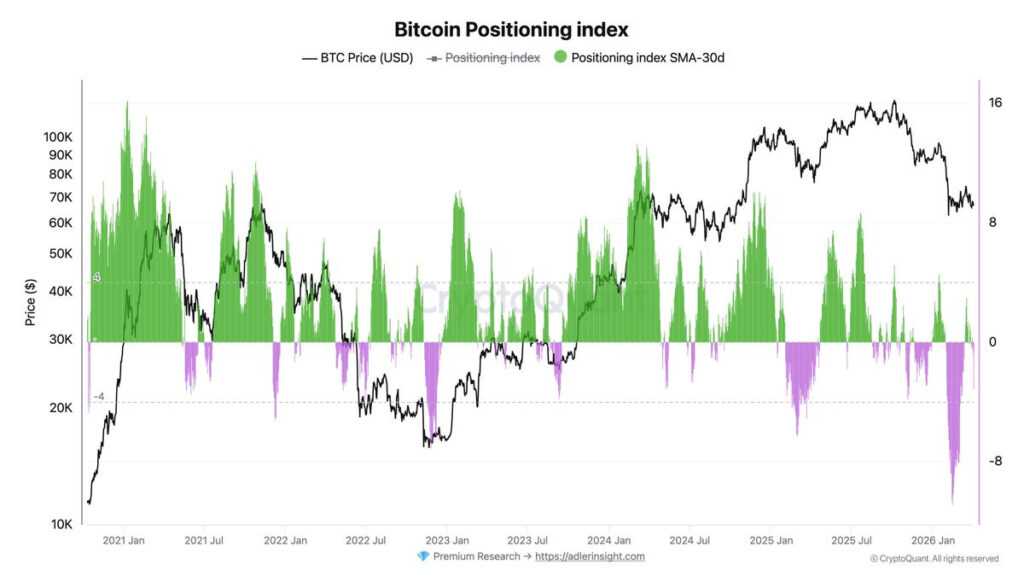
According to crypto analyst Axel Adler Jr, the Bitcoin Positioning Index indicator’s 30-day moving average reached +3.0 on 17 March. The indicator measures the aggressiveness of market participants in the derivatives market.
The +3.0 reading highlighted bullish positioning, but BTC’s price correction over the last two weeks brought the positioning index back below zero. This hinted at more aggressive bearish positioning.
The crypto market is heavily influenced by Bitcoin trends. A return above zero for the Positioning Index’s 30-day moving average would be a positive sign for crypto bulls. As things stand, short positioning is still dominant across the market.
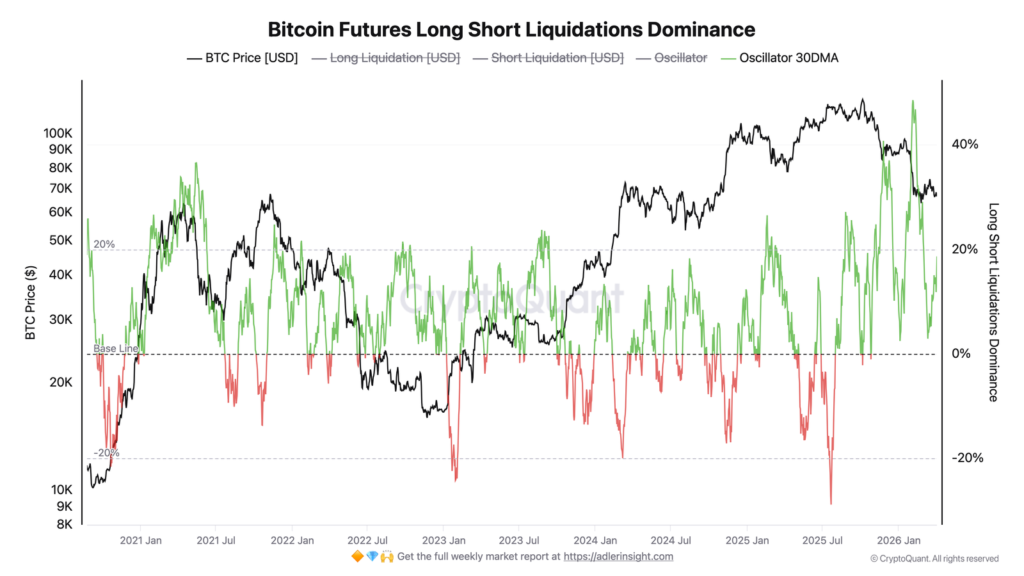
Futures liquidations have been increasingly dominated by long liquidations. The dominance of short liquidations has been absent since October 2025. This underscored the bearish strength in the market once again.
A reversal in the positioning index 30-day SMA above zero, combined with dominance of short liquidations, would signal a bullish regime change.

Zypto App introduces private key import and export features
Zypto App has rolled out a new feature enabling private key import and export, a move designed to give users greater control over their digital assets and enhance wallet flexibility.
The update, announced on April 2, allows users to smoothly import existing wallets into the app using private keys, making it easier to consolidate assets within a single interface. This enables users to manage, transfer, and interact with their cryptocurrencies without switching between multiple platforms.
In addition, the export functionality ensures that users retain full ownership of their wallets. By allowing private keys to be exported at any time, the feature reinforces the principle of self-custody, an increasingly important concept in decentralized finance, by preventing users from being locked into a single application.
The company emphasized that the update aligns with its broader goal of building a fully self-custodial, multi-functional crypto ecosystem. Zypto App already integrates features such as multichain support, token swaps, payments, and spending tools, positioning itself as more than just a storage solution for digital assets.
Industry observers note that features like private key portability are becoming critical as users demand greater autonomy and interoperability across crypto platforms. By enabling both entry and exit of wallets, Zypto aims to offer a more flexible user experience while maintaining security and control.
Find out more here.
Closing Remark
As difficulty grinds higher and input costs rise, the economics of mining increasingly favor large, well-capitalized operators over hobbyists. Against that institutional backdrop, the CKPool win stands out as individuals can still, on rare occasions, beat the odds.
Polymarket’s decision to add new markets tied to equities, commodities, and exchange-traded funds to its platform blurs the lines between prediction markets and traditional derivatives trading.
Dorsey continues to push for Bitcoin as an open, accessible, financial system, and not just an asset for investors. In simple terms, faucets lower the barrier to entry. They reflect Bitcoin’s original ethos: peer-to-peer money, open to anyone. If executed well, this could make that vision tangible again.
Rather than team up with an established prediction market platform like Polymarket or Kalshi, as the NHL and MLB have done, FIFA has picked a partner in ADI Predictstreet that has yet to publicly launch its platform.
Zypto’s update marks another step in the evolution of crypto wallet apps toward comprehensive financial platforms, where users can not only store assets but actively use them across a range of services.
What do you think about this week’s developments? Let us know in the comments section!
FAQs
How much did the Bitcoin miner win?
The solo Bitcoin miner secured a roughly $210,000 block reward.
Which services did Polymarket expand into?
Polymarket has added markets tied to equities, commodities and exchange-traded funds (ETFs).
What is the Ethereum Foundation working towards?
The Ethereum Foundation is working towards a 70,000 ETH staking target set in February.
What is a Bitcoin Faucet?
A Bitcoin Faucet distributes small amounts of BTC in exchange for simple actions, such as solving captchas, watching ads, or signing up.