Gm frens, another big week is unfolding across crypto.
Crypto trading is coming to X, and Anthropic’s $380B valuation is raising fresh questions for crypto markets. Coinbase faces backlash over delayed payouts, while an early Satoshi-era Bitcoin wallet made a decisive $2B accumulation move. Anchorage Digital and Kamino partnered around Solana, and Zypto reinforced the utility of its ZYP rewards.
Let’s dive in.
Crypto trading is coming to X soon
X is preparing to enable users to trade stocks and cryptocurrencies directly within the app, without switching to a separate brokerage.
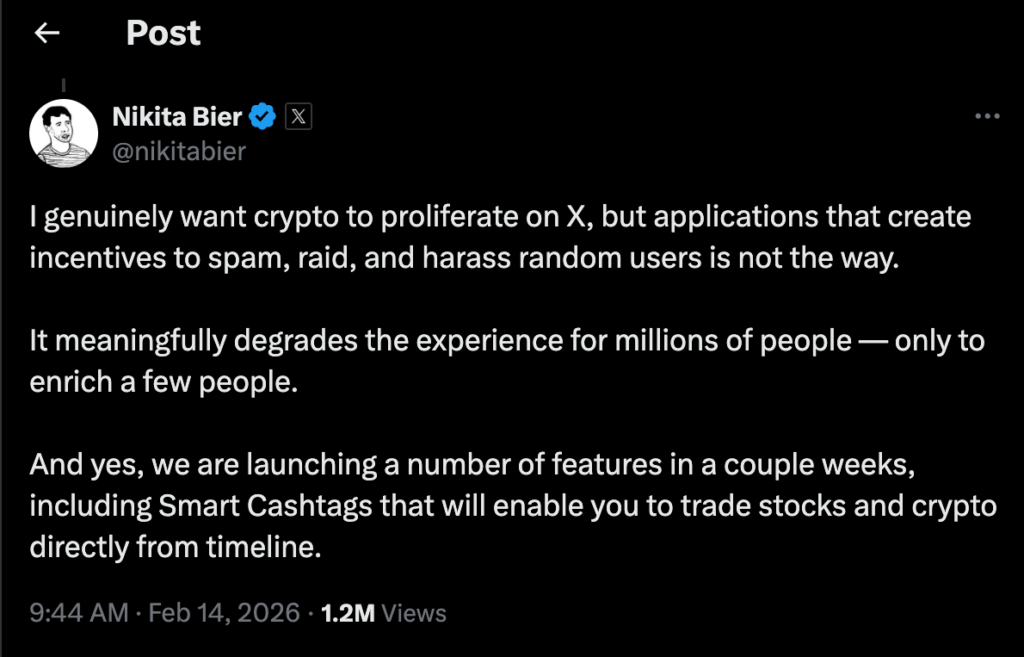
According to Nikita Bier, Head of Product, X will soon roll out a feature called “Smart Cashtags.” These build on the platform’s existing system, where users type symbols like $BTC to track assets such as Bitcoin (BTC).
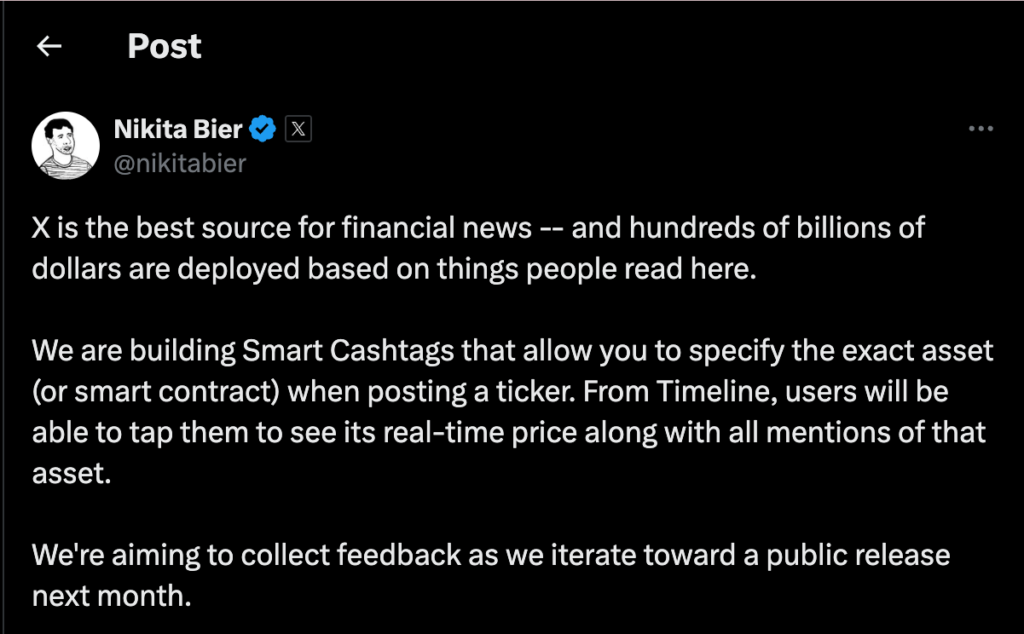
Still, the upgrade goes further. Instead of simply showing prices, tapping a cashtag will open live charts, related posts, and a built-in option to trade instantly.
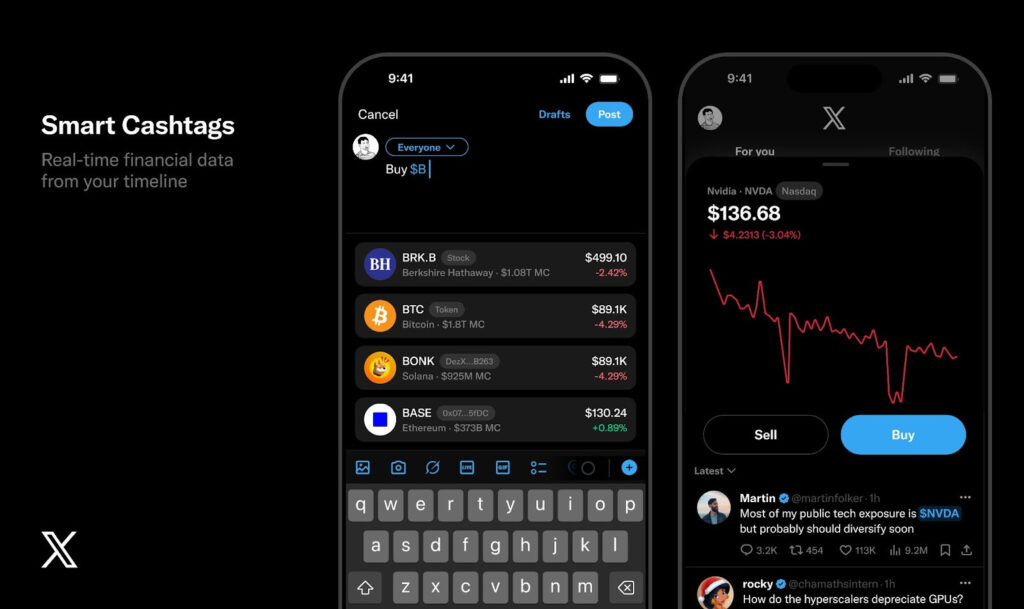
The goal is to remove the extra steps between discovering an asset and acting on it. X has been progressively adding financial features since introducing Cashtags in 2022. That said, trading is only one part of a much bigger plan.
Since acquiring X in 2022, Elon Musk has been clear about his goal, and that is to turn the platform into an “everything app” where users can handle their entire financial life. The firm has laid the groundwork for peer-to-peer transfers, daily consumer payments, and now, active investing.
A key step toward that vision is X Money, a payments feature currently in limited beta. Musk said it will let users send and receive money directly within the app, similar to popular peer-to-peer payment services.
He described it as a feature hub for everyday transactions, where users won’t need separate apps to manage payments. The vision mirrors the utility of Asian “super apps” that combine messaging, social networking, and payments.
At a recent presentation for his AI venture xAI, Musk said,
“This is intended to be the place where all money is. The central source of all monetary transactions…”
With around 600 million monthly users, X already has the scale to support such a turn. The company has spent the past few years building financial tools, ranging from simple price tracking to payments and now, direct trading.
Why Anthropic’s $380B valuation can trouble crypto
Anthropic, the strongest rival to OpenAI, has officially announced a record-breaking $30 billion fundraising round. The deal lifts the company’s post-money valuation to $380 billion, highlighting the powerful pull of capital into the artificial intelligence sector.
Behind the headline number, however, lie complex second-order effects that could increase pressure on the cryptocurrency market.
Anthropic confirmed it raised $30 billion in a Series G round at a valuation of $380 billion. The round was led by GIC and Coatue, with participation from major investors including Founders Fund, Sequoia, BlackRock, Temasek, Microsoft, and NVIDIA.
The company’s financial momentum is notable. Revenue run-rate has reached $14 billion, expanding more than tenfold annually over the past three years.
Claude Code has gained strong enterprise traction, with eight of the Fortune 10 companies now using Claude. The number of customers spending more than $1 million per year has surged from 12 to over 500.
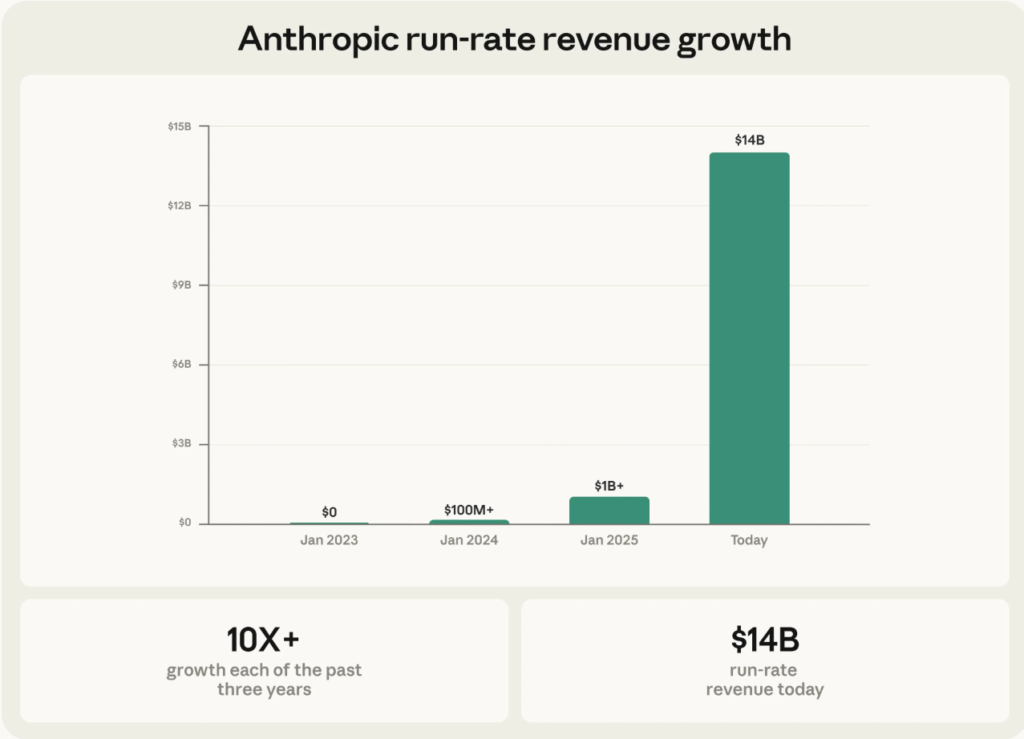
Anthropic now expects annual revenue to nearly quadruple this year, reaching approximately $18 billion. As AI tools become capable of autonomously executing complex tasks, demand for traditional software is likely to decline sharply. Instead of paying monthly subscriptions for dozens of SaaS products, enterprises may increasingly rely on a single general-purpose AI assistant to manage operations.
Bloomberg recently reported that advances in new AI automation tools from Anthropic triggered a sell-off of up to $285 billion in software stock market capitalization during the first week of February.
Bitcoin, meanwhile, continues to show a strong correlation with software stocks. The $3 trillion private credit flows largely drive this relationship, with software accounting for roughly 17% of investments by deal count.
Last week, analyst Jim Bianco stated, “Software stocks are struggling again today. $IGV (iShares Software ETF) is essentially back to last week’s panic lows. Don’t forget there’s another type of software, ’programmable money,’ crypto. Bitcoin (blue) with the software index (orange). They are the same thing.”
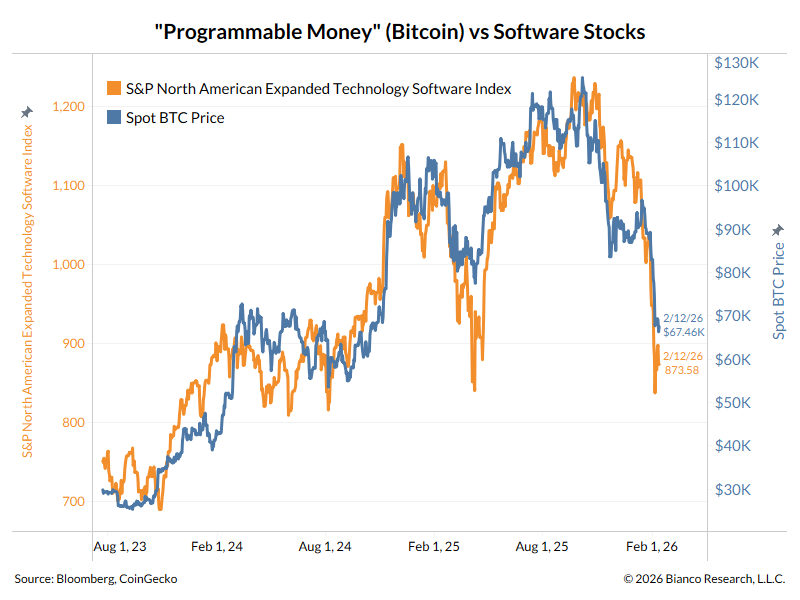
Pressure that began building in mid-2025 has tightened capital conditions. This shift has increased the risk of reduced lending, early repayments, and forced asset sales, with spillover effects reaching the cryptocurrency market.
As demand for AI tools rises, not only from Anthropic but across the sector, expectations for SaaS companies may weaken. That shift could elevate loan default risks. USB has warned that U.S. private credit default rates could reach 13%. Such stress may negatively affect Bitcoin and the broader crypto market through correlation channels.
AI threatens traditional software revenues by displacing demand. It also competes with crypto in areas such as quantum security. As a result, closely monitoring private credit flows and AI development has become increasingly important for crypto risk management.
Coinbase faces backlash over delayed Super Bowl predictions payout
Coinbase is facing mounting criticism from users after many participants in its Super Bowl “Big Game Challenge” prediction market contest reported delayed or missing payouts, even after qualifying for a share of the advertised Bitcoin prize pool.
Community complaints and technical issues highlight the growing pains of prediction markets as they surge in popularity while confronting regulatory, operational, and infrastructure challenges.
On Reddit and other forums, users described confusing and frustrating experiences with the payout process. Reportedly, some users correctly predicted outcomes in the Big Game but still haven’t been paid. Others reported winnings showing briefly in their account balances before disappearing without explanation, or payouts reflected in USD without transferability or access.
Amidst these frustrations, some are calling the situation a “rug pull,” claiming Coinbase’s app initially confirmed a win after five correct picks, the threshold for eligibility, only for a later email to declare they had not won.
However, support responses seen in some threads indicate that rewards are being held until all prediction markets and mail-in entries are settled, in line with the contest’s official rules.
Coinbase has previously said winners will receive their share of the $1,000,000 in Bitcoin directly into their accounts by February 23, 2026. Unfortunately, the lack of transparency and account migrations has frustrated users trying to confirm settlement status.
The timing of these complaints coincides with broader strains in crypto-linked prediction markets. Partner platform Kalshi, which provides the backend for Coinbase’s event contracts, suffered deposit and transaction delays during the Super Bowl due to overwhelming traffic.
Similar technical pressure was observed across the industry on prediction markets during the championship. This suggests systemic scalability challenges for platforms offering event contracts under high demand.
The Coinbase backlash arrives amid a broader regulatory and legal battleground. State gaming regulators, such as the Nevada Gaming Control Board, have sued Coinbase to block its prediction markets. They argue that they constitute unlicensed sports wagering.
These legal actions fuel uncertainty around the regulatory status of event contracts, complicating rollout and user experiences. The current Coinbase backlash highlights the operational and communication gaps that can accompany rapid product expansion.
Oldest Satoshi-era Bitcoin wallet buys $2B in BTC
While most small investors are focused on daily price changes, one of Bitcoin’s oldest and most famous wallets has made a major move.
A wallet from the early “Satoshi era,” when Bitcoin was still an experiment, has become active again and bought around 26,000 BTC.
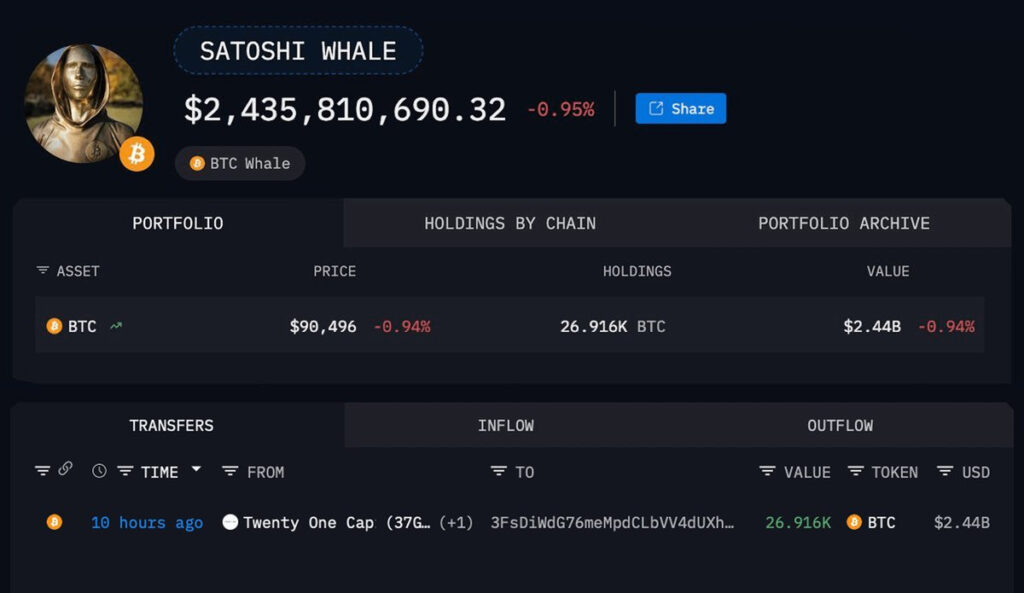
With a value of more than $2 billion, this is not just a normal trade. It sends a strong signal to the market. This wallet is well known among analysts because it has correctly bought during major market dips since 2015, earning over $800 million in profits.
When such an experienced and successful investor chooses to buy more at current levels, it suggests strong confidence in Bitcoin’s future. It also shows that short-term price drops may not matter as much as many people think.
The timing of this $2 billion purchase was not random. Just a day earlier, Bitcoin tried to break above the important $70,000 level but failed. Heavy selling pushed the price down by about 3%, sending it to nearly $68,500.
This made many small investors nervous, with some expecting prices to fall even further. While most people saw this drop as a bad sign, the Satoshi-era whale saw it as a buying opportunity. By purchasing 26,000 BTC at these levels, the whale turned a weak price zone into a strong support area.
This move matters for two main reasons.
First, large investors move their Bitcoin off exchanges and into private wallets, reducing the number of coins available for selling. With fewer BTC on the exchange, sellers find it harder to push prices lower.
Second, this wallet has a strong record of buying at market lows. When such an experienced investor buys heavily, it boosts confidence among other major institutions.
Together, their buying creates a strong price floor and helps prevent panic during short-term drops.
Anchorage Digital and Kamino partner with Solana
Anchorage Digital has partnered with Kamino and Solana Company to roll out a structure that allows institutions to borrow against staked Solana without moving assets out of regulated custody.
In an announcement, Anchorage said the initiative expands its Atlas collateral management platform by integrating with Kamino, a Solana-based decentralized lensing protocol.
The effort is being carried out in collaboration with Solana Company, a publicly listed digital asset treasury (NASDAQ: HSDT) dedicated to acquiring Solana and formed with backing from Pantera Capital and Summer Capital.
Under the structure, institutions can use natively staked SOL as collateral for on-chain borrowing while the assets remain held at Anchorage Digital Bank, a federally chartered crypto bank.
That means investors can continue earning staking rewards while accessing liquidity through Kamino’s lending markets.
Anchorage acts as collateral manager, overseeing loan-to-value ratios, margin requirements, and, if necessary, liquidations. Because the collateral remains in segregated custody, institutions do not need to move assets into smart contracts, a requirement that has historically limited participation by regulated entities.
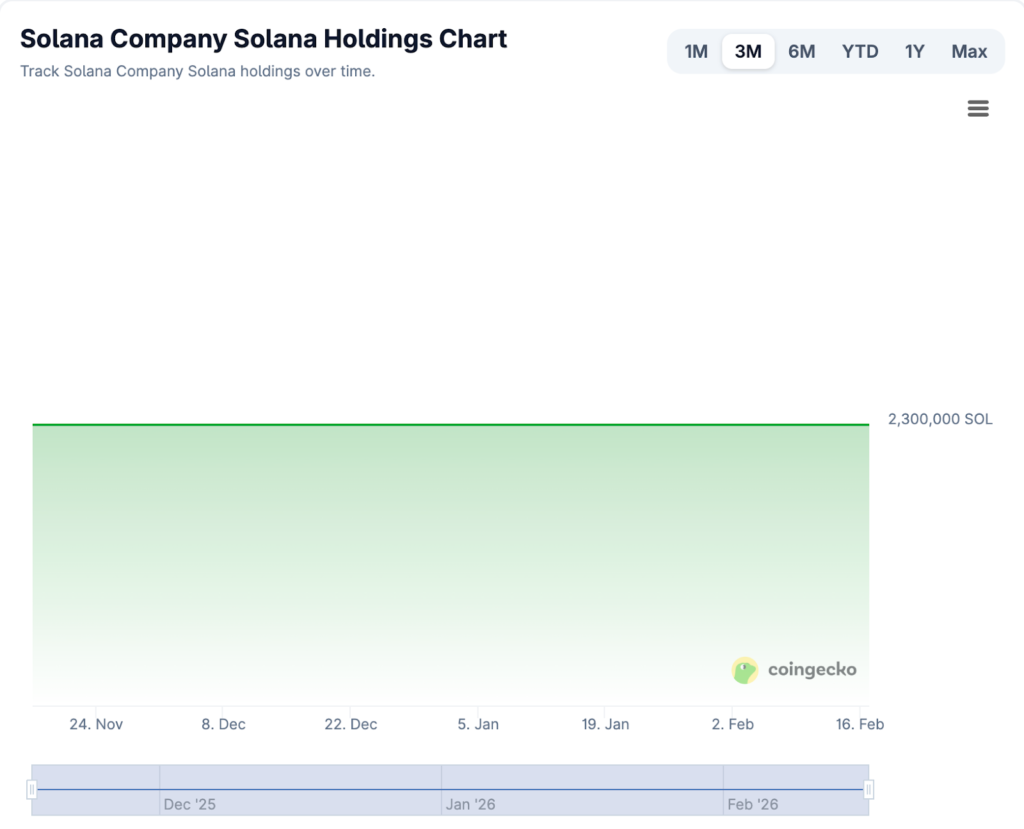
The integration between Anchorage Digital, Kamino, and Solana underscores growing institutional interest in decentralized finance.
However, that momentum is unfolding against an uncertain regulatory backdrop in the United States, where lawmakers are still debating how to oversee digital assets and DeFi platforms.
At the center of the debate is the proposed CLARITY Act, which aims to establish clearer jurisdictional boundaries and regulatory standards for digital assets, including DeFi protocols.
While the bill is intended to reduce uncertainty for market participants, some DeFi advocates argue that it falls short of addressing how decentralized protocols, developers, and governance structures should be treated under the law.
Industry groups have raised concerns that earlier draft language, including amendments introduced in January, does not sufficiently distinguish between centralized intermediaries and decentralized systems.
Zypto Reinforces Closed-Loop Rewards Model Ahead of Integration Launches
As Zypto prepares to roll out major interoperability integrations inside its mobile wallet, the company is drawing renewed attention to how its ZYP rewards system operates within the ecosystem.
ZYP rewards function as a usable in-app balance that can be applied fully or partially at checkout. They can be used toward crypto cards, bill payments, mobile top-ups, gift cards, or the Vault Key Card, allowing users to circulate rewards back into the same environment in which they were earned.
Closing remark
The ‘Smart Cashtags’ development is X’s latest move to reduce friction when switching between social media and brokerage applications. By bridging these functions, the update potentially accelerates how quickly retail investors can act on information.
Anthropic is not the sole driver of these risks. Its swift ascent, however, may signal a larger wave of volatility ahead. Coinbase’s operational issues highlight how infrastructure designed for everyday trading may struggle with spikes tied to major events.
After more than 14 years of ups and downs with Bitcoin, long-term growth is still seen as the best strategy. All in all, this shows that the most experienced investors are not leaving; instead, they are quietly preparing for what comes next.
Anchorage Digital’s partnership with Kamino and Solana potentially addresses a fundamental friction between traditional finance and decentralized lending markets.
ZYP rewards are earned through activity within the Zypto ecosystem, including referrals, swaps, and general platform engagement. The company describes the system as a closed-loop rewards model in which users earn and spend within the same ecosystem.
With so much to unpack, what do you think about this week’s news?
FAQs
What is the Smart Cashtags feature all about?
Smart Cashtags is an upcoming X feature that allows you trade stocks and crypto directly from the timeline.
How much did Anthropic raise?
Anthropic raised $30 billion in a Series G round at a valuation of $380 billion.
Why is Coinbase facing backlash?
Coinbase is facing criticism from users after reports of delayed or missing payouts from the Super Bowl prediction contest.
How much BTC did the Satoshi-era wallet buy?
The Satoshi-era wallet bought around 26,000 BTC ($2 billion).
Why did Anchorage partner with Solana?
Anchorage Digital partnered with Kamino and Solana to roll out an efficient lending structure.