Dear Frens,
This week,Tether pushes for a KRW stablecoin, SpaceX reveals $1.46B BTC holdings, while FIFA chooses ADI Predictstreet for World Cup 2026. Then, Ripple adds 4,300 new wallets, Ethereum falls 32% year to date, and a researcher proposes a $1 billion plan to strengthen Ethereum’s future. Finally, Zypto promotes crypto powered living with expanded in app capabilities.
Let’s dive in.
Tether pushes for a KRW stablecoin
Tether (USDT) is reportedly making an Asia bet, with new trademark filings found in South Korea. Additionally, the stablecoin giant has also expanded its presence around Bitcoin (BTC), with a stake in Twenty One Capital.
Tether has filed seven trademark applications with South Korea’s KIPRIS database. The spotlight is on two names in particular, KRWT and WONTETHER. Both clearly indicate the Korean won, which is why markets are reading them as a sign. Alongside the won-linked names, Tether also filed trademarks for Tether Gold (XAUT), QVAC, USAT, and its shield logo.
The timing lines up with USDT’s dominance in the market. Over the last month, USDT supply has expanded by more than $5 billion, while rivals like USDC, USDe, and PYUSD collectively shrank by roughly $4.2 billion. Even as overall growth in the stablecoin market slowed, Tether continued to gain market share.
Tether International has also taken full control of Twenty One Capital after acquiring SoftBank Group’s entire stake in the company. In fact, SoftBank’s board members have stepped down, leaving Tether with uncontested control.
Twenty One Capital is one of the world’s largest public holders of Bitcoin, with more than 43,500 BTC on its balance sheet. That’s worth around $4 billion. The deal value has not been disclosed so far.
After the filings and the Twenty-One capital move, markets now have three things to track. First is whether Tether officially confirms a KRW-backed stablecoin or keeps the trademarks as a defensive legal step. The second is the South Korean regulators’ response. A won-linked stablecoin from the world’s largest stablecoin issuer would likely draw attention. The third is Tether’s expansion pathway.
SpaceX reveals $1.46B Bitcoin holdings ahead of IPO launch
SpaceX, owned by Elon Musk, is preparing for its initial public offering (IPO) on the 12th of June. The company has submitted its S-1 registration statement to the U.S. Securities and Exchange Commission, aiming to stage the largest IPO in history. The filing also highlighted Musk’s quiet commitment to digital assets.

According to the filing, the company held 18,712 BTC, with a cost basis of $661 million and a fair value between $ 1.29 billion and $ 1.64 billion. However, at the current price of $78,029.03 per BTC, the position is worth approximately $1.46 billion.
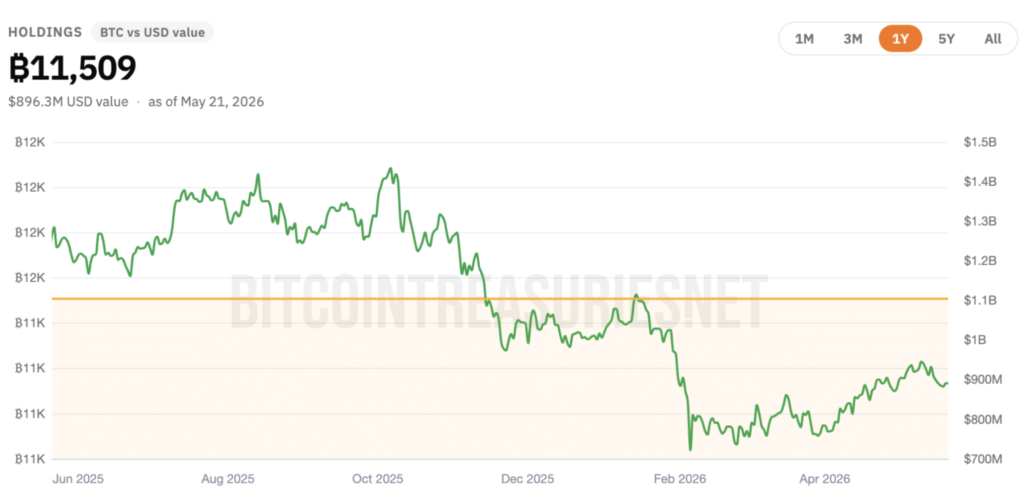
On-chain data shows Tesla, Musk’s other publicly traded company, holds 11,509 BTC. By comparison, Strategy remains the largest corporate holder with 843,738 BTC, meaning Musk would need to accumulate far more to reach that level. Still, his efforts are notable.
It was reported that SpaceX transferred $94 million worth of Bitcoin as part of a weekly trend. For nearly two months in late 2025, the aerospace firm consistently moved about $100 million each week.
FIFA chooses ADI Predictstreet for World Cup 2026
FIFA has named ADI Predictstreet as the official prediction market partner for the 2026 World Cup. The tournament, already set to become the largest in football history, will run from June 11 to July 19, 2026, featuring 48 teams, 104 matches, and 16 host cities across Canada, Mexico, and the United States.
FIFA said that the partnership will center on interactive forecasting markets tied to match outcomes, player performances, tournament statistics, and other key moments throughout the competition. Prediction markets can turn live sports into a constant, interactive experience, letting fans forecast goals, cards, substitutions, player performances, and tournament outcomes as they watch a match.
FIFA’s announcement positions ADI Predictstreet as a new way to turn match attention into forecasts. The platform is expected to use FIFA-linked data and let fans predict tournament events before and during matches. FIFA’s public language centers on fan engagement, collective intelligence, responsible participation, and official data.
Before the April 2 announcement, ADI Predictstreet was largely unknown within the prediction markets industry, especially compared to established platforms like Polymarket and Kalshi. Those two were already hosting markets on politics, economics, entertainment, and sports, including the 2026 World Cup.
Unsurprisingly, FIFA’s choice stands out. The official partner is a little-known company attached to a new blockchain ecosystem. ADI Predictstreet is connected to the ADI blockchain, which is an Abu Dhabi-based blockchain project founded by Sirius International Holding, the digital arm of IHC, one of the world’s largest investment companies.
FIFA has spoken in glowing terms about ADI Predictstreet, affirming that safeguards will support transparency, fairness, and responsible participation. Nonetheless, at the scale of the World Cup, the platform would have to absorb traffic surges, settle markets quickly, screen users by age and location, monitor fraud, and flag suspicious activity.
FIFA may see ADI Predictstreet as a controlled way to enter prediction markets before unofficial platforms capture World Cup attention. ADI may see FIFA as the perfect launchpad for a new blockchain-based forecasting product. Fans may see a game, regulators may see event contracts, while crypto users may see a new trading venue.
Ripple adds 4,300 new wallets
From a technical purview, XRP has lagged behind most large caps in this Q2 cycle. While liquidity continues to flow heavily into Bitcoin, XRP is still up less than 2% among major altcoins, meaning holders from the last couple of quarters are still largely underwater.
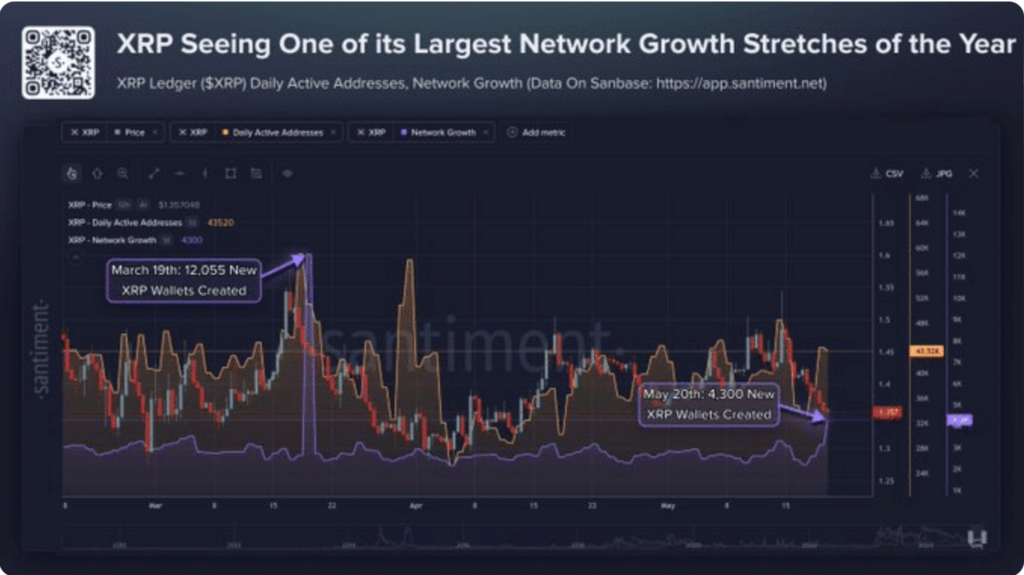
Against this backdrop, the recent spike in new XRP wallets appears to be a classic rotation. As the data shows, roughly 4,300 new XRP wallets appeared within a 24-hour window, marking the fourth-largest spike of 2026 so far. Such spikes often signal renewed speculative interest in a lagging asset.
Notably, recent derivatives positioning around Ripple (XRP) supports this setup. Per CoinGlass data,
Ripple’s Open Interest (OI) rose by over $20 million over the same 24-hour window, showing that leverage is slowly rotating back into the market.
This move to new wallets could also point to strengthening retail participation. In a recent move, U.S. President Donald Trump made another regulatory call. In a broader context, he reportedly directed the U.S. government to update regulations better to integrate crypto into traditional finance and payment systems.
With the CLARITY Act still stalled on the regulatory front, this renewed push was enough to trigger a market frenzy, with attention largely centered around XRP. Notably, the underlying metrics support this narrative.
Today, XRPL hosts a growing range of tokenized financial assets on-chain, from U.S. Treasuries and money market funds to commercial paper, structured credit, and more. With tokenization central to crypto regulation, the XRP market frenzy becomes easier to understand.
Supporting this narrative, Ripple’s recent partnerships further reinforce XRP’s growing integration with TradFi markets. Against that backdrop, rising retail participation in the network doesn’t look like classic short-term FOMO tied to momentum; instead, it reflects early-stage positioning and broader adoption trends. In this context, FOMO may be ‘evolving’ into a key bullish catalyst for XRP this cycle.
Ethereum down 32% year-to-date
Leading altcoin Ethereum has shed 31% of its value since the start of 2026, dropping from a January 1 close of $3,001 to $2,069.98 as of this writing. This drawdown leaves ETH among the worst-performing major assets of the year, even as a handful of altcoins have attracted fresh capital and posted stronger relative performance.
As the anchor for broader altcoin rotations, ETH’s weakness has pushed the prospect of an altcoin season further out. According to Blockchain Center, an altcoin season begins when at least 75% of the top 50 altcoins outperform BTC over three months.
New data from the on-chain analytics platform shows that only 29% of these tokens have outperformed BTC over the past 90 days, significantly below the required threshold. This means capital is still concentrating in BTC rather than rotating out into the broader altcoin market.

The sustained exit of institutional capital from ETH-backed products has compounded ETH’s price weakness. According to CoinShares’ latest weekly fund flows report, ETH investment products saw $249.3 million in exits last week, representing their largest single-week outflow since January 30.
Per the report, the redemptions were part of a broader $1.07 billion outflow from digital asset investment products for the week ending May 16. This marked the third-largest weekly withdrawal of 2026 and the first negative print after six consecutive weeks of inflows.
Furthermore, inflows into spot ETH exchange-traded funds (ETFs) have stalled since the beginning of May. SoSoValue data shows two consecutive weeks of net outflows, totaling $404 million.
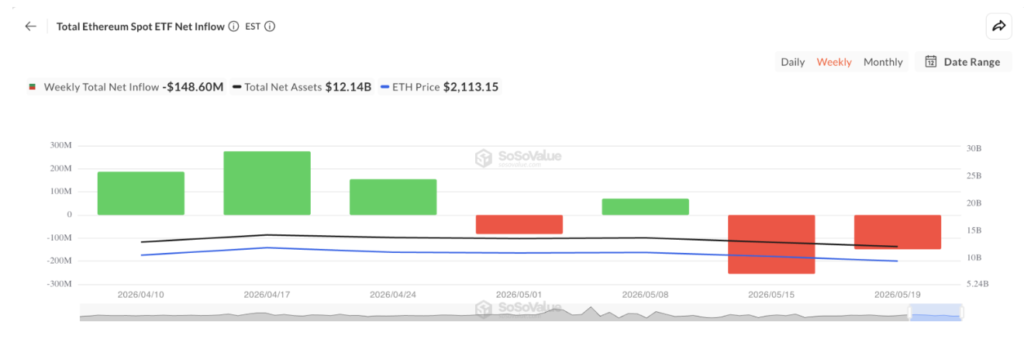
As of this writing, total net assets across spot ETH ETFs sit at $11.84 billion, down 25.3% from its year-to-date peak of $15.86 billion last seen in January. In addition to a drop in institutional interest in ETH, short-term holders have also significantly distributed their coins over the past few weeks.
Per Glassnode, these are investors who have held their coins for 1 to 3 months and are usually the most responsive to price moves. They have offloaded 14% of their holdings since April 26, and currently hold 5.54% of ETH’s circulating supply.
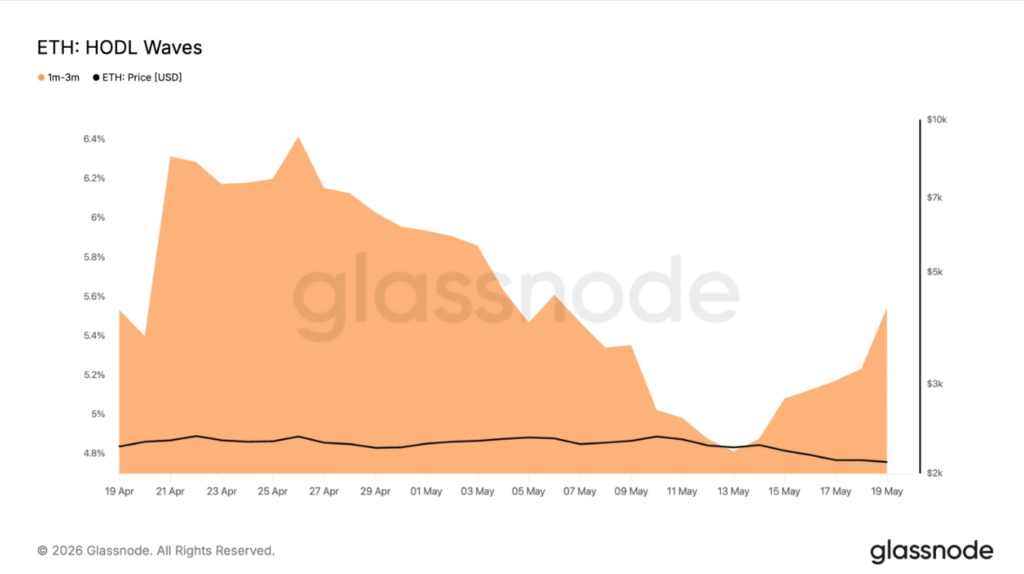
This dip in short-term holdings is significant because this cohort’s behavior tends to drive long-term price action. When they aggressively distribute, the added selling pressure typically weighs on prices, opening the door to further downside in ETH.
Researcher proposes $1 billion plan to save Ethereum
Dankrad Feist, a former Ethereum Foundation researcher, has called on the community to build a new ETH-aligned organization with at least $1 billion in funding, arguing it is the only credible path to putting Ethereum back on a winning trajectory.
His proposal, posted on X, arrives as at least eight senior EF members departed in 2026, with five leaving in May alone. He put his case directly.
“The community needs to create an organization that’s economically aligned with Ethereum and accountable to it.”
Feist sketched out some requirements for the new body. It needs at least $1 billion in credible funding and a competent leader willing to fight for the protocol’s interests. A board explicitly accountable to Ether (ETH) holders and a permanent staking revenue stream would complete the structure.
The Ethereum Foundation currently holds less than 0.1% of all ETH and collects no share of staking or transaction fee revenues. Its treasury holds roughly 92,548 ETH, a figure that has fallen as the Foundation sold holdings to cover operating costs. The EF launched a staking initiative in February, targeting 70,000 ETH, aiming to generate native yield without reducing its treasury balance.

Zypto promotes crypto-powered living with expanded in-app capabilities
Zypto is advancing its ‘live on crypto’ vision by showcasing the real-world utility of its app, enabling users to spend, manage, and interact with digital assets as part of everyday financial activity.
The platform integrates a broad set of features that go beyond passive crypto holding, allowing users to pay bills, transfer funds, and transact globally with cryptocurrencies without relying on traditional banking infrastructure.
Through its growing ecosystem, Zypto combines wallet functionality, payments, swaps, and financial services into a single interface, aiming to simplify how users interact with digital assets across multiple use cases.
The company positions its app as a bridge between decentralized finance and real-world spending, offering tools that allow users to convert and use crypto for routine expenses.
Zypto’s infrastructure supports multiple blockchain networks and a wide range of digital assets, enabling cross-chain functionality while maintaining user control over funds through self-custody.
The platform also emphasizes accessibility, with features designed to reduce friction in onboarding and daily use, including simplified transaction flows and integrated services that eliminate the need for multiple third-party applications.
Zypto’s mission reflects a broader shift in the crypto industry, where platforms are increasingly focused on utility and user experience as adoption moves beyond trading into everyday financial behavior.
Find out more here.
Closing remark
Tether’s trajectory in Asia has been impressive, and if it keeps up with more treasury deals or regional stablecoin initiatives, the Korea filings may just be the start of something much bigger.
Based on the filing, SpaceX expects a valuation of at least $1.5 trillion, potentially reaching $2 trillion. If the IPO succeeds, the company would immediately rank among the ten most valuable publicly traded corporations worldwide.
Billions will watch the 2026 World Cup. If ADI Predictstreet works smoothly, FIFA can claim it brought prediction markets into global football under an official framework. If the product stumbles, the fallout will reach far beyond crypto.
Zypto affirmed that its goal is to enable a future in which users can rely on crypto not just as an investment but as a primary financial tool for payments, transfers, and global transactions.
What is your favorite development this week? Tell us in the comments section.
FAQs
Which stablecoin offering is Tether reportedly after in Asia?
Tether is reportedly pushing for a KRW-backed stablecoin after filing trademarks applications with South Korea’s KIPRIS database.
How much BTC does SpaceX have in its holdings?
According to a filing, SpaceX has 18,712 BTC, worth approximately $1.46 billion.
Which prediction market did FIFA partner with ahead of the 2026 World Cup?
FIFA named ADI Predictstreet as the official prediction market partner for the 2026 World Cup.
How many new wallets did Ripple add?
Ripple added roughly 4,300 new XRP wallets, making it the fourth largest spike of 2026 so far.