Gm frens, ready for this week’s news round-up?
VeryAI raises $10M to build Solana, Ripple plans to secure a license in Australia, and the Ethereum Foundation sells 5,000 ETH in a $10M deal. MoonPay X Games athletes to be offered stablecoin bonus, Gen Z crypto ownership reaches 23% in Australia, Pi Network releases Pi Launchpad on Testnet, and Zypto highlights the shift beyond crypto exchanges.
Let’s get straight into the action.
VeryAI raises $10M to build on Solana
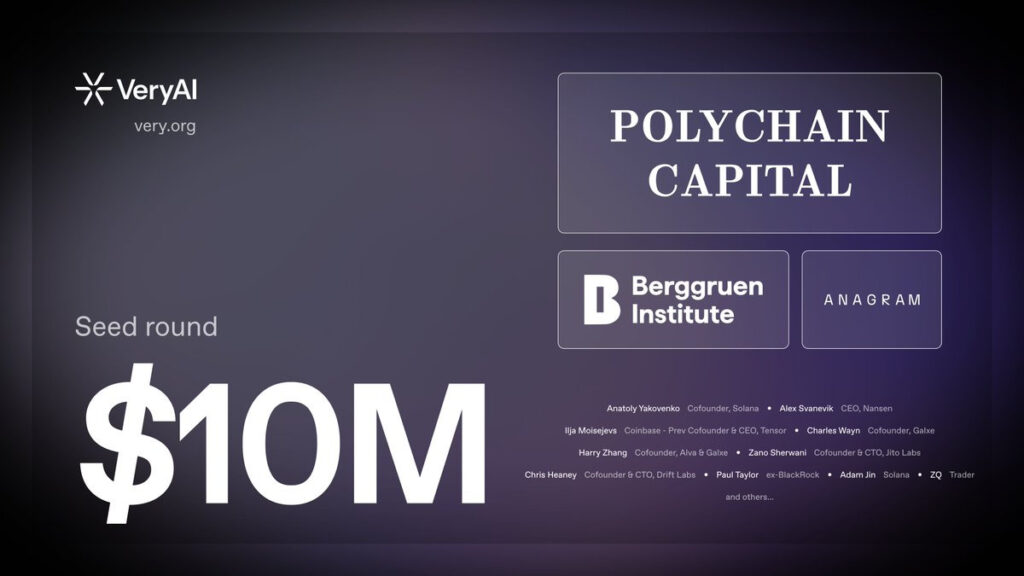
Startup VeryAI has raised $10 million in a seed funding round led by Polychain Capital to launch a palm-scan identity verification system designed to differentiate real users from AI-generated accounts, per an official X post.
The system captures palm images with a smartphone camera and converts them into encrypted biometric signatures used to confirm that a user is human without storing identifiable data. The company said zero-knowledge proofs allow users to verify their status across platforms without revealing personal information.
The platform records identity attestation on Solana and aims to help crypto exchanges, fintech companies, and online platforms address the growing risks posed by bots, deepfakes, and synthetic identities.
According to the company, palm biometrics are highly distinctive and less publicly exposed than facial features commonly used in identity checks. The scans are converted into irreversible feature representations rather than stored images, preventing the original biometric data from being reconstructed.
The company is already working with organizations including MEXC, Colosseum, Clique, and Talus, with other centralized exchanges and wallets preparing to integrate the plan verification system, Meltzer said.
Investors in the round included the Berggruen Institute and Anagram. Anatoly Yakovenko, co-founder of the Solana blockchain, also joined as an angel investor.
Ripple plans to secure a license in Australia
Ripple said it is set to secure key financial services in Australia through the acquisition of an Australian payments firm, adding to an international license grab over the last year.
In a statement last week, Ripple said it will buy BC Payments Australia, a corporate entity tied to the European Banking Circle Group, allowing it access to the company’s Australian Financial Services License (AFSL), which is set to become a requirement for certain crypto companies to provide financial services in the country.
The acquisition of BC Payments Australia is set to close on April 1, according to a report from The Australian, citing comments from Ripple APAC managing director Fiona Murray. She said “Australia is a key market for Ripple” and that an AFSL would strengthen the company’s ability to scale its payments business throughout the country.
Ripple has been working to expand its portfolio of international licenses over the last year. In addition to recently securing conditional approval for a national trust banking charter in the US, Ripple has also won payment licenses in Singapore, the UAE, and the UK over the last 12 months.
Also, the firm has been working to expand use cases for XRP and its Ripple USD stablecoin through key acquisitions in recent months, most notably non-bank prime broker Hidden Road and corporate treasury platform GTreasury.
The acquisition of Hidden Road, now Ripple Prime, made Ripple the first crypto-native company to own and run a multi-asset prime broker, covering everything from clearing, financing, and brokerage across digital assets, derivatives, swaps, foreign exchange, and fixed-income products for institutional clients.
Ripple’s plans for Australia come as lawmakers introduced the Digital Asset Framework bill last year, which passed through the lower house in February and is now before the Senate. The Australian Securities & Investments Commission (ASIC), the country’s top markets regulator, has also proposed rules for the crypto sector.
Ethereum Foundation sells 5,000 ETH in a $10M deal
On March 14, the Ethereum Foundation, the non-profit organization behind the blockchain network, revealed that it finalized the sale of 5,000 ETH to BitMine through an over-the-counter transaction.
Notably, the Foundation had come under market scrutiny in the past over its ETH sales. The Foundation said it sold the tokens at an average price of $2,042.96 to fund its core operations, including protocol research and development.
However, the choice of BitMine as the direct counterparty has drawn immediate scrutiny. BitMine currently stands as the largest corporate holder of Ethereum, controlling more than 4.47 million tokens valued at approximately $9.07 billion.
This is because the Tom Lee-led firm has aggressively acquired the cryptocurrency over the past year and has publicly outlined its intent to capture 5% of the total circulating supply.
In a proof-of-stake network, voting power and consensus influence are directly tied to token holdings. Consequently, facilitating the concentration of assets in a single corporate entity clashes with the foundation’s historical emphasis on network decentralization and anti-monopoly principles.
Meanwhile, the transaction underscores a broader, fundamental strategic pivot for the foundation. Following the sale, the organization now holds just over 200,000 ETH, worth roughly $424 million.
Facing a shrinking treasury runway, the foundation recently abandoned its long-standing policy of keeping its assets idle. The stance was originally taken to avoid influencing network consensus. Last month, it staked 70,000 tokens to generate yield. This is designed to redirect staking rewards toward ecosystem development and community grants.
Simultaneously, the foundation released a new governance manifesto that ties it to strict ideological standards. The new mandate aligns the Foundation and its workers with decentralization and an open-source ethos. It explicitly filters out protocols deemed “surveillance-friendly” or “centralization-dependent.”
These sweeping financial and policy changes coincide with a recent leadership shake-up at the organization. Earlier this month, co-executive director Tomasz Stanczak abruptly stepped down, with Bastian Aud appointed as the interim replacement.
MoonPay X Games athletes to be offered stablecoin bonus
The long-running action sports spectacle X Games will share a title with MoonPay. Athletes drafted to compete in the MoonPay X Games League are set to receive signing bonuses in stablecoins, providing an early look at how the crypto payments provider plans to elevate its partners via the action sports spectacle.

MoonPay said one-time payments of $2,500 will be sent to 40 athletes in the form of XO Cash, a stablecoin offered by Exodus. They will receive the funds in Exodus’ flagship product, with balances linked to payment cards.
In December, MoonPay said that it would work with Exodus to develop a stablecoin that dovetails with Exodus Pay, a self-custodial payments platform that’s supposed to launch in the second half of this year. That wasn’t long before MoonPay entered into a three-year title partnership with X Games, part of the organization’s shift towards a league-based format.
Exodus co-founder and CEO JP Richardson described the arrangement as especially beneficial for international competitors, who’d struggle to spend the signing bonuses abroad using traditional payment services.
When MoonPay signaled in January that the X Games were shifting to a league-based format, the firm noted that athletes didn’t receive compensation for participating in past standalone events.
Similarly, MoonPay President Keith Grossman also affirmed that its title partnership would function as a distribution mechanism for crypto-native projects, allowing them to gain media exposure through opportunities that they may not be able to access otherwise.
For athletes trying to find their footing in skateboarding, BMX, snowboarding, and freeskiing, X Games’ shift comes with the promise of perks like paid travel expenses and a health insurance stipend. This marks a departure from the high-stakes competitions rooted in prize money that have typically made athletes reliant on individual sponsorships.
Gen Z crypto ownership reaches 23% in Australia
Australia’s financial regulator has urged young investors not to rely on social media influencers and artificial intelligence (AI) chatbots to make financial decisions, according to a study that also found that one in four “Gen Zs” invest in crypto.
The Australian Securities and Investments Commission (ASIC) posted the results of a survey on Sunday, finding that Gen Z has high levels of trust in “often unreliable sources,” which has contributed to riskier financial decisions. ASIC said,
“Moneysmart’s Gen Z study found that while Gen Z has a strong appetite for reputable and trustworthy financial content, many struggle to find it and their search often leads them to sources designed for engagement rather than accuracy”
ASIC took action against influencers over their financial social media content last year in June, issuing warning notices to 18 influencers “suspected of unlawfully promoting high-risk financial products and providing unlicensed financial advice.”
The latest survey was conducted between November 28 and December 10 last year with 1,127 respondents between 18 and 28. It found that 63% of the group uses social media for financial information, while 18% use artificial intelligence (AI) platforms, and 30% said they use YouTube specifically.
It also found that 56% of Gen Z say they “somewhat or completely trust” financial information on social media, with 52% saying the same of social media influencers primarily covering financial niches. AI, however, ranked as the most trusted source at 64%.
Furthermore, the survey showed that 23% of Gen Z now own crypto in Australia, with 29% of these trading based on social media and influencer content, prompting a warning that influencers may set unrealistic expectations about investment returns, market volatility, and the intricacies of long-term investing.
ASIC commissioner Alan Kirkland noted that the regulator has been keeping an eye on marketing activity designed to drive people to make investments, noting some of them are scams. He mentioned that ASIC is monitoring what types of financial information are being derived from AI tools, as some companies have integrated them into their services to offer personalized trading guidance.

Pi Network releases Pi Launchpad on Testnet
Pi Network (PI) released the initial version of its Pi Launchpad as a Pi App on Testnet with a test token on March 16. The team claimed to introduce a token launch mechanism that differs from typical Web3 launchpad models.
The Pi Core Team said the Testnet rollout is designed to let Pioneers familiarize themselves with how the process works before a Mainnet launch. The Launchpad applies Design 1 from the PiRC framework, an open-source proposal system Pi released on its Open Network anniversary.
Over the weekend, Pi surged as investors responded aggressively to a cluster of bullish developments. The altcoin reportedly gained 30% in 24 hours on March 13, reflecting heightened market enthusiasm. Multiple catalysts aligned simultaneously, driving participation to levels not seen in months.
On March 14, Pi Day 2026 was celebrated, generating community excitement and renewed attention toward the token. The cultural significance of the date within the Pi Network ecosystem has historically driven engagement spikes, and this year appeared no different.
Zypto highlights shift beyond crypto exchanges
A new publication from Zypto is spotlighting a major shift in how users access digital assets, arguing that crypto exchanges are no longer the central gateway to the ecosystem. It outlined how exchanges have evolved alongside the rise of wallets and decentralized applications (dApps).
Crypto exchanges have traditionally served as the primary onboarding channel for new users, offering marketplaces to buy, sell, and trade digital assets. However, Zypto notes that users are increasingly interacting with crypto through alternative platforms such as self-custody wallets, decentralized finance (DeFi) protocols, and integrated mobile apps.
Now, applications combine multiple functions, including storage, payments, and on-chain interaction into a single interface.
Zypto also highlights the risks associated with leaving assets on centralized exchanges, including exposure to security breaches, operational failures, and withdrawal restrictions during market stress. The company suggests that self-custody solutions offer an alternative that reduces dependency on third-party platforms.
Despite the shift, exchanges continue to play a key role in the ecosystem, particularly for active traders who rely on deep liquidity, advanced order types, and fast execution. For many users, exchanges now function as a temporary tool rather than a long-term destination.
Find out more here.

Closing remark
As artificial intelligence continues to blur the line between human and automated activity on the internet, some developers say blockchain-based identity systems could help restore trust in digital interactions.
With the AFSL in place, Ripple Payments can manage the full lifecycle of a transaction, from onboarding and compliance through funding, FX, liquidity management, and final payout, while integrating both traditional banking rails and digital assets.
As the X Games prepares to retire a decades-old format laden with nostalgia, MoonPay is making efforts to affix itself to a brand where there is considerable overlap in terms of audience and ownership.
Pi Network’s release of the initial version of its Pi Launchpad, as well as the Pi Day celebration and listing, amplify optimism as broader market conditions keep improving. This creates a compounding effect where multiple tailwinds are reinforcing each other.
Zypto positions its app within this evolving landscape as a “full Web3 access layer,” combining self-custody wallet functionality with decentralized application access, cross-chain asset movement, and real-world payment services.
There’s so much to unpack this week, and we want to know your thoughts. Share them below!
FAQs
What does VeryAI want to build?
VeryAI has raised $10 million to launch a palm-scan identity verification system designed to differentiate real users from AI-generated accounts.
Where does Ripple plan to secure a license?
Ripple said it is set to secure key financial services in Australia.
Who did the Ethereum Foundation sell 5,000 ETH to?
Ethereum Foundation sold 5,000 ETH to BitMine via an over-the-counter transaction.
What is the Gen Z level of crypto adoption in Australia?
About 23% of Gen Z now own crypto in Australia.