
Hi frens! It’s a new year, and we’re back again with the same crypto flavor you love.
Here’s a rundown of this week’s hottest updates in the community: Tether purchased about $800M worth of BTC, Kalshi begins 2026 on a high, Polymarket insiders profit from Venezuela’s president’s capture, Bitcoin miners eye AI, Ledger faces customer data breach, and Zypto offers up a diverse range of crypto cards for 2026.
Come along!
Tether adds $800M Bitcoin to its reserves
While much of the crypto market entered the new year on a cautious footing, Tether wasted no time making its intentions clear.
On January 1, the stablecoin quietly added 8,888 BTC to its reserves, a nearly $800 million bet that underscores its growing role as one of Bitcoin’s largest institutional holders.
The purchase pushes Tether’s total BTC stash past 96,000 coins, cementing a strategy that has steadily expanded even as prices stall and other corporate buyers pull back. Tether CEO Paolo Ardonio confirmed that the company accumulated exactly 8,888.8888888 BTC during the quarter, continuing its pattern of symbolic “8888” purchases.
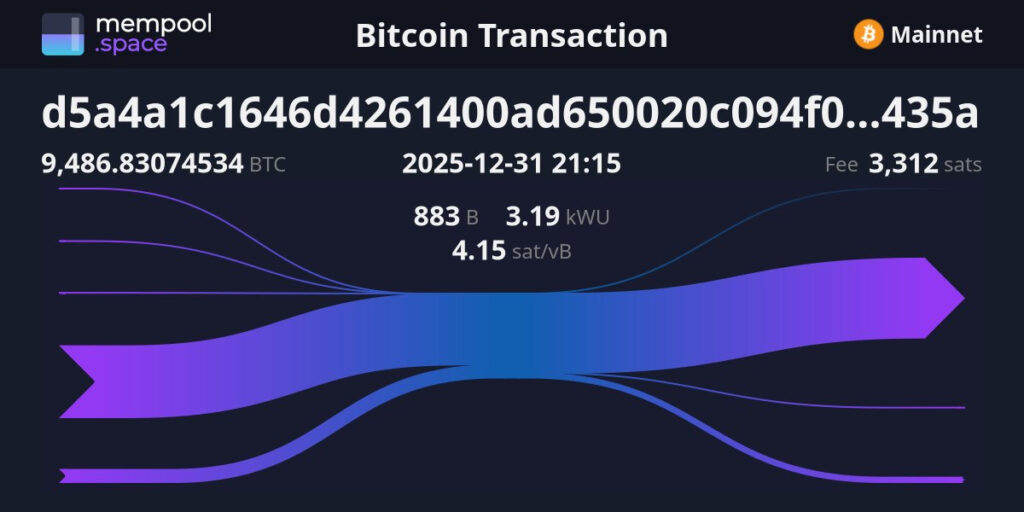
On-chain analysts at Arkham Intelligence estimate the total Q4 spend at roughly $876 million, or about 9,850 BTC, with the difference attributed to timing and consolidation discrepancies.
The accumulation reflects a strategy formalized in May 2023, under which Tether allocates up to 15% of its realized quarterly operating profits to Bitcoin as a long-term store of value and reserve diversification tool.
While Tether held Bitcoin before that announcement, the policy marked a shift toward systematic, ongoing accumulation. The latest purchase comes as crypto markets cool, with Bitcoin trading below $90,000 after strong gains earlier in 2025.
Corporate adoption of Bitcoin as a treasury asset surged early in 2025 but lost momentum as the year wore on. New adopters fell from around 53 in the third quarter to just nine in Q4, with November seeing as few as three new entrants.
By year-end, an estimated 117 to 145 public companies and institutions held Bitcoin on their balance sheets. Collectively, those firms control roughly 1.5 million BTC, worth between $90 billion and $150 billion at current prices.
The slowdown reflects a mix of challenges, including heightened market volatility, elevated Bitcoin prices that increase the cost of entry, shrinking equity premiums as treasury firms trade closer to, or even below, the value of their BTC holdings, and growing competition from spot Bitcoin ETFs.
Some weaker players have also been forced to scale back or exit their positions altogether. Even so, leading Bitcoin treasury firms have not followed the broader retreat. Longtime accumulators, such as Strategy and Tether, continue to add to their holdings, even as Bitcoin trades within a relatively narrow range.
Still, Strategy remains the clear outlier.
The company treats Bitcoin as its primary reserve asset and now holds 672,497 BTC, which is more than 3.2% of the total supply. It has spent over $50 billion building that position at an average cost of roughly $75,000 per coin.
Kalshi begins 2026 on a high after a record 2025 year
Prediction market platform Kalshi opened 2026 with roughly $291 million in daily notional volume on January 1, doubling the $147 million recorded on December 1, 2025, a sign of continued momentum following a breakout year of twelvefold growth.
The strong start follows an explosive 2025 in which Kalshi processed $23.8 billion in total notional volume, representing growth of more than 1,100% year-over-year, according to data published on X.
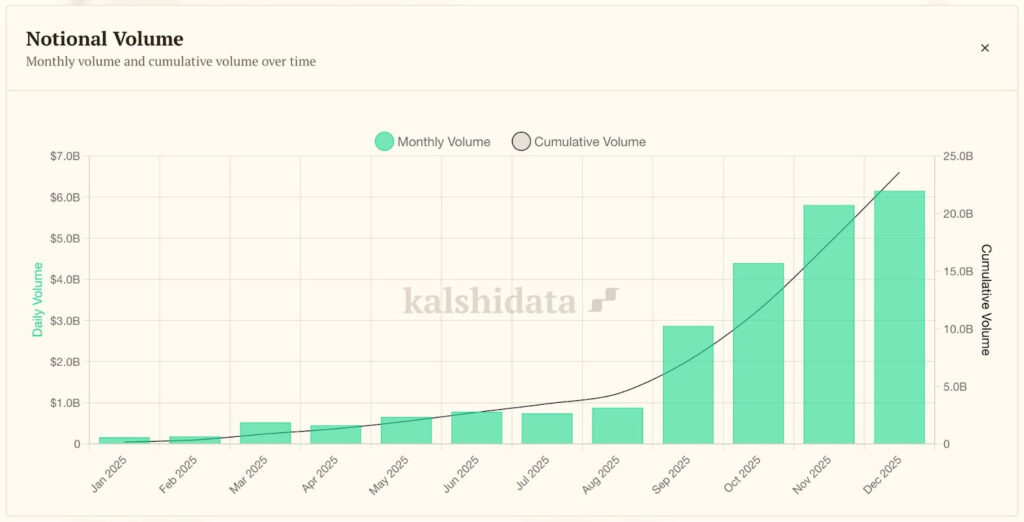
But how did it get there?
Sports markets have emerged as a major driver of Kalshi’s expansion. Users traded contracts on outcomes across the NFL, NBA, College Football Playoff, and NHL.
This has been a blessing and a curse for Kalshi, as it has positioned it to compete with traditional sportsbooks while operating under a different regulatory framework as a Commodity Futures Trading Commission (CFTC) designated contract market for event-based derivatives.
The traditional sportsbooks are agitating that the same rule that applies to them applies to prediction market platforms like Kalshi, and state prosecutors are swooping in. Yet, Kalshi successfully defended its political betting contracts against CFTC challenges in 2024 and 2025, a victory that opened the door to election markets.
Together with rival Polymarket, the two platforms formed what analysts describe as a duopoly, generating more than $44 billion in combined trading volume throughout 2025.
Kalshi has also received institutional investments from heavyweight investors, having raised $1 billion in Series E funding at an $11 billion valuation, led by Paradigm with participation from Sequoia Capital and Alphabet’s CapitalG.
The company has also secured partnerships with CNN and CNBC to integrate real-time market data into editorial coverage. In November, Google announced that it would integrate both Kalshi and Polymarket prediction market data on its search and finance platforms.
Given its January 1 performance, Kalshi may be closer to exceeding its 2025 daily peak of $382 million. However, sustaining such growth will depend on both market conditions and regulatory outcomes.
For instance, the 2026 U.S. midterm elections may also impact Kalshi’s trajectory, as they give users the opportunity to make political bets, an activity that brought prediction markets, especially platforms like Polymarket, to the limelight during the 2024 presidential elections.
The coming event could either validate the sector’s mainstream potential or expose limitations in market depth and accuracy. Kalshi’s expansion beyond sports into politics, economics, and cultural events has helped to boost its appeal, but sports remain the core business.

Polymarket insiders profited just before the capture of Venezuela’s president
A cluster of suspicious wagers netted more than $630,000 on Polymarket after betting on the arrest of Venezuelan President Nicolas Maduro. The activity triggered a swift legislative response in Washington, with lawmakers moving to ban federal officials from trading on prediction markets.
On January 4, blockchain analytics firm Lookonchain identified three digital wallets that netted a combined profit of $630,484 on Polymarket by betting on the removal of Maduro.
Notably, the wallets were created and funded days before the operation, had no prior trading history, and only targeted contracts tied to the Venezuelan leader.
According to on-chain data, one wallet identified as “0x31a5” wagered about $34,000 and booked nearly $410,000 in profit, while another turned $25,000 into $145,600. The third wallet converted a $5,800 bet into roughly $75,000.
The precision of the trades, executed shortly before the news broke globally, suggests the bettors may have possessed advanced knowledge of the sensitive diplomatic and military maneuver.
Considering this, Lookonchain said that these wallets’ trading patterns strongly suggested they had “insider” access to non-public information. Consequently, the incident has catalyzed an immediate push to close regulatory loopholes.
Rep. Ritchie Torres reportedly plans to introduce the Public Integrity in Financial Prediction Markets Act of 2026. The bill would bar government insiders from profiting from outcomes they can influence or anticipate, plus it aims to extend ethical frameworks similar to the STOCK Act to the decentralized betting economy.
According to reports, which Torres acknowledged on social media, the legislation would impose a strict ban. This restriction would apply to buying, selling, or exchanging prediction markets tied to government policy, government action, or political outcomes on platforms engaged in interstate commerce.
It would prohibit federal elected officials, political appointees, and executive branch employees from buying, selling, or exchanging contracts on platforms such as Polymarket and Kalshi, for personal gain.

Demand could drive more Bitcoin miners to AI
The surging growth and adoption of AI have already seen a host of Bitcoin (BTC) mining companies either fully or partially pivot to the sector over the past couple of years.
This has partly been due to the Bitcoin mining difficulty increasing over time, and AI also presents an opportunity for miners to maximize their resources and potentially earn greater revenues outside of BTC.
Nvidia CEO Jensen Huang said demand for computing resources is “skyrocketing” due to the rapid advancement of artificial intelligence models, calling it an “intense race” to the next frontier of tech.
In a Monday Nvidia live event in Las Vegas, Huang discussed a host of developments for the company ahead of 2026, as he pointed to the strong competition in the artificial intelligence sector.
Commenting on the growth of AI since it first hit the market, Huang said that everyone has been fighting to be the first to hit the next level of the tech.
“The amount of computation necessary for AI is skyrocketing. The demand for Nvidia GPUs is skyrocketing. It’s skyrocketing because models are increasing by a factor of 10, an order of magnitude every single year,”
he said, adding:
“Everybody’s trying to get to the next level, and somebody is getting to the next level. And so, therefore, all of it is a computing problem. The faster you compute, the sooner you can get to the next level of the next frontier.”
During his speech, the Nvidia CEO also discussed the firm’s modern Rubin Vera chips, stating they are currently in “full production” and are on schedule.
Huang said the combination of Rubin and Vera, which were designed to work together, will be able to deliver five times greater artificial-intelligence computing performance compared to previous models.
Ledger faces a customer data breach
Hardware wallet giant Ledger is grappling with a data exposure incident, this time linked to its third-party payment processor Global-e.
An email notification sent to customers by Global-e and initially shared by pseudonymous blockchain sleuth ZachXBT on X said the breach involved unauthorized access to Ledger users’ personal details like names and contact information from Global-e’s cloud system. Still, the email did not disclose the number of clients affected or specify when the exploit occurred.
Unfortunately, this isn’t an isolated incident, as this has happened a couple of times in the past.
In 2020, Ledger experienced a data breach that exposed information of 270,000 customers through e-commerce partner Shopify. In 2023, Ledger was hacked for nearly $500,000, affecting several decentralized finance applications.
Global-e said it detected unusual activity and swiftly implemented controls while launching an investigation, which verified the improper access. It said in the email,
“We retained independent forensic experts to investigate the incident, and we were able to determine that some personal data, including name and contact information were improperly accessed,”
Ledger’s social media channels show no active incidents, urging vigilance as yet. Nonetheless, Ledger has emphasized that the breach occurred at Global-e, adding that the payment processor sent the email notification to customers because it is the data controller. It said,
“This was not a breach of Ledger’s platform, hardware, or software systems, which remain secure. For the avoidance of doubt, as the Ledger product is self-custodial, Global-e does not have access to your 24 words, blockchain balance, or any secrets related to digital assets”

Zypto’s range of crypto cards for 2026
In 2026, the best crypto cards lock in value at the time of load, rather than at checkout. They support high or unlimited usage without friction, and work for everyday purchases as well as serious transactions. And, they integrate directly into a mobile app experience where cards are part of how crypto is actually used day to day.
This is the lens Zypto’s card range is built around. Let us consider its diverse crypto card offerings.
The crypto card for everyday spending
The Zypto Virtual Premium VISA Card is designed for users who want crypto-backed spending without needing a physical card. It’s built for online purchases, mobile payments, subscriptions, and everyday transactions.
The crypto card for high-value and global use
The Zypto Physical Premium VISA Card is built for high value and global usage. It supports extremely large transactions and offers up to $1,000,000 in monthly spending, making it one of the highest limit crypto cards available.
The crypto card for privacy, gifting, and control
Zypto’s single load Virtual Mastercard range is built around control and privacy. These cards are loaded once, used, and finished. They are well-suited for gifting, travel, one-off online purchases, and controlled spending.
Find out more here.
Closing remark
Top treasuries keep buying Bitcoin, even as the accumulation trend cools. Companies like Strategy and Tether remain steadfast in their bulk purchase of the coin.
As traditional sportsbooks and cryptocurrency exchanges eye the prediction market space, competition is bound to get hot for a sector that has transitioned from a niche financial product to a mass-market phenomenon.
The proposed Public Integrity in Financial Prediction Markets Act of 2026 aims to protect the integrity of markets that rely on the wisdom of the crowd. More demand for AI computing power could make a pivot to AI computing even more enticing for Bitcoin miners.
Ledger explained that clients’ payment information wasn’t involved in the breach, and it is working with Global-e to reach out to affected users with relevant information. It remains to be seen how that will pan out.
There’s so much to unpack this week, so what’s on your list? Share with us below.

FAQs
How much Bitcoin did Tether add to its reserves?
Tether added 8,888 Bitcoin to its reserves, which amounts to nearly $800 million.
Why is Kalshi in the news?
Kalshi opened 2026 with roughly $291 million in daily notional volume on January 1, doubling the amount reached on December 1
How much did the Polymarket insiders win?
They netted more than $630,000 on Polymarket after betting on the arrest of Venezuelan President Nicolas Maduro.
Why do Bitcoin miners want to pivot to AI?
This is due to an increase in Bitcoin mining difficulty, resource management, and potentially higher revenue.
What happened to Ledger?
Ledger had a data exposure incident linked to its third-party payment processor Global-e.