Hello, dear reader! We’ve come to our second weekly news series for March, and the cryptosphere isn’t slowing down.
This week, BNB Chain outpaces rivals in stablecoin activity, AVAX announces a new buyback and what it could mean long term, and Tether invests in an AI sleep tracking firm at a $1.5B valuation. Michael B. Jordan now leads on Polymarket for the Oscars Best Actor race, Solana processes $650B in stablecoin transfers, and Zypto integrates KuCoin Pay across its ecosystem.
Let’s dive in.
BNB Chain outpaces rivals in stablecoin activity
Stablecoins are rapidly becoming the primary liquidity rails of the crypto economy as traders seek stability during volatile markets. As capital rotates between assets, participants increasingly rely on dollar-pegged tokens to settle trades and move funds across chains.
Ethereum (ETH) currently anchors this infrastructure with about $161.4 billion in stablecoin supply, supported largely by Tether’s (USDT) dominance near 48.6%. TRON follows with roughly $86.7 billion, where USDT controls over 98% of the ecosystem. This reinforces its role as a major liquidity corridor.
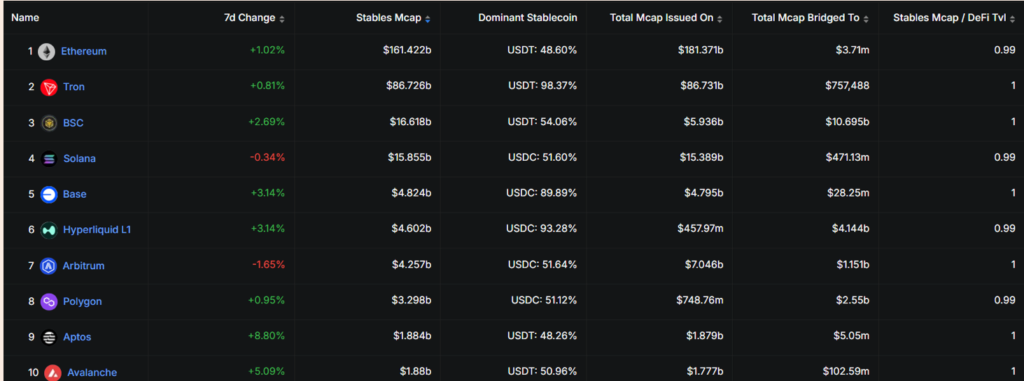
Further below the list, BNB Chain (BNB) holds around $16.6 billion, while Solana (SOL) maintains about $15.8 billion, reflecting growing multi-chain distribution of stablecoin capital. Similarly, emerging networks like Base hold $4.8 billion, while Hyperliquid (HYPE) accounts for around $4.6 billion. This is evidence of rising participation in new settlement layers.
This expansion signals intensifying competition among blockchains. As stablecoin liquidity deepens across ecosystems, chains increasingly compete not just for supply but for transaction velocity, trading activity, and settlement dominance.
At the time of writing, stablecoin activity across blockchains revealed a striking imbalance between supply and usage. BNB Chain processed nearly 40% of global stablecoin transactions. More recently, BNB Chain recorded $21.7 billion in stablecoin transfers within a single day. This milestone marked the highest level over the past year.
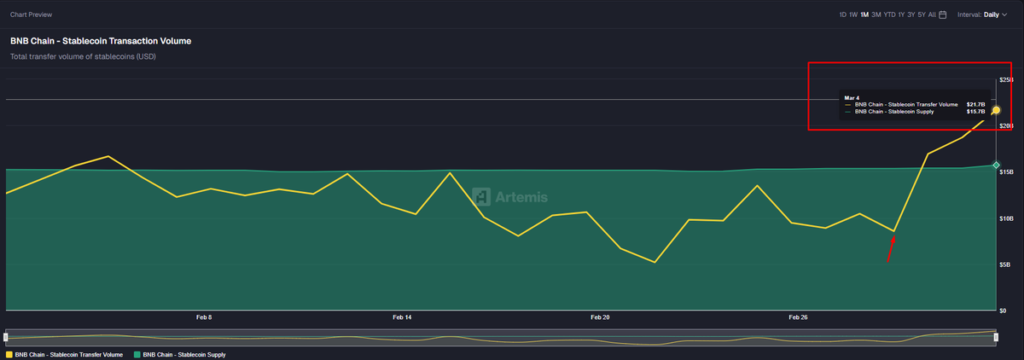
Meanwhile, chains such as Ethereum and TRON hold far larger supply shares. And yet, their transaction share has remained comparatively lower. On the contrary, stablecoins on BNB Chain circulate rapidly rather than remaining idle in wallets or liquidity pools.
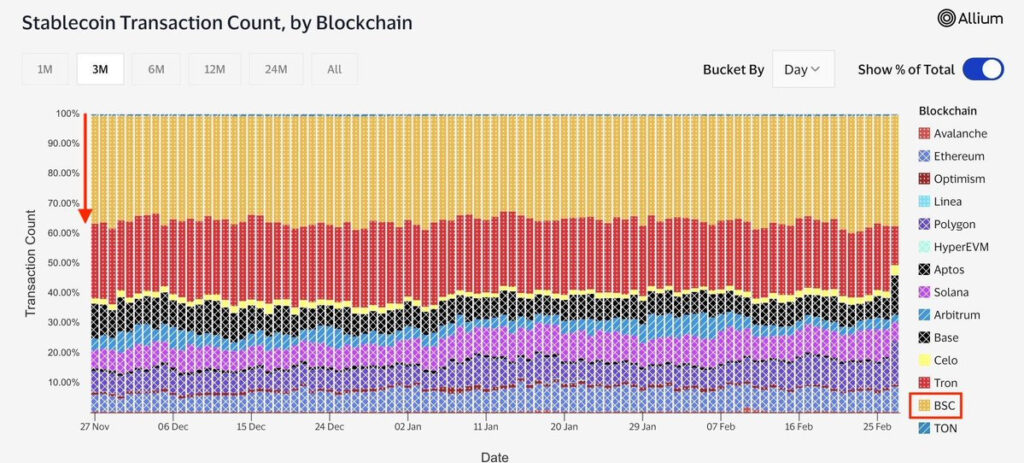
This dynamic becomes clearer through participation metrics. BNB Chain now hosts roughly 25% of the world’s active stablecoin wallets, reflecting strong user engagement across trading and payments.
Stablecoin activity is increasingly concentrated on the BNB Chain, supported by structural advantages that enable rapid transaction flows. Transaction costs have remained very low, too, with $2.11 million in weekly fees costing about $0.02 per transfer. The Fermi upgrade in January enhanced this efficiency by reducing block times to 0.45 seconds.
At the same time, network capacity has been strong. Daily activity averages about 15 million transactions. This throughput allows stablecoin transfers, particularly USDT payments, to move without congestion.
AVAX’s latest buyback and what it means long-term
AVAX has returned to the spotlight after AVAX One repurchased 2.4 million shares under its $40 million share buyback program. According to an update, the move signals confidence in the company’s long-term strategy.
CEO Jolie Kahn described the repurchase as a reflection of disciplined capital deployment. Such moves often strengthen investor sentiment. They also tend to put a spotlight on the broader ecosystem.
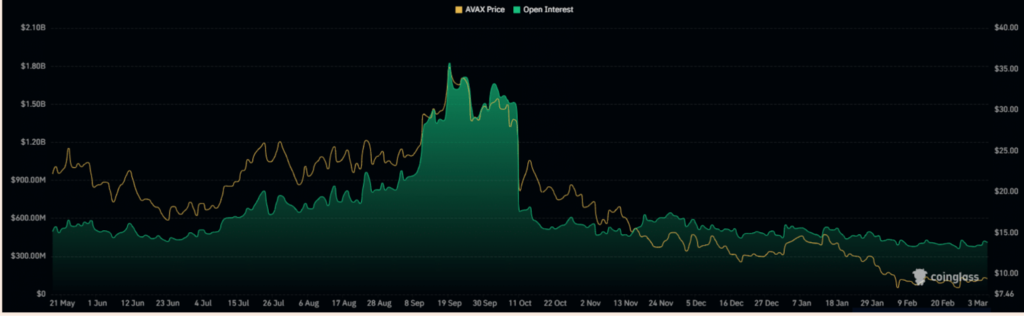
At the time of writing, market data suggested that larger investors have already started positioning themselves. AVAX’s Open Interest has been rising slightly over the past 24 hours. Rising Open Interest often signals new capital entering the derivatives market. This is usually associated with growing institutional participation. Such a signal becomes stronger when combined with whale activity.
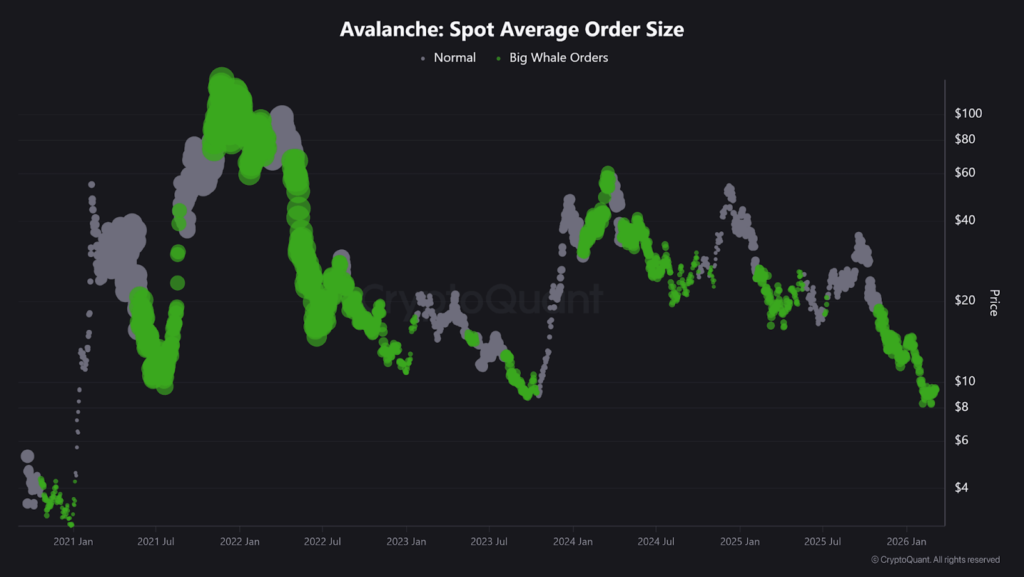
Avalanche network whales are also aligning with surging institutional purchases. According to the Spot Average Order Size data, token whales have been heavily investing on the dip. Large investors are accumulating more orders across both Spot and Futures markets. This type of accumulation usually is evidence of strategic positioning, rather than short-term speculation.
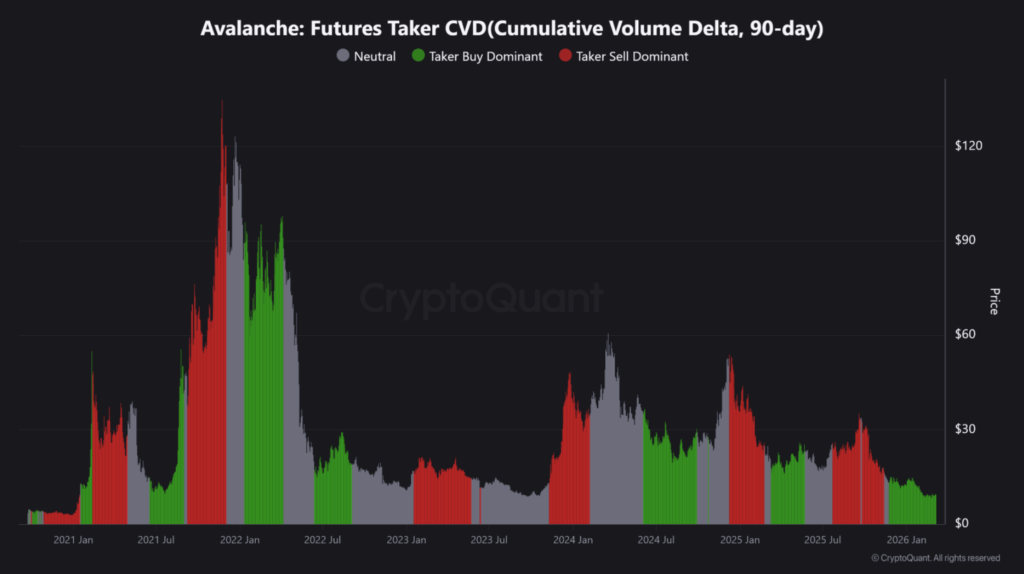
Another shift is happening in the derivatives market. Buyers have started to dominate Futures trading activity. This change in order flow could mean improving market confidence. Historically, when buyers control derivatives markets, rallies often gain stronger support. The same projection could replicate itself on AVAX’s price action.
Tether invests in AI sleep tracking firm at a $1.5B valuation
Stablecoin firm Tether has led a $50 million strategic investment round in sleep technology startup Eight Sleep, to help the company integrate artificial intelligence agents into its sleep tech products.
The latest funding round was announced on Tuesday, with Eight Sleep raising $50 million at a $1.5 billion valuation. It follows a $100 million raise last August. The firm specializes in sleep health products, primarily across bedding and supplements.
In an announcement on Tuesday, Tether expressed its strong conviction in health technology to support “longevity, performance, and disease prevention,” and will collaborate with Eight Sleep to bring artificial intelligence-based health technology products to market.
Tether’s QVAC is a privacy-focused health tech service launched in December that enables users to integrate their bio-health data from multiple services or products, like smart rings, into a single platform, supported by local on-device AI to help users with data management and health insights.
Eight Sleep has stated that it plans to build a sleep-focused AI agent to support its Pod, a sleep tech product that automatically adjusts bed temperature, elevation, and sound based on factors such as heart rate, breathing, snoring, time asleep, and sleep stages.
The Pod already has AI integrations to track sleep health data; however, Eight Sleep has said the funding will help evolve the company’s current AI tools and capabilities. CEO and co-founder of Eight Sleep, Matteo Franceschetti, noted as part of Tether’s announcement,
“We’ve built the most smooth AI-powered health sensing system in the world, and this partnership with Tether gives us the infrastructure to take that intelligence beyond the Pod, into every aspect of personal health”,
On X, Franceschetti provided more detail, saying that Eight Sleep is now building a predictive agent trained on over 1 billion hours of sleep data; meanwhile, it is also “advancing FDA filings for sleep apnea detection.”
Michael B. Jordan leads on Polymarket for the Oscars’ Best Actor
Actor Michael B. Jordan overtook Timothee Chalamet on prediction market platform Polymarket as most likely to win “Best Actor” at the 2026 Oscars awards show, with his odds rising by over 4x since March 1.
Last week, the “Sinners” star won the best actor award at the Actor Awards, formerly known as the Screen Actors Guild Awards, or SAG.

A week out from the Academy Awards, Polymarket traders place Jordan’s odds of winning the award at about 47%, while Chalamet is a close second at 45%, Leonardo DiCaprio is at 5%, Wagner Moura has 4% odds, and Ethan Hawke has only 1% odds.
Jordan was nominated for an Oscar for his role as twin brothers Smoke and Stack Moore in the 2025 vampire horror film, Sinners. Chalamet was nominated for his role in “Marty Supreme,” a fictional drama film about a table tennis player. Chalamet was in the lead till Saturday.
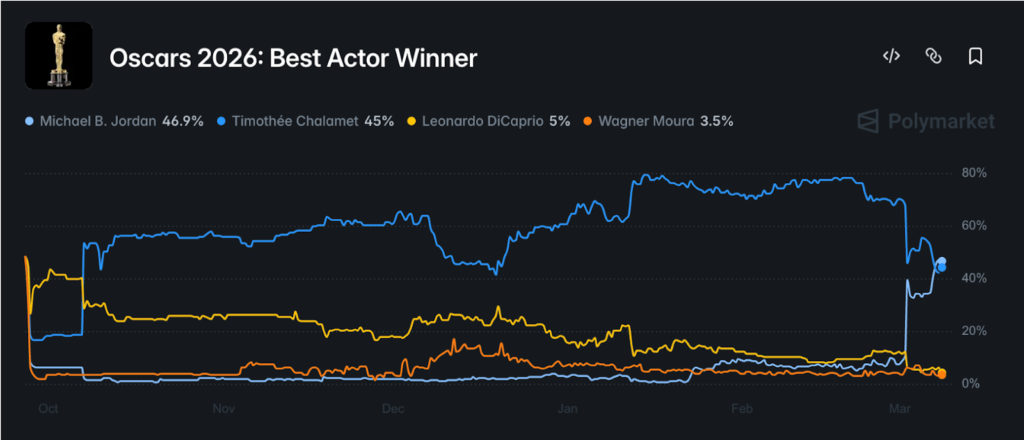
The Academy of Motion Picture Arts and Sciences awards show will air on March 15, and the prediction market for Oscars’ Best Actor has over $5.6 million in trading volume on Polymarket at the time of writing.
Prediction market platforms came to the fore during the 2024 US elections and continue to gain momentum, with crypto exchanges integrating prediction markets into their platforms and traditional financial companies also eyeing prediction market-style products.
Polymarket opened up its application for select, waitlisted US users in December 2025, with a full rollout of a US-regulated platform expected later in 2026. However, prediction market platforms continue to face scrutiny from some state-level regulators in the United States, who argue that they have the authority to regulate event contracts.
Solana transfers $650B in stablecoins
Stablecoin transaction flows have expanded rapidly across major blockchains, reflecting growing demand for digital dollar settlement. As adoption expanded, activity accelerated through late 2024 and early 2025. Combined monthly volumes regularly approached $700 billion, led primarily by Ethereum (ETH) and Tron (TRX).
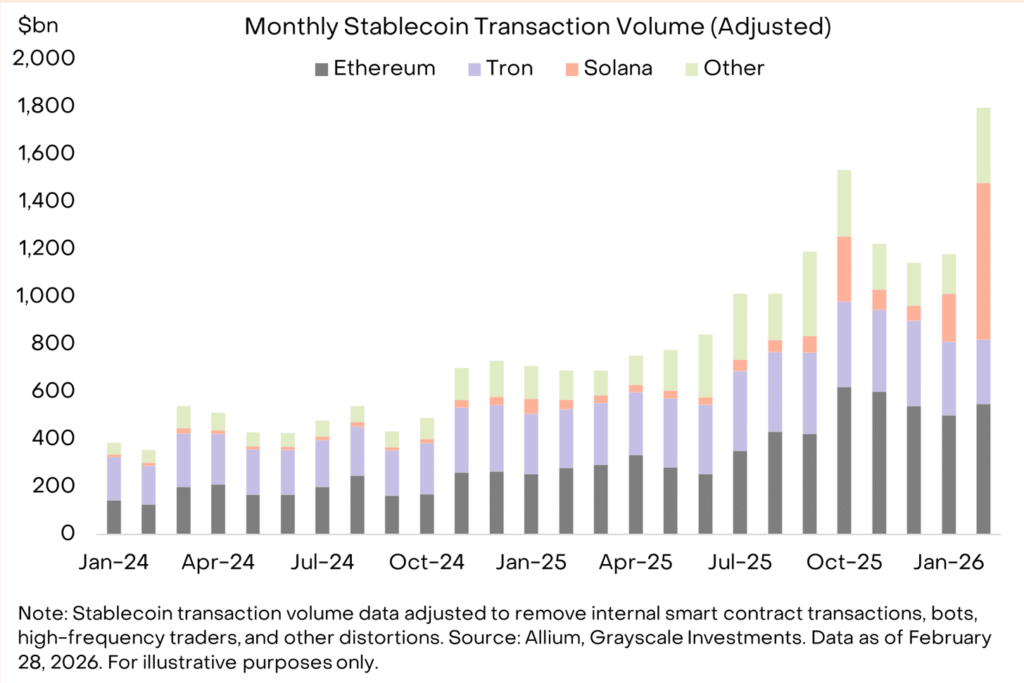
However, the structure began shifting during 2025 as Solana’s (SOL) settlement activity increased steadily. Low fees and high throughput encouraged payment flows and trading pairs to migrate toward faster rails.
The trend culminated in February, when Solana processed roughly $650 billion in stablecoin transactions, surpassing competing networks. Together, rising settlement volumes suggest stablecoins are increasingly functioning as operational payment infrastructure rather than purely trading liquidity.
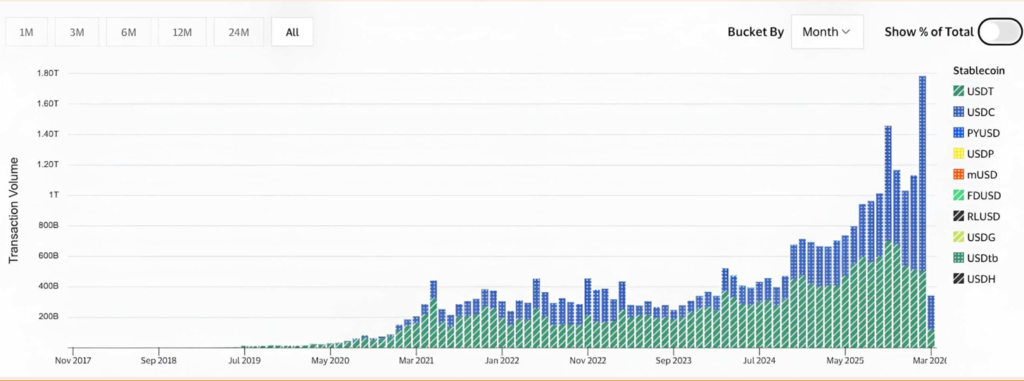
This shift appears clearly in transaction flows. During early 2024, adjusted stablecoin transfers ranged between $300 billion and $500 billion monthly. As financial use cases expanded, activity accelerated through 2025, frequently approaching $1 trillion per month.
By February, global stablecoin volume reached roughly $1.8 trillion, signaling deeper financial integration. Several forces drive this expansion. Exchanges increasingly route liquidity through USDC and USDT pairs, while DeFi protocols rely on stablecoins for collateral and settlement.
Meanwhile, institutional infrastructure reinforces these flows. Visa expanded USDC settlement to U.S. banks, allowing regulated institutions to process blockchain-based dollar transfers. For markets and participants, this implies stablecoins are becoming the default monetary layer for digital finance, shaping liquidity flows, trading structure, and cross-platform capital movement.
February’s stablecoin transfer volume marked a sharp acceleration in on-chain dollar settlement. The surge doubled prior monthly records, raising questions about durability once market conditions normalize.
Early indicators, however, suggest activity remains resilient. Stablecoin supply on Solana has reached roughly $15.4 billion, rising more than 12% over the past month. At the same time, USEC maintained about 53% market dominance, supporting stable liquidity across payments, trading pairs, and treasury transfers.
Wallet participation also continues expanding. Global stablecoin addresses now approach 49.6 million, reflecting sustained engagement across digital dollar transactions. If post-peak volumes stabilize near 70-80% of February’s surge, the data increasingly points toward stablecoins evolving into a durable payment infrastructure rather than episodic market activity.
Zypto integrates KuCoin Pay across its ecosystem
Zypto has announced the full integration of KuCoin Pay across its product ecosystem, allowing users of the crypto exchange KuCoin to access Zypto’s payment services directly from their exchange balances.
Under the integration, KuCoin users can now use KuCoin Pay as a native payment option inside the Zypto App, enabling them to fund and spend crypto through Zypto’s various services without first transferring funds to an external wallet.
The partnership connects KuCoin’s trading infrastructure with Zypto’s payments ecosystem, allowing exchange balances to be used for everyday financial activities such as bill payments, gift card purchases, and mobile top-ups.
With the integration live, KuCoin Pay can now be used across Zypto’s core products. These include the ability to load Zypto’s crypto-linked Visa and Mastercard payment cards, which convert crypto into local currency when the card is funded.
Users can also pay bills through the platform, covering services such as utilities, credit cards, insurance, and loans. In addition, the app enables purchases from Zypto’s digital gift card marketplace and global mobile airtime and data top-ups.
The integration also extends to Zypto’s USDC-to-cash services, allowing users to convert stablecoins into physical cash or vice versa in Zypto App at participating MoneyGram locations.
Joe Parkin, co-founder of Zypto, said the integration provides users with easier access to practical financial services. He said,
“Integrating KuCoin Pay helps users by giving them easy access to a wide range of practical services they can use in everyday life”
Zypto positions its mobile application as a self-custodial, multichain crypto wallet that combines Web3 functionality with payment services, supporting more than 24,000 digital assets across over 20 blockchains.
By embedding KuCoin Pay directly into Zypto App, the companies aim to make it easier for crypto users to move from trading and holding assets to spending them on everyday services.
Find out more here.
Closing remark
Conditions like network capacity, block time, and transaction cost position BNB Chain as a high-throughput transactional layer. All while other networks increasingly function as stablecoin storage or liquidity reserves within the broader crypto settlement infrastructure.
For now, the market remains in a transition phase. However, rising Open Interest, whale accumulation, and growing buyer dominance could allude to possible bullish continuation for AVAX.
Tether has been using its capital stockpile to invest in a wide range of areas outside crypto. Its investments span the gold sector, media, biotechnology, and AI. The firm has also made multiple attempts to buy professional football clubs.
The surge in stablecoin settlement provides critical context for the transaction growth observed across blockchain networks. Over the past two years, stablecoins have evolved from trading instruments into operational liquidity for payments, trading, and treasury management. Solana has been one of the dominant networks spearheading this.
Zypto said the partnership with KuCoin is designed to close the gap between holding cryptocurrencies on exchanges and using them in everyday transactions.
What do you think about this week’s developments? Let us know your thoughts!
FAQs
How did BNB Chain outpace its stablecoin rivals?
BNB Chain recorded $21.7 billion in stablecoin transfers within a single day, which marked the highest level over the past year.
What happened with AVAX?
AVAX One repurchased 2.4 million shares under its $40 million share buyback program.
What did Tether invest in?
Tether invested $50 million in sleep technology startup Eight Sleep to help integrate artificial intelligence agents into its sleep tech products
Who leads on Polymarket for the Oscars’ Best Actor?
Michael B. Jordan, nominated for his role in Sinners, leads by about 47% at the time of writing.
How much did Solana process in February?
Solana processed roughly $650 billion in stablecoin transactions in February, surpassing its competitors.