Welcome to September’s first crypto news report.
Speculation is rife regarding a billion-dollar Solana reserve, stablecoin inflows are influencing layer-1 chains, and Sony launch a new blockchain feature. The Bitcoin and Ripple whales are at it again, while Tron records network activity.
Let’s dive in?
Is there an upcoming billion-dollar Solana reserve?
A recent Bloomberg report noted that three major crypto companies are looking to raise $1 billion to build the largest-ever Solana treasury. They include Galaxy Digital, Multicoin Capital, and Jump Crypto.
These top firms are backing a massive Solana treasury plan that could dwarf all existing reserves. A bold move, the project could turn SOL into a serious asset for institutional portfolios. If successful, the $1 billion reserve would eclipse existing corporate SOL treasuries by a wide margin.
The largest holder today is Upexi (a supply chain management brand), which recently disclosed owning over 2 million SOL (worth about $400 million). The next is DeFi Development Corporation, which follows with 1.29 million SOL (roughly $240 million). Then, BTC miner Bit Mining has shifted to Solana, announcing plans to raise $300 million for its own reserve.
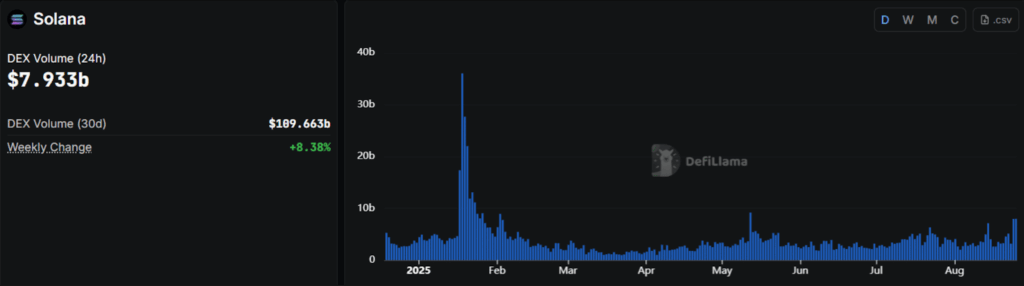
Compared to these, this push would more than double the size of Upexi’s stash, creating an unmatched corporate Solana reserve. Solana’s market strength adds context to this: the sixth-largest cryptocurrency by market cap, trading close to $200, and a daily DEX volume of $7.93 billion.
The firms are said to be planning to take over a publicly traded entity to establish a digital asset treasury company focused solely on Solana. Furthermore, the effort has the support of the Solana Foundation, so it could bring great credibility to Solana as a treasury asset.
This is significant for multiple reasons.
First, it would cement Solana’s position as a serious contender in the corporate treasury space. Secondly, it builds momentum for Solana’s recovery after the FTX collapse, which had weighed heavily on the ecosystem.
Ultimately, having prominent names involved proves to both traditional finance (TradFi) and crypto-native investors that Solana is here to stay.
Stablecoin inflows are influencing the L1 price race
Stablecoin supply has more than doubled in less than two years. Since January 2024, the circulating supply has increased from $130 billion to $270 billion.
Some of the reasons behind this include a landmark bill, major market share grabs, and domestic launches pegged to local currencies.
The top four issuers now control 96% of the market. They include Tether (USDT) which leads the pack, Circle (USDC), Ethena (ENA) and Sky (SKY).
Stablecoin supply has surged across blockchains since 2018, driving a clear divergence in layer-1 chains (L1) dominance. Now, the narrative is shifting: L1s are racing to capture these stablecoin flows. Consequently, could this be the driver behind the recent L1 price divergences?
Notably, Ethereum (ETH) and Tron (TRX) lead the pack, together controlling 90% of total supply, while Solana (SOL) has crossed the $10 billion threshold, securing the third spot in stablecoin adoption.
Meanwhile, smaller chains and Layer-2s like BNB Chain, Avalanche, Arbitrum One, Base, and zkSync Era are scaling steadily, gradually capturing incremental stablecoin flows.
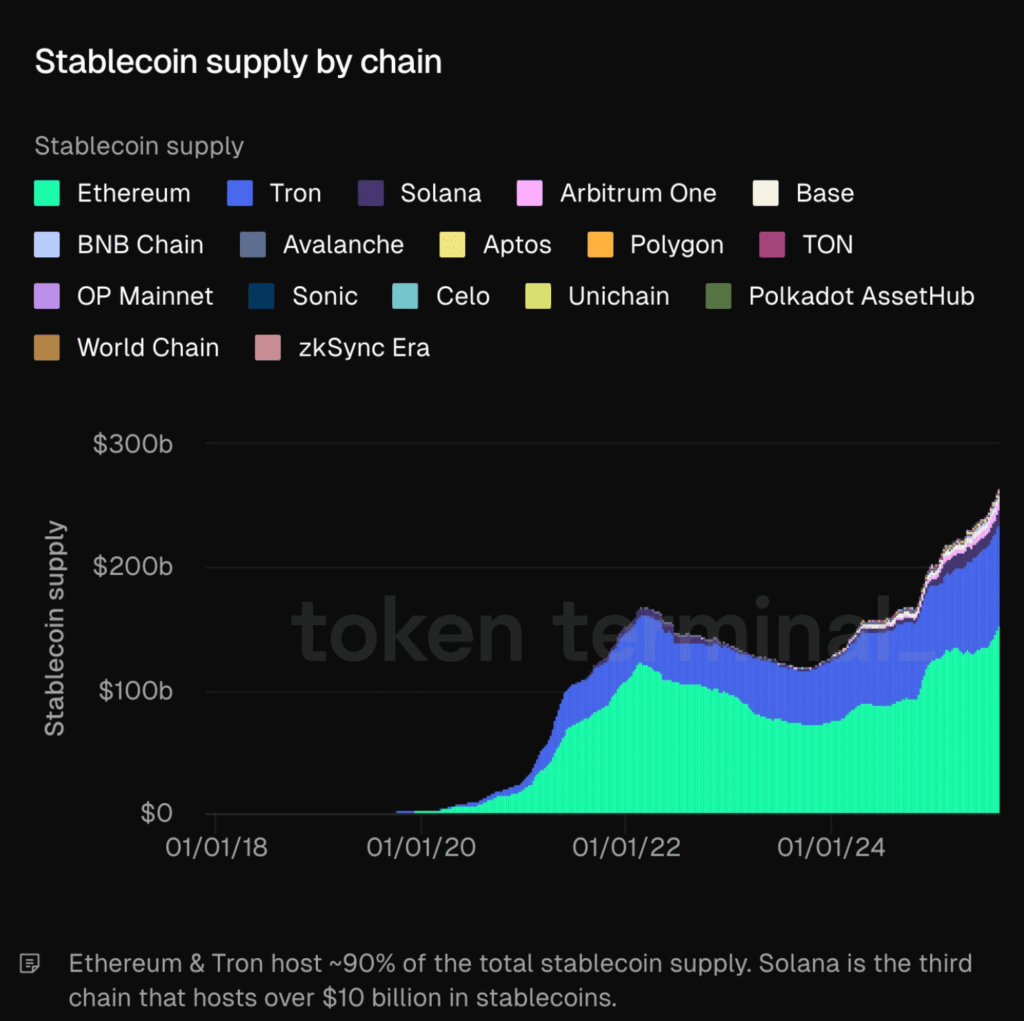
All in all, L1s are clearly competing for stablecoin capital. This widening L1 stablecoin gap is shaping how money flows, and ultimately, influencing price discovery. Higher market share means more liquidity staying on-network, fueling DeFi activity, staking flows, and transaction demand, which can push prices higher as bid-side pressure accumulates.
On-chain, stablecoin dominance is clearly aligning with technicals.
Tron (TRX), for example, has absorbed nearly $20 billion in stablecoins this year, pushing total supply to a record $82 billion. It is up almost 80% to $0.36. By contrast, Solana (SOL) has added roughly $8 billion in network stablecoins, but is still down 2% from its $213 yearly opening.
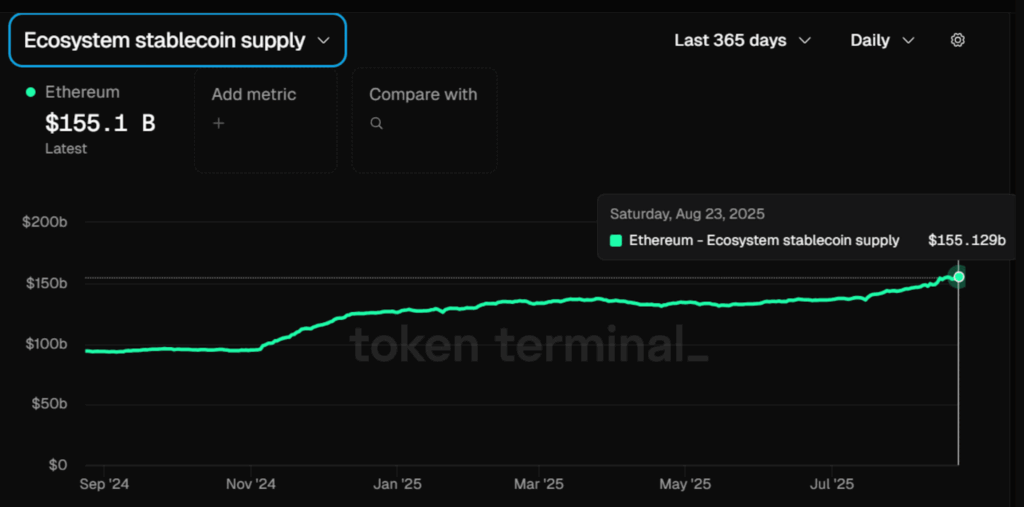
Ether (ETH), meanwhile, is outperforming the rest. As the chart shows, the network has onboarded nearly $30 billion in stablecoins.
This divergence shows stablecoin inflows translating unevenly into price action.
Sony launches new blockchain scoring system
Soneium, Sony’s blockchain venture, has launched an innovative scoring system. The platform rewards authentic blockchain ecosystem contributions while solving Web3 engagement challenges.
The newly launched Soneium Score transforms blockchain engagement by using advanced algorithms to evaluate real contributions across the ecosystem. It moves beyond simple token-based reward models that have dominated the space.
A comprehensive activity tracking system, the mechanism tackles two major Web3 problems. First, it addresses the lack of consistent user evaluation methods. Second, it helps projects maintain long-term community engagement.
Also, it transforms how networks measure and reward user participation. It precisely tracks verifiable on-chain activities: users earn points for asset swaps, staking protocols, and NFT transactions. Furthermore, it rewards liquidity provision across decentralized exchanges. This creates a complete view of user participation that goes beyond transaction volumes.
Sony Block Solutions Labs (SBSL) developed this Ethereum Layer 2 network before the joint venture between Sony Group and Startale Labs completed extensive testing. Over 14 million wallets participated before the January 2025 mainnet launch.
Strategic partnerships with Uniswap and AAVE position the system within the broader DeFi ecosystem, reducing developers’ adoption barriers while enhancing decentralized application utility.
Season one promises integration with various DeFi, gaming, and NFT projects. The system issues non-transferable Soulbound Token (SBT) badges based on contribution levels.
Bitcoin whale makes a $3.8B bet on Ethereum
A major Bitcoin whale has accumulated $3.8 billion in Ethereum. The legendary “Bitcoin OG” who began shifting its $11.4 billion trove into Ethereum in August showed no signs of slowing down over the weekend.
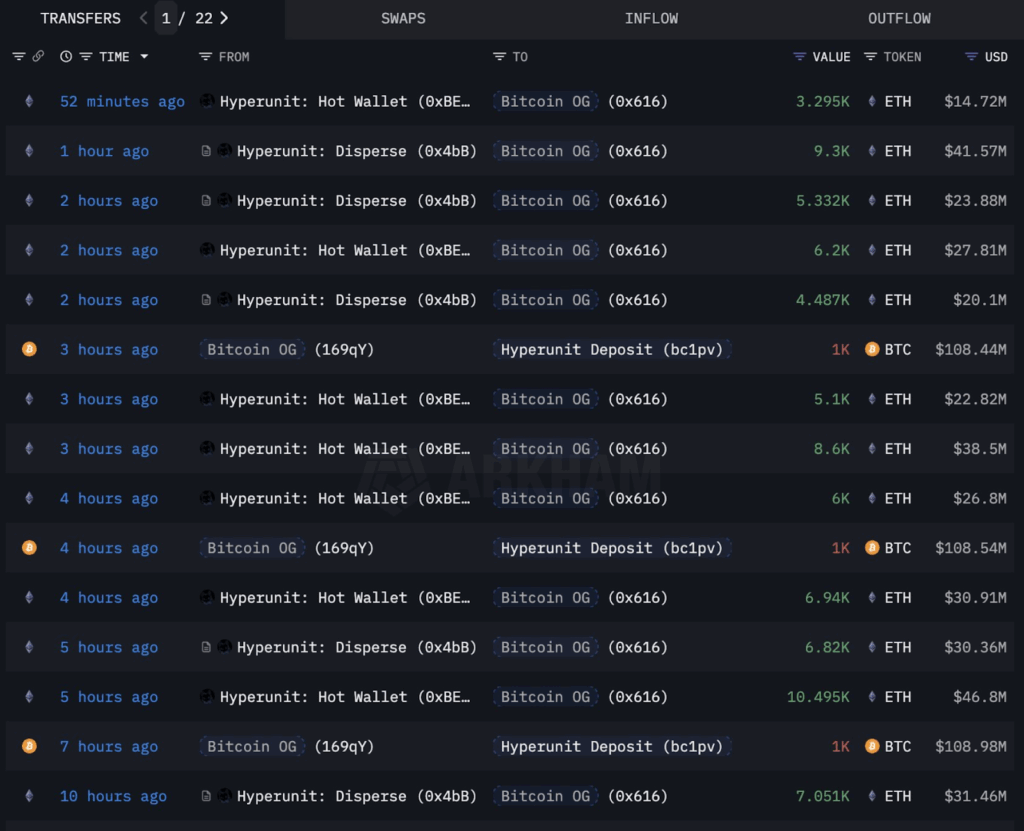
On-chain data revealed the whale sold 4,000 BTC worth roughly $435 million, for 96,859 ETH in just 12 hours. The move pushed the whale’s Ether stash to $3.8 billion, making it one of the largest individual ETH holders in the market.
Adding to the momentum, the whale funneled another 1,000 BTC into decentralized exchange Hyperliquid (HYPE) on the 1st of September, so more Ether purchases could be in play.
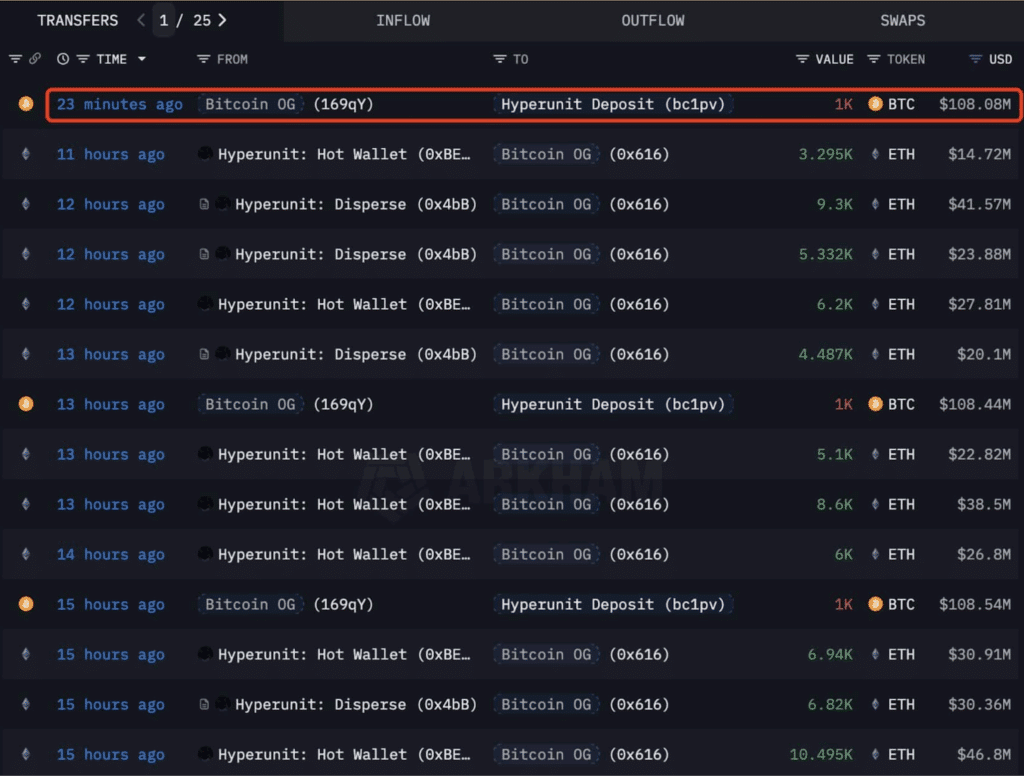
This isn’t the only big move. Nine other whale addresses snapped up $456.8 million worth of ETH through BitGo and Galaxy Digital OTC.
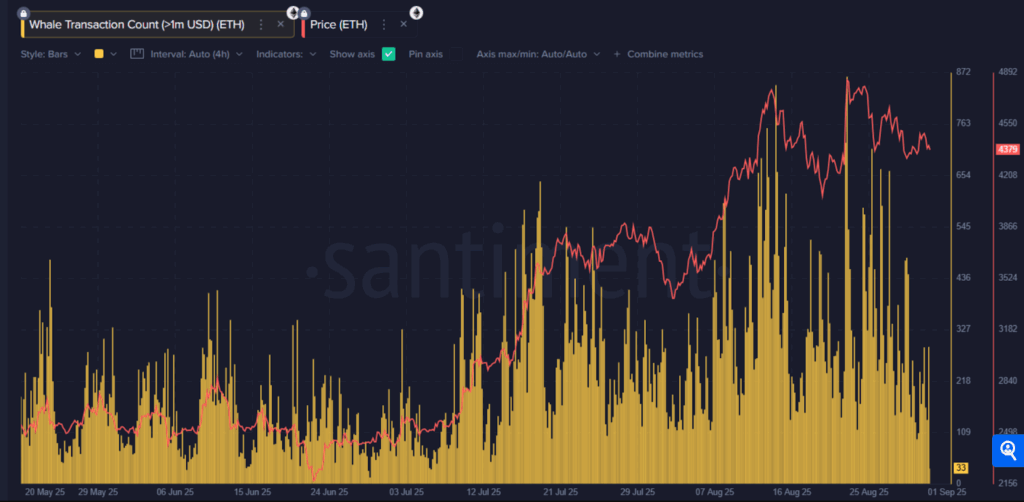
Whale transaction counts for transfers over $1 million spiked through August, coinciding with ETH’s climb above $4,300. Big players have been actively repositioning, adding momentum.
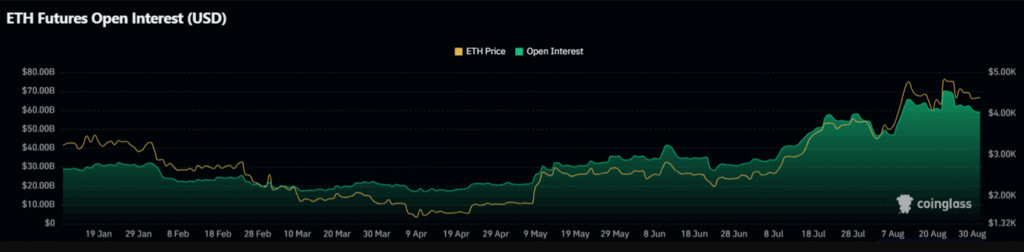
At the same time, ETH’s Futures Open Interest surged past $70 billion before settling near $60 billion. Spot derivatives markets are aligning behind Ethereum, with whales providing liquidity on one end and traders increasing exposure on the other.
This is the type of move that reshapes sentiment, raising doubts about what it might mean for Ethereum’s (ETH) next chapter.
And with market signals flashing green, the timing couldn’t be more interesting.
Tron reaches 2.5 million active addresses
At the time of writing, the Tron blockchain recorded approximately 2.5 million active addresses over the past 24 hours. This gives it a lead over other major networks like BNB Smart Chain (2.4 million) and Solana (2.2 million).
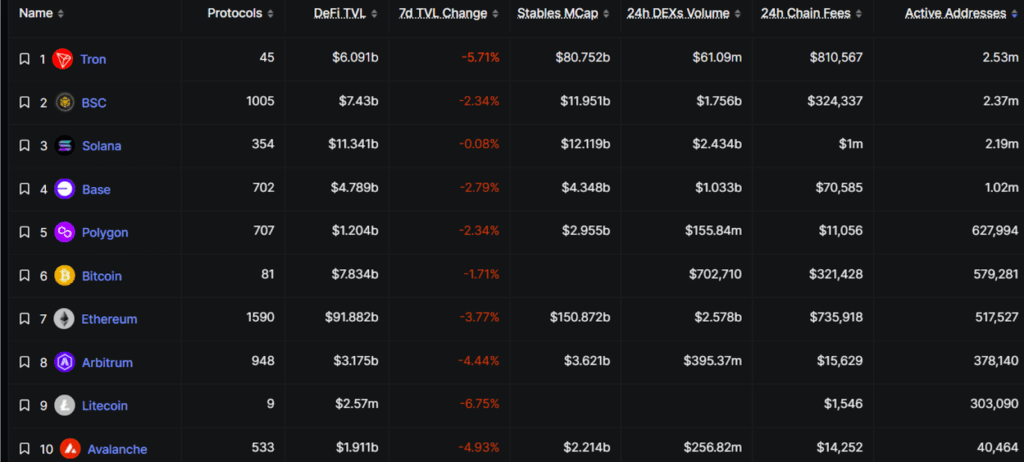
The surge in bullish sentiment can be traced to two main reasons.
First, it follows Tron’s decision to cut network fees by 60% last Friday after a community vote, as announced by founder Justin Sun. It is a response to rising transaction costs over the past year that had limited participation, particularly in stablecoin transfers, where Tron dominates with Tether’s USDT.
Sun emphasized that lower fees may reduce revenue in the short term but noted that the change would stimulate adoption and transaction growth, ultimately strengthening the network’s long-term profitability and competitive edge.
He had revealed earlier this year that his team was developing a zero-fee transaction framework for stablecoins in a bid to enhance stablecoin adoption. This makes sense as the chain is massively used in the transfer of stablecoins, especially USDT ($70 billion) and ETH ($30 billion).
Secondly, the bullish sentiment came after the US Department of Commerce announced Tron as one of the nine blockchains chosen to record the release of the country’s Q2 2025 Gross Domestic Product (GDP) data.
This recognition strengthens Tron’s global reach and credibility as an enterprise-ready network capable of hosting vital data. After the announcement, Tron had an increase in market activity, as its 24-hour trading volume jumped 40% to reach $687 million.
Whales scoop $962M XRP
During the recent price drop, some investors accumulated XRP, likely preparing for a rally. Santiment data showed that during the two-week downturn, whales purchased 340 million XRP worth $962 million at $2.83.
This large-scale accumulation suggested whales viewed the market decline as an opportunity to buy in bulk. Spot investors also joined in. Data from CoinGlass’ Spot Exchange Netflow showed that $268 million worth of XRP was withdrawn from exchanges over the past ten days.
Such accumulation often provides support for an asset to push higher, fueling potential rallies. If renewed liquidity flows into the broader crypto market, XRP could benefit from this momentum.
Whales aren’t the only ones investing in Ripple, institutional investors remain keen. None more than the Japanese gaming and blockchain firm Gumi, which bet $17M on XRP.
On August 29, the Tokyo-listed firm announced board approval for a $17 million investment in Ripple. It showed that Japanese corporations remain keen on both Bitcoin and altcoins despite shifting global investor sentiment.
The investment is scheduled for September 2025 through February 2026. Also, according to reports, the company clarified that this move goes beyond speculative motives and reflects a deliberate strategy to secure a foothold in the XRP ecosystem.
The firm emphasized that while Ethereum dominated global headlines as institutions and individual investors piled in, its own decision to prioritize XRP stemmed from alignment with its largest shareholder, SBI Holdings.
SBI has been a long-time backer of Ripple, the issuer of XRP, and is actively promoting the token’s use in cross-border payments and liquidity solutions. By adopting XRP, Gumi aims to leverage this strategic synergy and position itself in an ecosystem where utility and adoption in financial services are rapidly growing.
From payments to white label: Zypto keeps B2B crypto-ready
Zypto continues to push forward in the B2B sector with its established suite of crypto business solutions.
From on-chain payment gateways with stablecoin conversion to white-label wallets and cards, the platform equips companies with the infrastructure to integrate digital assets directly into their operations.
As enterprises look to capture new efficiencies and tap into Web3 markets, Zypto’s offerings remain part of the growing toolkit shaping crypto adoption at scale.
Find out more here.
Closing remark
If the proposed treasury goes through, Solana could become a benchmark for how companies treat blockchain tokens as long-term strategic assets. Then, with 90% of supply concentrated in two networks (Ethereum and Tron), the L1s dominating liquidity are clearly driving the biggest price moves.
The Soneium score evaluates daily activity consistency, liquidity contributions, NFT holdings, and partner project bonuses. It sounds like a promising development for the industry.
For traders and investors, Tron’s network activity and the government reports serve as both a headline-driven catalyst and a potential long-term validation of Tron’s role in institutional adoption.
For Gumi, its latest initiative represents a medium-to-long-term growth vision, with XRP acting as a vital asset in the company’s evolving digital finance strategy.
Finally, Zypto’s crypto business stack continues to offer a practical, high-performance path for companies looking to turn digital assets into real-world utility.
There’s so much information to unpack here! So, let’s do it together in the comments section.

FAQs
What are the firms that want to build a Solana treasury?
The firms are Galaxy Digital, Multicoin Capital, and Jump Crypto.
Which milestone did stablecoins cross?
Since January 2024, stablecoins’ circulating supply has increased from $130 billion to $270 billion.
What is the Soneium Score about?
The Soneium Score transforms blockchain engagement by using advanced algorithms to evaluate real contributions across the ecosystem.
How much worth of ETH did the Bitcoin whale invest?
A major Bitcoin whale accumulated $3.8 billion in Ethereum over the weekend.
Which milestone did Tron achieve?
Tron recorded 2.5 million active addresses on its blockchain.