Hi there, frens. It’s been a high impact week across crypto, marked by major launches, bold partnerships and capital flowing fast through the markets.
Dash integrates Zcash Orchard privacy tool, Bitcoin miner buys stake in AI data center firm, and ZachXBT’s mysterious post sparks $2 million Polymarket bets. Vitalik Buterin proposes AI ‘stewards’ for DAOs, PUNCH meme coin surges but faces scrutiny, and Zypto launches native CCIP integration and announces a strategic partnership with KuCoin.
Let’s dive in.
Dash integrates Zcash Orchard privacy pool
Dash, the layer-1 blockchain protocol with privacy-preserving features, announced last week the integration of Zcash’s “Orchard” shielded pool into the Dash Evolution chain, a secondary layer on the L1 network that supports smart contract functionality.
The integration will go live following the completion of cybersecurity audits and is expected to launch in March. Initially, the integration will support basic transfers of Zcash between parties on the Evolution chain, with subsequent upgrades adding Orchard’s privacy features for tokenized real-world assets (RWAs).
The price of DASH, the network’s native token, surged by over 125% in January. Dash briefly reached a local high of about $96 before retracing to current levels of $31.69 at the time of writing.
On-chain privacy protocols and privacy blockchain tokens gained significant momentum in 2025 and early 2026, with proponents of the technology framing it as a response to increased financial surveillance from governments and corporations.
Many crypto insiders have claimed that the lack of privacy is holding back crypto payments and may be the missing link for crypto adoption.
Avidan Abitbol, former business development specialist for the Kaspa project, said that transaction data could also reveal information about key partnerships and other trade secrets to competitors.
Agata Ferreria, assistant professor at the Warsaw University of Technology, argues that true financial privacy is achieved through a combination of regulation, culture, and code, rather than simply protecting on-chain metadata.
However, a Bitcoin advocate, Saifedean Ammous, affirmed that user anonymity can still be breached, and ownership of privacy tokens can be determined through forensic analysis and law enforcement investigation..
Bitcoin miner buys stake in AI data center firm
Bitcoin miner MARA Holdings has completed the purchase of a majority stake in French computing infrastructure operator Exaion, deepening its push into artificial intelligence (AI) and cloud services.
The deal, first agreed in August 2025 with EDF Pulse Ventures, gives MARA France a 64% stake in Exaion after required regulatory approvals were secured, the Bitcoin miner said in a Friday announcement.
French energy giant EDF will remain a minority shareholder and continue as a customer of the business. The investment also creates a broader alliance. NJJ Capital, the investment vehicle of telecom entrepreneur Xaviel Niel, will acquire a 10% stake in MARA France as part of a partnership with MARA.
Governance of Exaion will reflect the new ownership structure. The company’s board will include three representatives from MARA, three from EDF Pulse Ventures, and one from NJJ, alongside Exaion’s chief executive and co-founder. Niel and MARA CEO Fred Thiel will both hold seats on the board.
After the 2024 halving cut block rewards and rising network difficulty squeezed margins, several publicly traded miners began adopting a hybrid model, keeping mining as a source of cash flow while building steadier revenue from AI cloud and high-performance computing services.
HIVE Digital Technologies is one example of the shift. The company reported strong results even during weaker Bitcoin prices, supported by expanding AI operations. CoreWeave has also moved from crypto mining to become a major AI infrastructure provider after GPU mining demand fell.
Other firms, including TeraWulf, Hut 8, IREN, and MARA, are also repurposing mining facilities and energy capacity into AI data centers.
Meanwhile, Bitcoin’s mining difficulty rose about 15% to $144.4 trillion over the weekend. It reversed an 11% drop earlier in the month, the biggest decline since China’s 2021 mining ban. The earlier fall followed severe winter storms across the United States that disrupted power grids and temporarily forced many miners offline, sharply reducing the hash rate.
While the greater difficulty reinforces Bitcoin’s security, it also raises the computing effort needed to mine new blocks, adding further margin pressure on operators already dealing with rising costs.
ZachXBT’s mysterious post sparks $2 million Polymarket bets
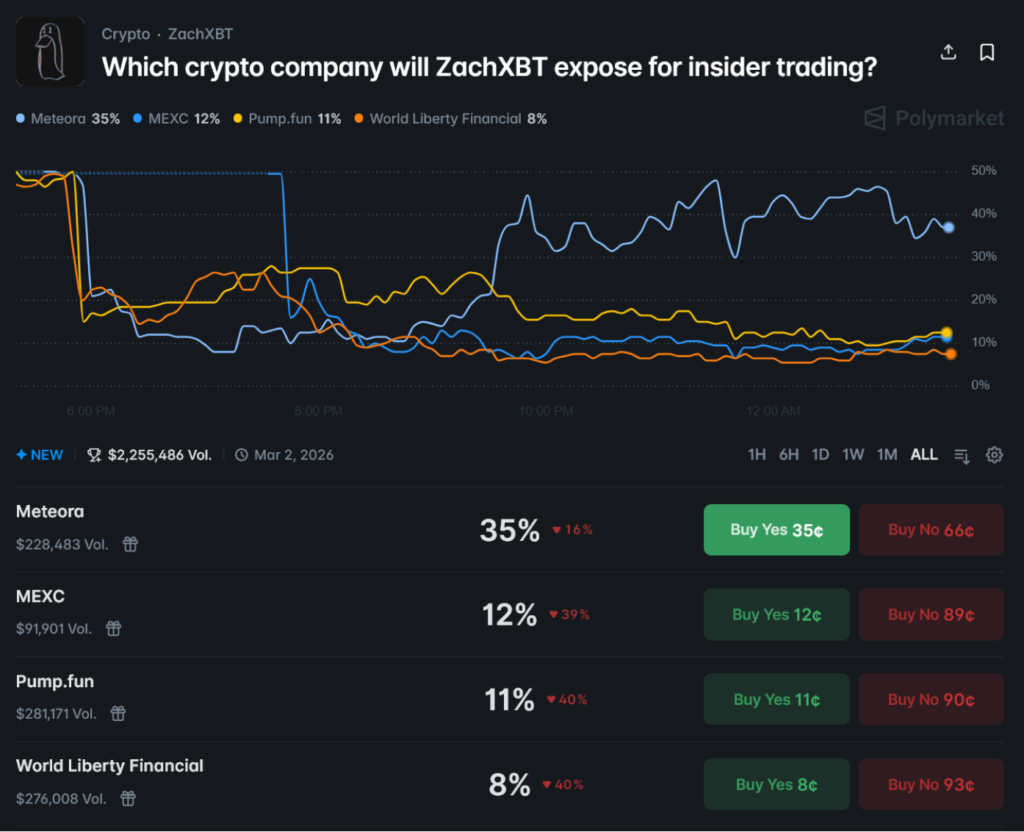
A cryptic post from blockchain investigator ZachXBT triggered a surge of betting activity on Polymarket, with more than $2.2 million traded on a market asking which crypto company he will expose in an upcoming insider-trading investigation.
ZachXBT wrote on X that a “major investigation” will be released on February 26 into one of crypto’s most profitable businesses, alleging insider trading. He did not name the company.
Within hours, traders piled into prediction bets. Polymarket shows Meteora leading the odds, followed by MEXC and Pump. fun, and World Liberty Financial (WLFI).
Meteora has drawn heavy attention because of its role as a Solana-based trading infrastructure tied to high-volume meme coin liquidity. It has also faced scrutiny in community discussions around politically linked meme coin activity, including Trump-related tokens.
MEXC appears on the list because it has repeatedly been mentioned in social media debates around listing behavior, whale activity, and alleged insider-style trading patterns in meme coin markets. While that does not prove wrongdoing, it helps explain why bettors quickly priced it as a candidate.
Pump.fun also drew bets because it sits at the center of the meme coin launch economy. The platform has been under intense community scrutiny over early-wallet activity, sniping, and whether some participants gained unfair advantages during launches.
Recent online discussion has focused on claims that Hayden Davis may have been an early whale in the PUMP token launch. However, Pump.fun later refuted those claims, calling them baseless. Those claims remain part of broader market speculation unless backed by direct evidence or formal findings.
WLFI likely entered the betting conversation after USD1 briefly depegged earlier on February 23 before recovering. WLFI blamed a coordinated attack, saying hackers compromised cofounder accounts, spread fear, and opened short positions. That episode, plus fresh rumor cycles, appears to have pushed the company onto traders’ radar.
Vitalik Buterin proposes AI ‘stewards’ for DAOs
Ethereum co-founder Vitalik Buterin proposed a technical overhaul of decentralized autonomous organizations (DAOs), calling for the use of personal artificial intelligence (AI) agents to privately cast votes on behalf of users and help scale digital governance.
The plan, published on social media platform X one month after Buterin criticized DAOs for drifting into low participation and power centralization, aims to shift users away from delegating votes to large token holders.
“There are many thousands of decisions to make, involving many domains of expertise, and most people don’t have the time or skill to be experts in even one, let alone all of them,” Buterin said. “So what can we do? We use personal LLMs to solve the attention problem.”
First is privacy of content, ensuring sensitive data remains confidential. AI agents would operate within secure environments such as multi-party computation (MPC) or trusted execution environments (TEEs), enabling them to process private data without leaking it to the public blockchain.
Second is the anonymity of the participant. Buterin called for the use of zero-knowledge proofs (ZKPs), a cryptographic tool that allows users to prove they’re eligible to vote without revealing their wallet address or how they voted.
This guards against coercion, bribery, and whale watching, where smaller voters mimic the decisions of larger token holders. These AI stewards would automate routine governance participation and flag only important issues for human review.
To filter out low-quality or spammy proposals, an emerging problem as generative AI floods open forums, Buterin suggests launching prediction markets. In these, agents could bet on the likelihood that proposals would be accepted. Good bets would earn payouts, incentivizing valuable contributions while penalizing noise.
Buterin also called for privacy-preserving tools such as multi-party computation and trusted execution environments, enabling AI agents to assess sensitive data, such as job applications or legal disputes, without exposing it on a public blockchain.

PUNCH meme coin surges but faces scrutiny
$PUNCH is a Solana-based meme coin that has captured the crypto world’s attention with an 80% price surge after securing a listing on a crypto exchange. This meteoric rise, which included a 22,290.8% increase in a week and a 260% increase in a day, propelled its market capitalization past $30 million over the weekend.
The token’s success is deeply rooted in a viral emotional narrative, a common factor in the meme coin space. The inspiration behind PUNCH comes from the heartwarming yet distressing story of a Japanese macaque monkey called Punch. Rescued from illegal wildlife trafficking, the monkey gained global sympathy after images and videos showed him clinging to a small orangutan doll, his inseparable comfort companion.
Beyond the compelling backstory, several structural factors fueled PUNCH’s parabolic ascent.
The token, launched on the Solana network, benefits from the chain’s low fees and high transaction speeds, which enable rapid trading and liquidity formation. Its website claims a fixed supply of 1 billion tokens, 0% transaction tax, locked and burned liquidity, and renounced ownership; features touted to attract speculative traders looking for quick gains.
This combination of a potent emotional narrative, aggressive social media amplification, and favorable technical characteristics within the Solana ecosystem created a perfect storm for PUNCH. It quickly became CoinGecko’s top daily gainer and a trending asset, drawing in a flood of retail investors and momentum traders eager to capitalize on the next major meme coin pump.
Similarly, it hasn’t been all fun and games with PUNCH. Popular crypto trader The White Whale issued a warning about the token, suggesting that it’s showing signs of ‘market manipulation’ and that the sheer volume of liquidity the token attracted suggests that it’s not organic.
It’s not just crypto traders who have jumped on the monetary potential of a viral monkey, as users have already suggested buying up the plushie monkey from their local IKEAs and selling them on at an inflated price. IKEA has also recorded an increase in sales of the plushie thanks to Punch’s fame.
In addition, the zoo has been experiencing a surge of visitors who have come just to see Punch the monkey. Punch has even caught the eyes of Justin Sun, the billionaire founder of Tron, who donated $100,000 to the zoo housing Punch via his exchange HTX.
Zypto Launches Chainlink CCIP Integration and Announces KuCoin Partnership
Zypto App v1.26 introduces an innovative native Chainlink CCIP integration, expanding decentralized cross chain swaps within its self custodial mobile environment. With CCIP deployed, cross chain movement becomes a direct, embedded capability inside the app rather than relying on external bridge interfaces.
Zypto App already supports more than 24,000 crypto assets and over one million cross chain swap routes across multiple blockchains and liquidity sources. The addition of native CCIP infrastructure broadens those capabilities further, giving users additional ways to move assets across supported networks from within a single application.
Alongside the technical release, Zypto and KuCoin announced a strategic partnership integrating KuCoin Pay directly into Zypto App. KuCoin users can now fund cards, purchase gift cards, pay bills, complete mobile top ups and access USDC to Cash services directly from their exchange balance.
Joe Parkin, Co-founder of Zypto, said:
“Integrating KuCoin Pay helps users by giving them easy access to a wide range of practical services they can use in everyday life. Together, we’re putting the currency back into cryptocurrency.”
Alicia Kao, Managing Director of KuCoin, said:
“KuCoin Pay is about empowering our users to utilize crypto into every aspect of their lives. Zypto provides a powerful and intuitive real-world spending layer that perfectly complements our vision. ”
By aligning exchange liquidity with mobile first payment infrastructure, Zypto continues positioning its app as a consolidated environment for storage, cross chain movement and real world crypto utility.
Closing remark
Dash’s integration with Zcash’s Orchard privacy pool is a step in the right direction for on-chain privacy protocols and privacy blockchain tokens. Bitcoin mining companies are increasingly turning to AI and data center computing as pressure on mining economics grows.
For now, the Polymarket market reflects sentiment and speculation, not confirmation of ZachXBT’s target. Time will tell if his claims were true or simply a bluff. Buterin’s stance is for individuals to deploy their own AI model, trained on their past messages and stated values, to vote on the thousands of decisions DAOs face.
Punch’s powerful visual and emotional narrative resonated deeply across social media platforms, transforming a tragic animal story into a cultural phenomenon that quickly found its way into the crypto ecosystem.
Zypto’s latest releases reflect that same structural shift. With native CCIP integration and a strategic partnership with KuCoin, interoperability and liquidity access are moving closer to everyday crypto use inside a single mobile environment.
What do you think of this week’s developments? Let us know in the comments section.
FAQs
Which infrastructure did Dash integrate?
Dash integrates Zcash’s Orchard privacy pool into the Dash Evolution chain.
How much of a stake does MARA Holding have in Exaion?
Bitcoin miner MARA Holdings purchased a 64% majority stake in computing infrastructure operator Exaion.
Which cryptic post did ZachXBT make?
ZachXBT wrote on X that a “major investigation” will be released on February 26 into one of crypto’s most profitable businesses, alleging insider trading.
What did Vitalik Buterin propose?
Vitalik Buterin proposed that AI agents help to privately cast votes on behalf of users in DAOs.
How did Punch get global appeal?
Punch had a powerful visual, emotional narrative, and outstanding structural factors like Solana’s low fees and high transaction speeds.