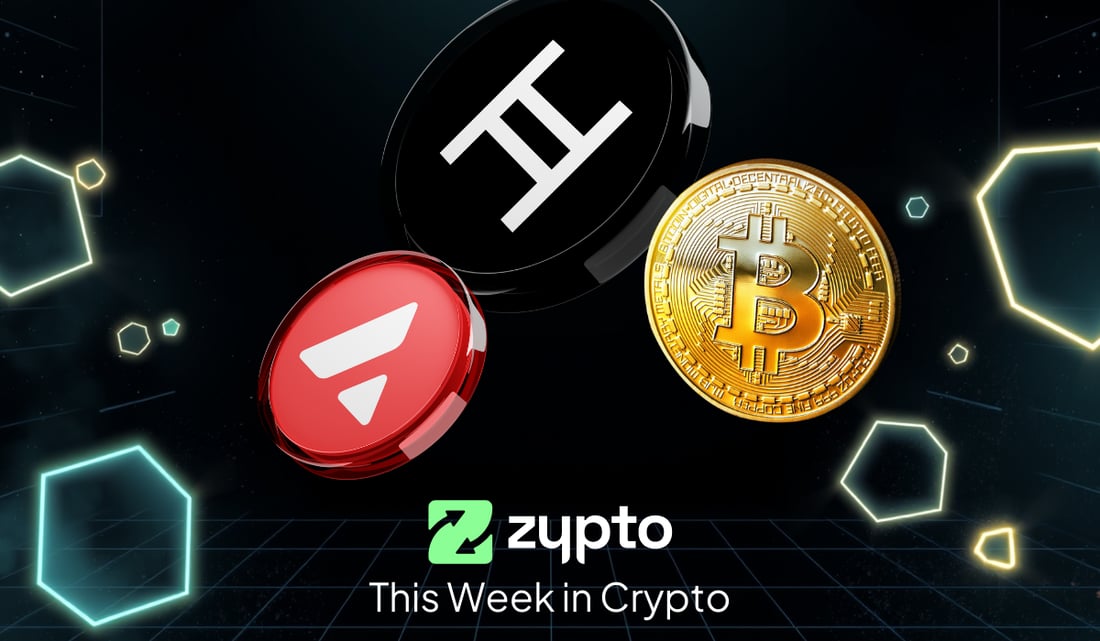
Gm and welcome to this week’s edition of This Week In Crypto.
Two thousand BTC awakened after thirteen years, a Polymarket trader pulled in one million dollars on Google Search bets, Tether backed an Italian robotics startup, an AI powered studio partnered with Avalanche to tokenize entertainment IP, and Hedera signed an MoU with Georgia’s Ministry of Justice. You can also now buy crypto gift cards directly inside Zypto App.
Let’s dive in.
2,000 BTC stored in coins gets unlocked 13 years later
Two dormant Bitcoin wallets tied to physical Casascius coins moved a total of 2,000 BTC, worth roughly $180 million after more than a decade of inactivity. The coins had been untouched since 2011 and 2012, when BTC was trading for less than $15 versus today’s price just shy of $90,000.
The movement was confirmed by a blockchain explorer tracking the addresses.
These pieces trace back to the early 2010s, an era when bitcoin enthusiasts experimented with turning an entirely digital asset into something tangible. One of them emerged in late 2011, when a single BTC cost less than a cup of coffee. Another followed in 2012, still long before mainstream finance acknowledged the asset’s existence.
Casascius coins are physical collectibles containing embedded private keys, made by Utah-based entrepreneur Mike Caldwell beginning in 2011. The coins, issued in denominations ranging from 1 to 1,000 BTC, were designed as offline cold storage.
Each coin came with a tamper-evident holographic seal to protect the key underneath.
They became cult artifacts, not only because of their embedded value but because Caldwell was forced to cease production after regulators suggested his minting model looked too close to unlicensed money transmission. Thus, the U.S. Financial Crimes Enforcement Network (FinCEN) labeled him an unregistered money transmitter.
That regulatory pressure effectively ended the Casascius project, leaving around 90,000 coins in circulation, most holding small amounts of BTC. A handful, just six coins and 16 bars, were minted with 1,000 BTC. Scarcity instantly made them more than novelty pieces; they became time capsules.
It’s unclear whether the recent transfers were sales, internal organizations or simply precautionary moves to preserve access. The transfers could be linked to degrading physical components.

Polymarket trader makes $1 million on Google Search bets
A Polymarket trader has earned nearly $1 million by placing suspiciously accurate bets on Google’s 2025 Year in Search rankings, sparking heated debate about insider trading on prediction markets.
The wallet address “0xafEe” (previously “AlphaRaccoon”) netted nearly $1 million by correctly predicting nearly every outcome in Google search trend markets.
The trader bought “Yes” shares on d4vd, a 20-year-old singer given just a 0.2% chance of being the most searched person of 2025, turning a $10,647 wager into nearly $200,000. The real money came from betting “No” on favorites like Pope Leo XIV, Bianca Censori, and Donald Trump.

According to Meta engineer Jeong Haeju, who exposed the situation on X, the trader achieved a 22-for-23 success rate on Google search predictions.
Public blockchain data shows the wallet deposited $3 million into Polymarket last Friday and immediately began placing large bets. The same account previously won over $150,000 by correctly predicting the exact Gemini 3.0 Flash release date. Haeju said.
“He’s a Google insider milking Polymarket for quick money,”
However, there’s no confirmation that the trader is actually a Google insider. The allegations remain community speculation based on the unusual winning streak.
The incident has divided the crypto community. Some argue that prediction markets are designed specifically for insider trading, creating financial incentives to share privileged information with the market.
The controversy arises as Polymarket officially relaunched in the United States this week after receiving CFTC approval. The platform announced that its iOS app is now rolling out to waitlisted users, starting with sports markets. Currently valued at approximately $9 billion, reports suggest the company is seeking additional funding at a $12 billion valuation.
Chief Marketing Officer Matthew Modabber confirmed the platform will launch its native POLY token along with an airdrop for users, though not immediately. The token launch is expected to occur in 2026, following the stabilization of the US platform.

Tether invests in Italian robotics startup
Tether has entered the humanoid robotics race. The company announced on Monday that it invested in Generative Bionics as part of a €70 million ($81 million) round, joining a sector dominated by firms like Tesla and Nvidia.
Tether said its funding will help the startup complete industrial testing and build its first production facility ahead of planned deployment in 2026. Generative Bionics describes its machines as “Physical AI” systems designed to fuse humanoid robotics with artificial intelligence.
For Tether, the investment continues a pattern of funding hardware and infrastructure projects beyond crypto, including artificial intelligence, media, and agriculture, and brain-computer interface technology, that sit outside its core stablecoin business.
Other firms joining Tether in the Generative Bionics fundraise included the Artificial Intelligence Fund of CDP Venture Capital, which led the round, as well as AMD Ventures, Duferco, Eni Next, and RoboIT.
Launched in 2024, Generative Bionics spun out of the Italian Institute of Technology, where researchers built more than 60 humanoid prototypes over two decades. It also said it plans to debut its first complete humanoid robot at CES 2026 in Las Vegas.
“Our mission is to build a future where intelligent humanoid robots collaborate daily with people, amplifying human cognitive and physical potential,” Generative Bionics CEO and co-founder, Daniel Pucci, said in a statement.
He continued,
“Our Physical AI enables us to design and manufacture human-inspired robots that create tangible value across multiple applications.”
AI-powered studio partners with Avalanche to tokenize entertainment IP
Mugafi, an AI-driven platform for entertainment intellectual property (IP), has partnered with Avalanche to tokenize films, anime, music and other media assets, allowing creators to finance and distribute projects directly on-chain.
The initiative will draw from Mugafi’s catalog and upcoming films. According to the company, its AI systems, trained on thousands of scripts and story structures, help evaluate projects before they are brought on-chain for financing.
Mugafi and Avalanche plan to finance more than $10 million in entertainment IP. The companies said their long-term target is to exceed $1 billion in annual IP financing throughput.
Avalanche said the partnership aims to demonstrate how its network can support large-scale real-world asset issuance. The companies plan to use Avalanche’s infrastructure to fund, track and distribute entertainment projects on-chain.
Mugafi, launched in 2020 in India, is backed by several entertainment and venture investors, including Nexus VP, HashedEM, Netflix, Amazon and Panorama Studios, among others. Its 2025 release, Kuberaa, recorded $35 million in box office collections and was distributed via Amazon Prime Video.
According to the announcement, the collaboration is expected to support new roles across AI, production, blockchain operations and compliance. Mugafi projects more than 1,500 creator and studio opportunities across several regions including India, North America, Japan and Korea.
The push to bring entertainment IP on-chain has been gathering momentum for years among both creators and platforms, with several projects exploring tokenization and Web3 rights management.
In September, Aimoca Brands partnered with ibex Japan, the corporate innovation arm of Antler, to launch a Web3 entertainment fund focused on bringing Japan’s anime and manga IP on-chain. The initiative aims to unlock value from Japan’s largely underutilized IP catalog.
Furthermore, PIP Labs has emerged as a major player in the Web3 IP space with the development of Story Protocol, a layer-1 blockchain designed to manage and program intellectual property on-chain.
Founded in 2022 by former Google DeepMind product manager Jason Zhao, the project enables creators to tokenize their work, record IP on-chain, and set the terms under which it can be used, shared or updated. The framework is intended to help rights holders maintain control over their content and its downstream use.
Hedera Foundation signs MoU with Georgia’s justice ministry
Georgia has taken a new step towards using modern digital systems in its public sector. The country’s Ministry of Justice has signed a memorandum of understanding (MoU) with Hedera, a major blockchain project. This agreement is expected to bring safer and more transparent digital services to the nation.
The Minister of Justice, Paata Salia, met with Hedera representatives to explore how the two sides can work together. Their talks focused on building tools that make public records easier to manage and harder to tamper with.
One of the main ideas on the table is moving data from the National Agency of Public Registry to the Hedera network. Government officials believe this can help protect property records, reduce errors, and make the system more open to the public.
Hedera’s technology can record information in a way that cannot be changed later. This gives citizens more trust in how their property rights are handled. It also helps government workers process records faster and more safely.
Both sides discussed new ways to expand this service. One idea is the tokenization of real estate. This means turning property rights into digital units that can be stored or transferred more easily. Tokenization could open doors to after transactions, clearer ownership records, and better access for citizens.
To push the work forward, Georgia will form joint groups made up of experts from the Ministry of Justice, the Public Registry, and Hedera. These groups will study how the technology can fit into existing public systems and prepare for real-world use.
Buy crypto gift cards in the Zypto App
Crypto gift cards are increasingly becoming one of the easiest ways to move value, top up balances and unlock new on-chain options without touching an exchange.
Zypto’s crypto gift cards make it fast for anyone to buy Bitcoin or store value with a simple purchase inside Zypto App. They work in many countries and cover a wide range of price points, so you can choose how you want to send or save.
They also plug into the wider Zypto ecosystem, which means rewards, flexibility and real world utility when you buy one.
Find out more here.
Closing remark
The story of the 2000 BTC unlocked from wallets since 13 years ago is testament to the staying power and financial value of Bitcoin.
How Polymarket handles insider information could define its regulatory future. The Google search markets serve as a test case for whether prediction markets are efficient information aggregators or insider profit machines.
Humanoid robots drew heavy investment in 2025. In February, Figure AI raised $675 million, then Bedrock Robotics secured $80 million in July. Then, Roundhill Investments filed for a humanoid robotics ETF in April. Morgan Stanley has also projected the market could reach $5 trillion by 2050.
The MOU agreement marks a major moment for Hedera and Georgia. If the plan succeeds, the project could become a model for how countries use blockchain to improve trust and safety in public records.
Zypto’s crypto gift cards are a no-brainer for anyone who plans to engage in cryptocurrency activities. They work in many countries, cover an extensive range of prices and are integrated into the Zypto ecosystem.
What’s your favorite news story this week? Share with us in the comments section.

FAQs
How much worth of BTC was stored in the wallet?
Two dormant Bitcoin wallets tied to physical Casascius coins housed a total of 2,000 BTC.
How did the Polymarket trader make money?
A Polymarket trader earned nearly $1 million by placing suspiciously accurate bets on Google’s 2025 Year in Search rankings.
What did Tether invest in?
Tether invested in an Italian robotic startup called Generative Bionics.
Who did Avalanche partner with?
Mugafi, an AI-driven platform partnered with Avalanche to tokenize films, anime, music and other media assets.
Why should I buy crypto gift cards with the Zypto App?
Why should I buy crypto gift cards with the Zypto App?
Zypto crypto gift cards work in many countries, cover multiple price points and integrate with the wider Zypto ecosystem.