Gm frens, we’re back for our weekly round-up of crypto news.
TON blockchain is allegedly now 10x faster, TRON users can now buy event tickets with USDT, and Coreweave lands agreement with Anthropic to run AI workloads.
Tether launches toolkit for building AI apps, analysts warn XRP price may struggle by 2030, MicroStrategy STRC volume hits $1.1 billion, and Zypto expands TRON functionality to drive real-world crypto payments.
Let’s dive in.
TON blockchain is allegedly now 10x faster
Pavel Durov announced that the TON blockchain is now 10x faster. The Telegram founder shared the news on April 9, explaining that the transactions now confirm in under one second. Before the upgrade, users waited over five seconds for finality.
The speed improvement comes from Catchain 2.0, a new consensus mechanism running under the hood. Blocks now generate every 400 milliseconds, which is 6x faster than before. A new streaming layer pushes updates to apps almost instantly rather than making them wait for the next block.
Durov framed the upgrade as the first step in a seven-part plan he calls “Make TON Great Again,” or MTONGA. The name echoes a certain political slogan, but the goals are technical: making TON fast enough and cheap enough to compete with centralized platforms.
The next steps on the roadmap: cutting transaction fees by 6x. TON fees are already lower than Ethereum or Solana. But further reductions would make micropayments and high-frequency applications more practical.
Durov designed TON to operate within Telegram, which has over 1 billion users. His vision includes payments that feel like sending a message, Mini Apps that respond instantly, and DeFi tools that rival the spread of centralized exchanges.
At five-second confirmation times, delivering that experience was difficult. At sub-second finality, it becomes possible. The infrastructure now matches what users expect from any other app on their phone.
The upgrade went live on mainnet on April 10, 2026. Durov confirmed the fee reduction as step two but has not yet shared the timeline for the remaining six steps in the MTONGA roadmap.
TRON users can now buy event tickets with USDT
Uquid has launched Uquid Tickets, a platform built for the TRON network that allows users to purchase event tickets using USDT and other supported tokens.
TRON continues to see strong stablecoin activity, particularly USDT, supported by high throughput and low transaction fees. These features have contributed to its use in payments, especially in emerging markets.
In regions where TRON already accounts for a significant share of Uquid transactions, users can book concerts, sports events, and festivals without bridging assets or facing higher fees on other networks.
Tickets are delivered shortly after confirmation, reducing delays often associated with crypto payments. Increased ticket purchases drive more on-chain activity, boosting network security, liquidity, and overall usage.
For many users, TRON is already used for remittances, savings in volatile currencies, and everyday transactions. The addition of ticketing introduces another practical use case, linking digital assets to consumer spending.
By channeling stablecoin spending into entertainment, one of the most vibrant consumer categories, the integration strengthens TRON’s position as a high-volume payment rail rather than just a DeFi hub.
Uquid is developing agentic payment features, including automated ticket buying based on user budget and smart tracking for favorite artists or teams. Combined with TRON’s scalable infrastructure, these tools could create personalized, hands-free experiences that feel more like modern consumer apps than traditional blockchain transactions.
Coreweave lands agreement with Anthropic to run AI workloads
CoreWeave, a publicly traded AI cloud infrastructure company, announced on Friday a “multi-year” agreement with AI developer Anthropic, which will use CoreWeave’s cloud computing data centers for its Claude AI model workloads.
Shares of CoreWeave surged more than 12% on Friday and are trading at $102.73 at the time of writing. The agreement follows CoreWeave’s recent $8.5 billion capital raise, led by tech giant Meta Platforms.
The financing was collateralized against CoreWeave’s deployed computing capacity, which is tied to predictable cash flows, rather than its graphics processing unit hardware, making a notable departure from traditional crypto mining financing structures.
CoreWeave pivoted away from crypto mining and rebranded as an AI infrastructure company in 2019, as the mining sector faced prolonged economic pressure following the 2018 crypto market downturn.
Bitcoin (BTC) miners are struggling with rising energy costs, reduced rewards, and declining crypto asset prices, leading many to repurpose their mìning hardware for AI processing.
Up to 20% of Bitcoin miners are unprofitable in the current economic environment, according to asset manager CoinShares’ latest mining report.
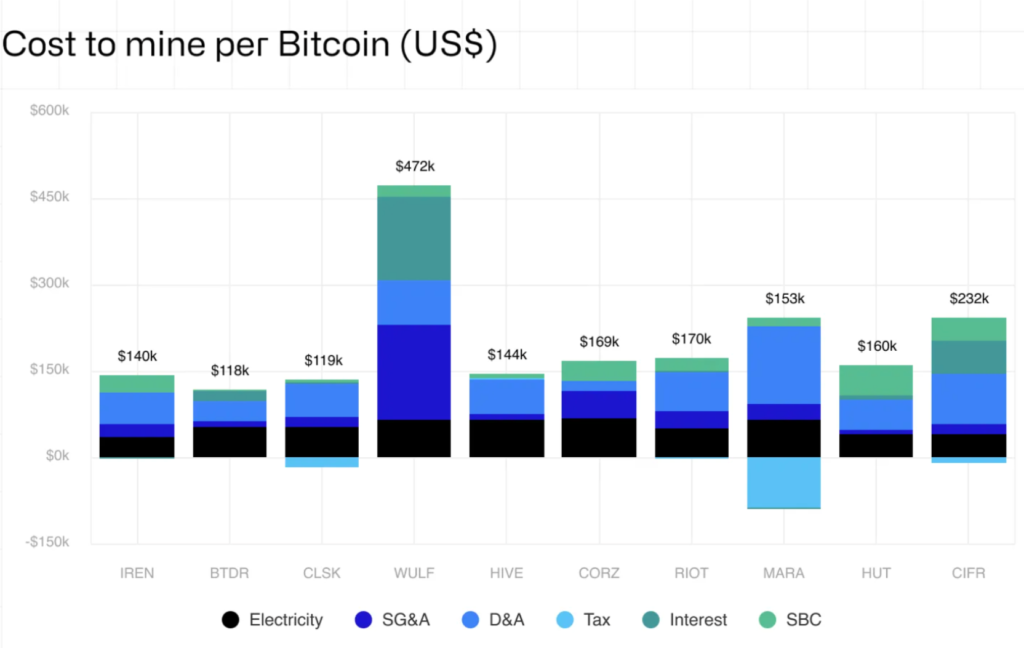
Crypto miners must generate yield on their assets by deploying their crypto on decentralized finance (DeFi) platforms to shore up declining revenues, according to market maker Wintermute.
The mining industry’s economic challenges worsened after the October 2025 market crash, which took BTC down from a high of about $126,000 to the low $60,000 range. Prices have since then stabilized around $73,000.
Tether launches toolkit for building AI apps
Tether, the company behind the world’s largest stablecoin, USDT, announced the launch of QVAC SDK, a fully open-source software development kit designed to run artificial intelligence applications directly on any device without requiring cloud servers.
The cross-platform toolkit works unchanged across iOS, Android, Windows, macOS, and Linux environments, the company said. The SDK is built on QVAC Fabric, a fork of Ilama.cpp, providing compatibility with the Illama.cpp model ecosystem for text generation, embeddings, and multimodal workloads.
Through a single interface, developers can access text completion, embeddings, vision, optical character recognition, text-to-speech, speech-to-text, and translation capabilities. The toolkit’s peer-to-peer functionality, powered by the Holepunch stack, enables decentralized model distribution and delegated interference. The company plans to add peer-to-peer swarms for decentralized training, fine-tuning, and interference in future updates.
“The laws of physics alone make centralized AI a dead end: speed-of-light latency, single points of failure, and concentration of control are features of a system designed for a smaller world,” Tether CEO Paolo Ardoino said. “QVAC is built for the world that’s coming. It is the building block of the Stable Intelligence Era.”
The SDK emerges from QVAC, Tether Data’s AI research initiative focused on building open, decentralized, and adaptive intelligence systems. The company has committed to substantial investments to expand QVAC’s open-source ecosystem over the coming months and years, including specialized toolkits for robotics and brain-computer interfaces.
The launch marks a significant strategic expansion for Tether beyond its core stablecoin business, positioning the company to compete with centralized AI providers by offering privacy-focused alternatives that process data locally rather than transmitting it to cloud servers.
Analysts warn XRP price may struggle by 2030
The XRP Ledger has surpassed 7.7 million holders for the first time in its 13-year history, according to on-chain data, underscoring a steady expansion in network participation. The data also showed a spike in engagement, with daily active addresses hitting a five-week high of 46,767 on Monday.
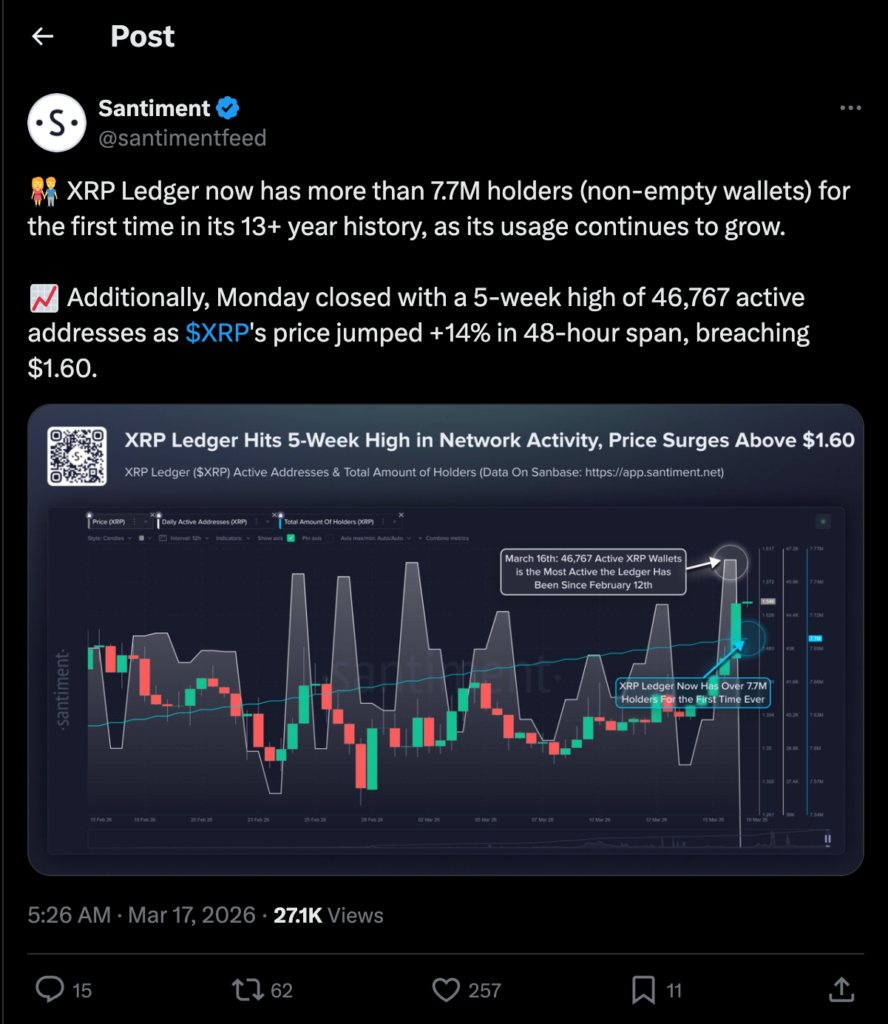
The simultaneous rise in wallet count and activity suggests broader participation rather than isolated large-holder movements. For XRP, such metrics are often viewed as leading indicators of underlying demand. A growing base of holders can signal increasing adoption, while higher active address counts typically point to stronger transaction activity and network utility.
Johnny Rice, an analyst at Motley Fool, said increased adoption of Ripple’s technology does not necessarily drive demand for XRP itself. Rice warned that while Ripple as a company may continue to grow, XRP holders may not see proportional benefits by 2030.
The analyst highlighted how spot XRP exchange-traded funds attracted more than $1.3 billion in inflows within their first 50 days, making them the second-fastest-growing crypto ETFs after Bitcoin. Yet, Rice argued that these catalysts have not translated into sustained price gains, XRP remains significantly below its historical highs, and he attributes this to a deeper issue.
Separately, institutional investment in XRP-linked exchange-traded funds has increased, though its overall impact on prices remains constrained, according to regulatory filings.
Goldman Sachs has emerged as the largest disclosed institutional holder of spot XRP ETFs, with more than $150 million invested across several products, according to U.S. 13F filings.
However, Bloomberg intelligence analyst James Seyffart said the filings reflect only a “small portion” of total ownership. Meanwhile, senior ETF analyst Eric Balchunas said the investor base may be concentrated among committed XRP supporters rather than broader institutional participants.
The limited visibility into ETF ownership comes as XRP has struggled to sustain price gains despite more than $1 billion in inflows into the products during 2025.
MicroStrategy STRC volume hits $1.1 billion
MicroStrategy’s STRC preferred stock recorded $1.1 billion in daily trading volume on Monday, increasing the firm’s holdings to 780.897 BTC. The company confirmed the surge, noting a 46.5% increase from its previous peak. The sudden spike has drawn attention across crypto markets, with traders attempting to decode its implications for Bitcoin exposure.
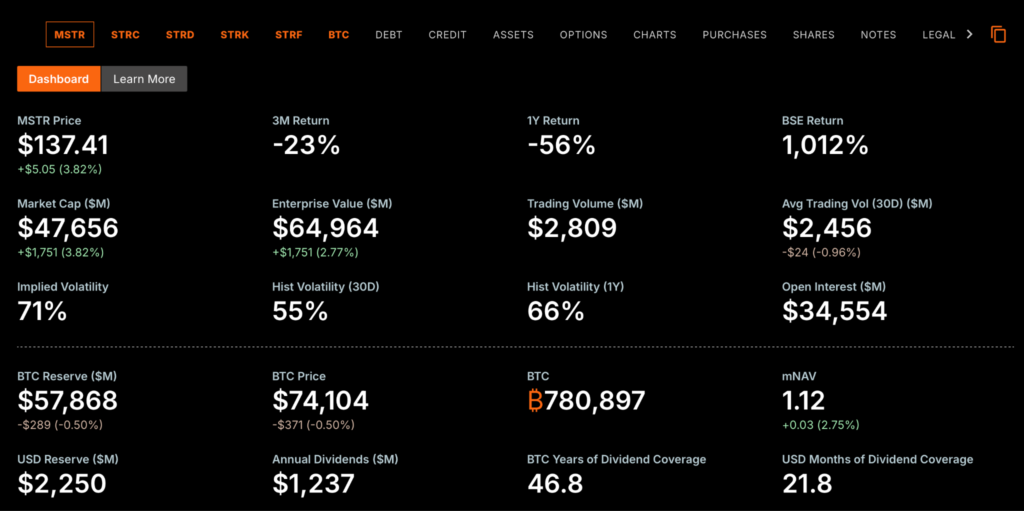
According to Matthew Sigel, the head of digital assets research at VanEck, the volume spike could be tied to a large Bitcoin purchase. The timing of the move has fueled speculation, especially since MicroStrategy has historically used market events to expand its Bitcoin holdings.
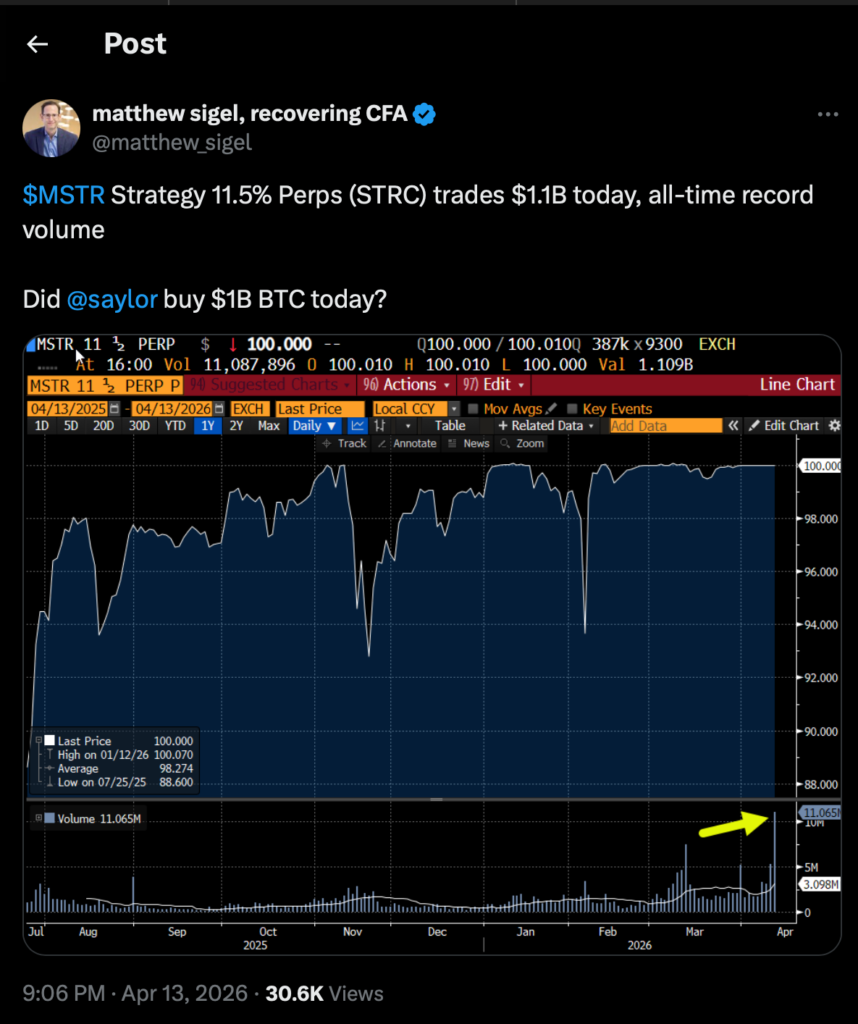
Michael Saylor reinforced the narrative by highlighting the session’s scale and stability. The combination of high liquidity and low volatility suggests controlled execution, often associated with institutional-scale positioning rather than retail-driven trading.
An analyst estimated that between $600 million and $700 million in Bitcoin may have been acquired through STRC-linked flows.
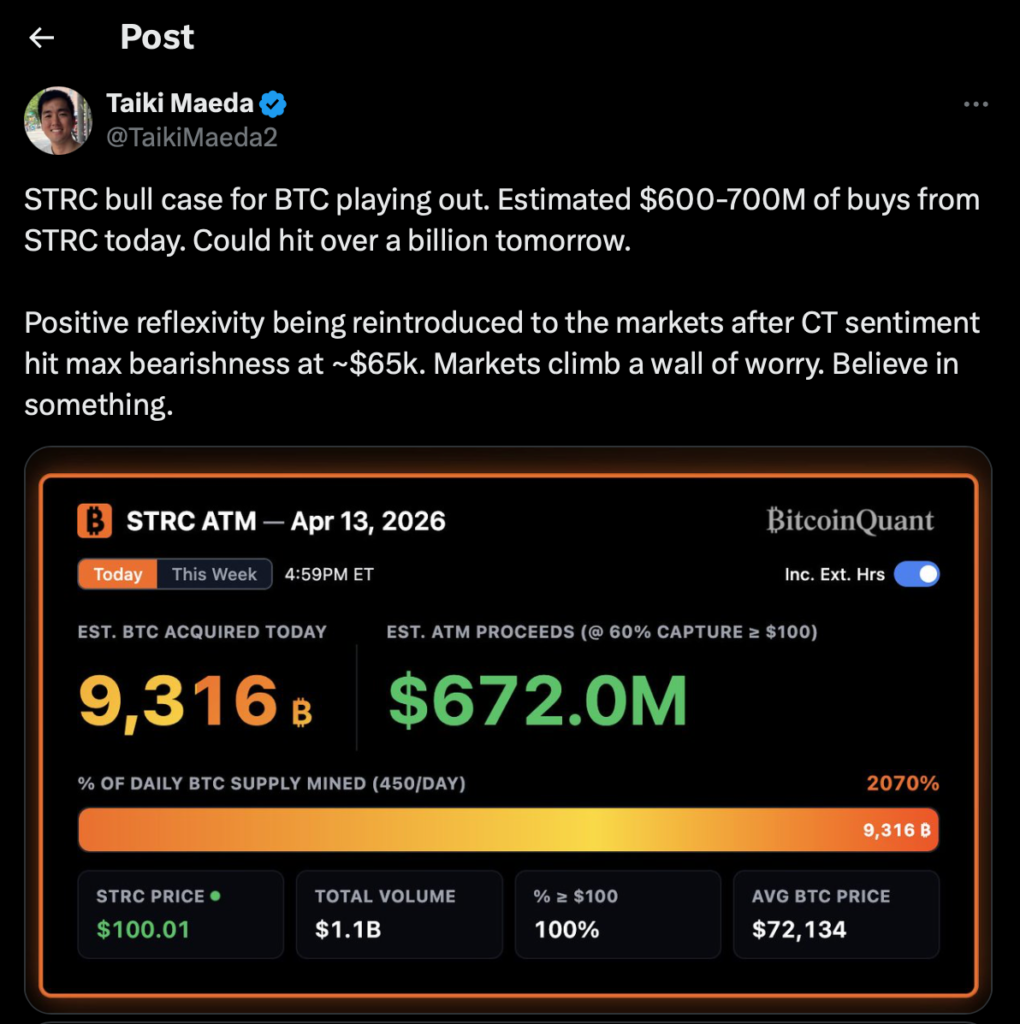
At the same time, comparisons between STRC and MicroStrategy’s core stock trading activity have raised eyebrows.
Analysts noted that STRC volume reached a significant share of MicroStrategy’s daily trading levels, an unusual development for the instrument.
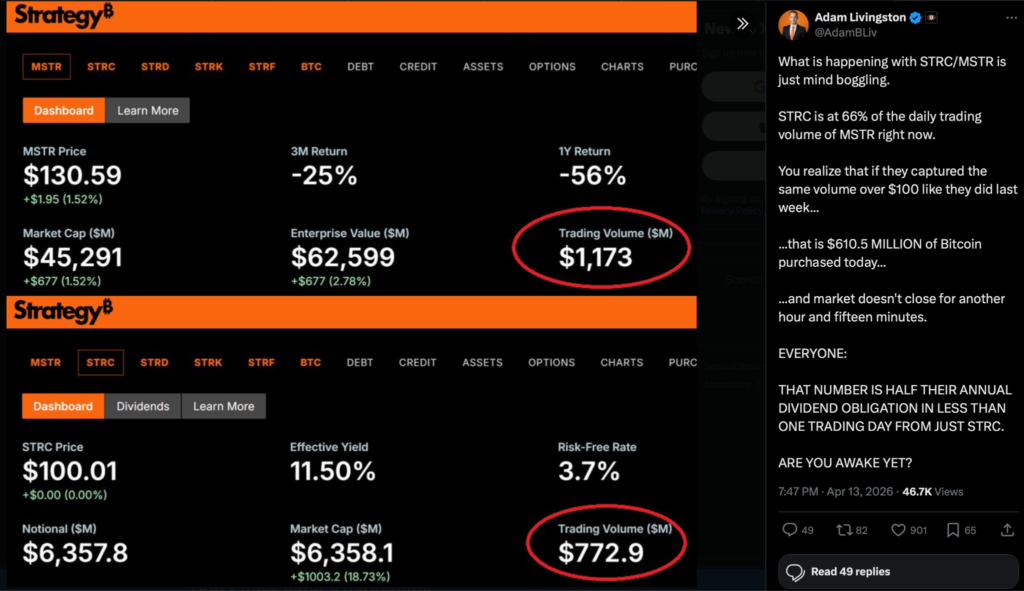
Additional projections suggest that if historical patterns hold, STRC volume could expand further ahead of key market events.
One tracker estimated a potential move beyond $1 billion again, based on prior month trading trends. The latest surge highlights how structured products tied to MicroStrategy may be influencing Bitcoin demand.
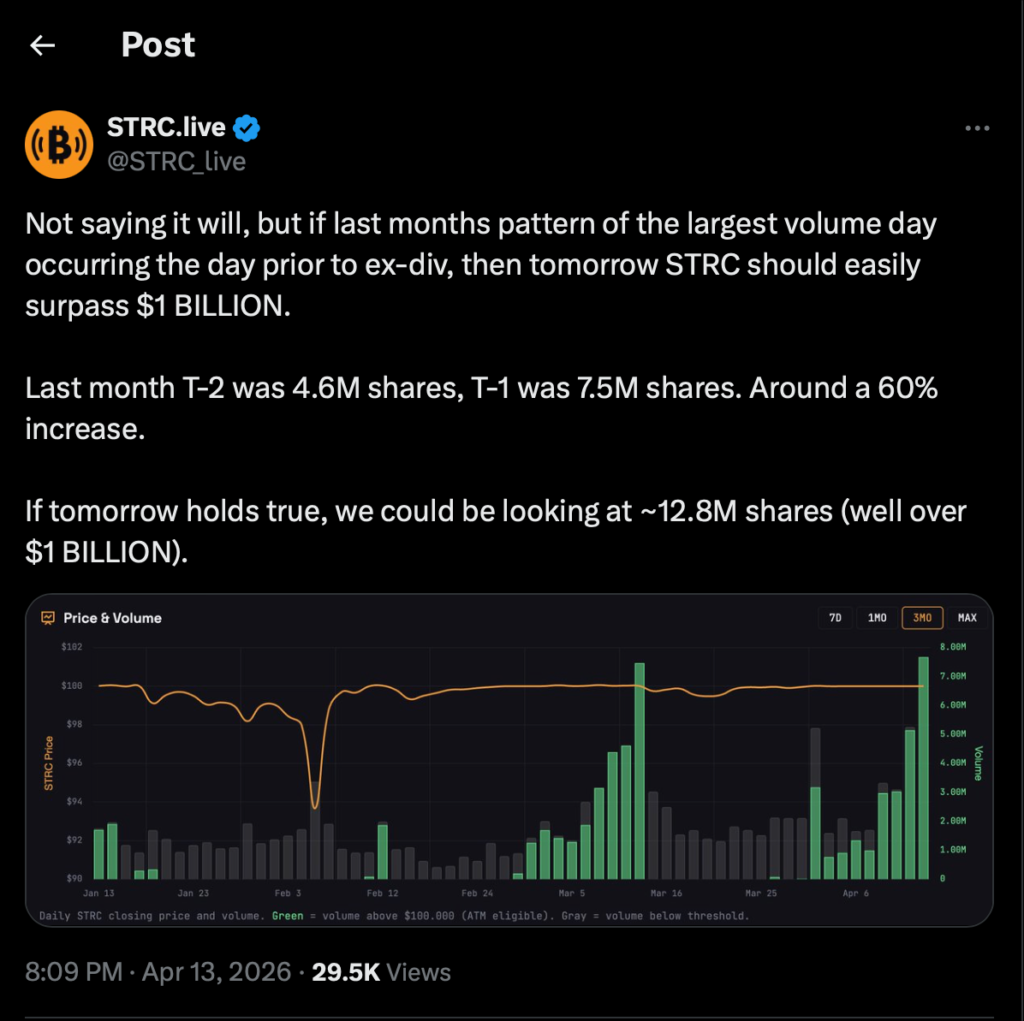
Whether this activity reflects direct accumulation or broader market positioning remains unclear, but the scale of flows suggests that institutional dynamics are once again shaping Bitcoin’s trajectory.
Zypto expands TRON functionality to drive real-world crypto payments
Zypto has announced an expanded integration with the TRON network, enabling users to easily use TRX and USDT for everyday payments within the Zypto App. The launch reinforces Zypto’s mission to transform digital assets from passive holdings into practical tools for daily financial activity.
With this update, users can hold, send, and receive TRX and TRC-20 USDT while accessing a comprehensive suite of in-app payment services. The integration leverages TRON’s fast transaction speeds and low fees, making it well-suited for frequent, real-world use.
The new functionality allows users to move beyond simple storage of digital assets and instead use their balances for essential financial tasks. Through the Zypto App, TRX and USDT can now be used to:
- Fund and spend via payment cards, enabling purchases online and in-store.
- Pay utility bills and subscriptions to streamline everyday expenses.
- Top up mobile airtime globally, supporting connectivity across over 100 countries.
- Purchase digital gift cards, providing instant access to retail and online services.
By consolidating these capabilities into a single platform, Zypto offers users a smooth bridge between blockchain-based value and real-world transactions.
TRON’s infrastructure plays a major role in this rollout. Known for its efficiency and minimal transaction costs, the network supports high-frequency payments and microtransactions. The inclusion of USDT further enhances the experience by offering price stability, making it suitable for routine spending.
In line with Zypto’s commitment to user empowerment, the app operates within a self-custodial environment, ensuring that users maintain full control over their digital assets while benefiting from an intuitive and secure interface.
This launch marks another step in Zypto’s broader strategy to enhance the practical value of digital assets. By enabling TRX and USDT to function as everyday money within a unified ecosystem, Zypto is helping redefine how users interact with blockchain-based finance.
Find out more here.
Closing remark
For developers building on TON, the recommendation is to update their apps to use streaming APIs rather than polling. In other words, the blockchain is faster. Apps need to catch up.
TRON’s focus on fast, low-cost stablecoin transfers is extending into everyday use cases such as event ticketing. The ticketing service allows users to spend existing crypto holdings directly on real-world experiences.
The high cost of mining and shrinking profit margins threaten the viability of Bitcoin mining, with AI models becoming much more attractive in this environment. Some analysts have warned that XRP may not see long-term growth by 2030, sparking concerns amongst holders.
As digital assets continue to evolve, Zypto’s TRON integration underscores a clear shift from passive ownership to active, real-world utility. This brings users closer to a future in which managing and spending value are both smooth and borderless.
With so much to unpack today, what’s your favorite development?
FAQs
What is the latest with the TON blockchain?
Pavel Durov announced that the TON blockchain is now 10x faster, with transactions confirming in under one second.
What is the latest with TRON?
Uquid has launched Uquid Tickets, a platform built for the TRON network that allows users to purchase event tickets using USDT and other supported tokens.
Why did Coreweave partner with Anthropic?
CoreWeave partnered with Anthropic so its cloud computing data centers can be used for Anthropic’s Claude AI model workloads.
What did Tether launch?
Tether launched QVAC SDK, a software development kit designed to run AI applications directly on any device without requiring cloud servers.
What is MicroStrategy’s BTC holding?
MicroStrategy’s Bitcoin holdings increased to 780.897 BTC.