Gm frens, welcome to our first news report of May!
Crypto card spending jumps 500%, Bitcoin drives 2M customers to a U.S. steak restaurant, and Tether Investments proposes a merger to form a Bitcoin platform. Meta launches USDC creator payouts on Solana and Polygon, X rolls out a new crypto trading terminal, Bitcoin struggles near $80K, and Zypto spotlights its premium crypto cards.
Let’s dive in.
Crypto card spending jumps 500% since September 2024
Crypto card usage has surged more than 500% since September 2024, with monthly volumes reaching roughly $600 million as of April 2026. What was once a niche tool for early adopters is quickly becoming a practical payments option, driven by one key shift: the rise of stablecoins.
The growth in crypto card spending closely tracks the rise of stablecoins. People are loading stablecoins onto debit-style cards and swiping them at coffee shops, gas stations, and online checkouts just like any regular card.
In early 2023, monthly crypto card volumes hovered around $100 million. By late 2025, some reports showed volumes exceeded $1.5 billion, while volumes had stabilized around $600 million per month, with occasional spikes above that level. This pattern suggests not just experimentation, but sustained usage.
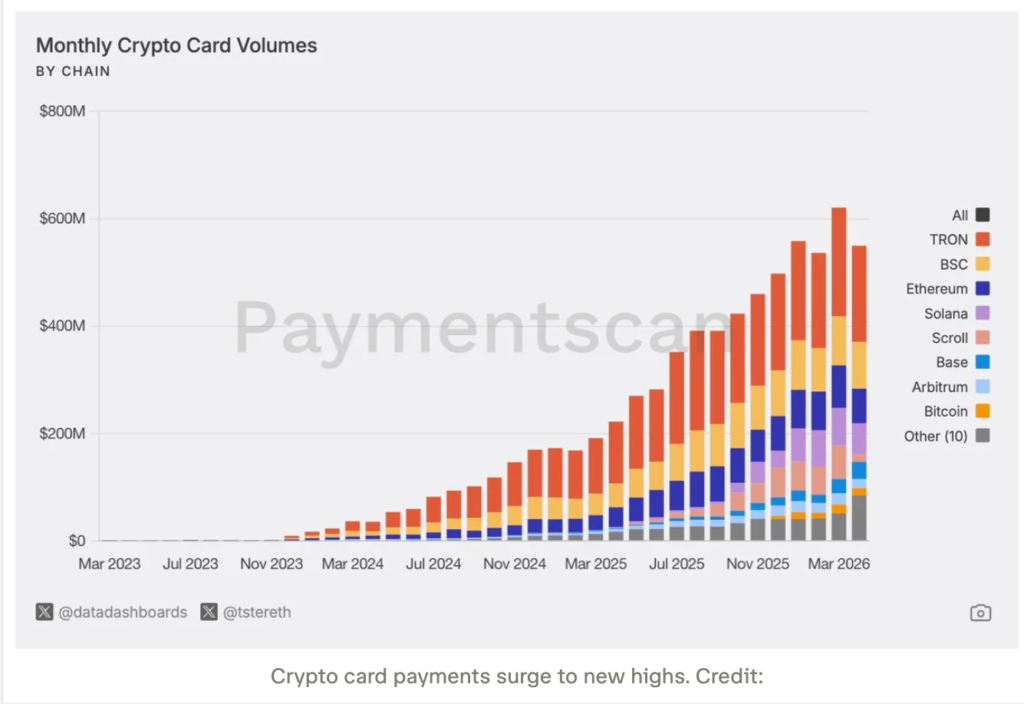
Rather than relying on traditional banking rails, companies have partnered directly with crypto-native issuers, enabling faster, more cost-efficient card launches that settle in stablecoins. Users aren’t just testing the waters anymore; they’re spending real money, billions annually, because the experience finally feels smooth.
At the center of this hype are stablecoins, especially USDC and USDT, whose stability makes them perfect for spending. Users hold them in their Zypto wallet and link it to their physical and virtual Zypto VISA card. When the user taps to pay, the system converts instantly on the backend, often using stablecoin rails, while the merchant sees a normal fiat transaction.
Stablecoins have turned crypto balances into usable money, and the numbers back it up. Stablecoin market cap increased past $300 billion in early 2026, while transaction volumes hit $33 trillion in 2025. Today, USDT and USDC account for roughly 90% of crypto card funding, and the reasons are straightforward.
Stablecoins remove volatility risk, allowing users to spend without worrying about price swings. They also enable faster and cheaper settlement, particularly when integrated with existing payment networks. Moreover, in regions with limited access to banking, they provide a way to spend dollar-denominated assets globally.

Bitcoin drives 2M customers to a U.S. steak restaurant
Steak ‘n Shake’s Bitcoin strategy is delivering measurable results, and the latest figures are hard to ignore. The company has added roughly 2 million new customers since launching BTC payments in May 2025 and has achieved the highest same-store sales growth in the restaurant industry.
Steak ‘n Shake began accepting Bitcoin on May 16, 2025, rolling it out across hundreds of US locations, with additional international sites where regulations allow. Within months, same-store sales climbed more than 10%, reaching 11% in Q2 and 15% in Q3, according to company figures. The momentum was amplified by social media buzz and widespread media coverage, drawing in curious first-time customers and converting many into repeat visitors.
Steak ‘n Shake’s growth has been tied to Bitcoin adoption as well as improvements in food quality and employee compensation. It was also revealed that using Bitcoin has cut payment processing costs by around 50%. Additionally, it was announced that BTC payments for the company’s burgers go into its Strategic Bitcoin Reserve, which funds Bitcoin bonuses for its employees.
The cost savings and additional revenue generated by Bitcoin have enabled the company to reinvest heavily in its menu. Over the past year, the chain has upgraded its ingredients and processes, including shifting to beef tallow fries, using higher-quality dairy, and removing microwaves across locations.
Tether Investments proposes a merger to form a Bitcoin platform
Tether Investments, the investment arm of stablecoin giant Tether, announced proposals for a triple merger combining Twenty-One Capital, Strike, and Elektron Energy into what it described as “the premier listed Bitcoin company in the world.”
The proposed combination would unite three distinct Bitcoin operations under a single public entity. Twenty-One Capital, which ranks second among public companies for Bitcoin holdings, with over $3.3 billion in BTC, would contribute its substantial treasury operations to the merged platform.
Strike, the Bitcoin financial services company founded by Jack Mallers (Twenty-One Capital’s CEO), operates in more than 100 countries and enables users to buy, sell, hold, and borrow against Bitcoin. Millers affirmed that Strike has secured a $2.1 billion credit facility to meet lending demand.
Elektron Energy would bring significant mining infrastructure to the merger. Led by Raphael Zagury, the company has mined more than 5,500 Bitcoin across its managed portfolio and maintains all-in production costs below $60,000 per Bitcoin.
Tether Investments wrote, “The proposed leadership structure is intended to combine Mallers’ product, brand, and consumer Bitcoin leadership with Zagury’s capital markets, operating, and execution experience.”
Market participants responded positively to the merger announcement, with Twenty-One shares jumping after market trading, though those gains have since been largely reduced.
The merger builds on Twenty-One Capital’s recent transition to public markets. The company went public through a SPAC merger with Cantor Equity Partners in December. Tether was one of the prominent backers of the original business combination, setting the stage for further proposed mergers.
Meta launches USDC creator payouts on Solana and Polygon
Meta has begun allowing content creators to receive earnings in USDC stablecoin directly to their crypto wallets on Solana and Polygon.
A Meta spokesperson emphasized that the firm is not issuing a Meta stablecoin. Instead, the company is tapping Circle’s USDC, the second-largest stablecoin with a market cap of over $77 billion. They said, “We strive to offer the most relevant payment methods, which is why we are exploring how stablecoins could become part of our suite of options.”
The geographic selection reflects Meta’s strategy of testing financial features in emerging markets where crypto adoption often outpaces traditional banking infrastructure. The stablecoin payments feature is currently available to a limited group of creators in Colombia and the Philippines.
Meta’s adoption of a stablecoin represents a strategic reversal from its earlier crypto ambitions. The company shut down its Libra project, later renamed Diem, in 2022 after facing intense regulatory scrutiny.
Stablecoin interest among U.S. companies has grown substantially since last year’s signing of the GENIUS Act, which regulates the dollar-pegged crypto tokens.
Chainalysis projects that stablecoin trading volume could reach $1.5 quadrillion by 2035, reflecting growing confidence in digital-dollar payment rails among traditional finance players.

X launches new crypto trading terminal
X head of product Nikita Bier said the company was rolling out a web version of Cashtags, a feature that converts $tickers for stocks and crypto into clickable, real-time charts and asset-specific post feeds.
Bier framed the tool as a way to position X as a core trading terminal. Bundled controls, including contract address matching and account locks on first-time crypto posters, are intended to filter out fraudulent tokens before they reach users.
The rollout fits a broader X finance push that also includes payments and pilot trading features. Musk’s distinction between merit assets and scams maps directly onto Cashtags’ pitch, separating what the feature wants to surface from what its anti-scam controls are designed to suppress.
In other news, crypto ranks as the most muted topic on X since the platform launched its new snooze feature. The data, shared by Nikita Bier, signals growing user fatigue with the asset class.
Users snoozed crypto posts more than politics, the Iran conflict, sports, and business content combined. The pattern marks the strongest feed-level pushback against any single category since launch.
X has steadily expanded its crypto exposure even as Premium users tune out the topic. The company recently hired designer Benji Taylor away from a crypto-native firm. X is also preparing XChat as a payments-ready messaging product to compete with WhatsApp and iMessage.
Elon Musk himself remains entangled in a high-profile OpenAI lawsuit that continues to dominate his public agenda. The widening gap between platform strategy and audience appetite continues to grow. X will need to rethink how crypto surfaces in Premium feeds without alienating its most engaged users.
Bitcoin struggles near $80K – trouble for BTC bulls?
Bitcoin (BTC) rallied to $79.2K late on May 2, but at press time, BTC was rejected from a key local resistance zone. Notably, Glassnode reported that defensive positioning was rising as the price approached the $80K psychological resistance.
In a post on X, the crypto intelligence platform highlighted that takers were selling calls and buying downside protection. The post also used BTC options data to highlight how the $82K level could trigger a short squeeze.
Implied volatility trended lower throughout April, with upside sold rather than chased. Another short squeeze could be just around the corner. Using the 30-day sum of the Bitcoin Apparent Demand metric, crypto analyst Darkfost observed that it was too early to conclude that Bitcoin had shifted into a bullish regime.
The metric is calculated as the difference between new BTC issuance and the amount of coin supply that has been dormant for over a year. It tracks structural accumulation or distribution trends across higher timeframes.
The chart showed the 30-day sum was still at -44,700 BTC. Though it was an improvement from -89,000 in early April, the negative figures meant apparent demand was still weak.
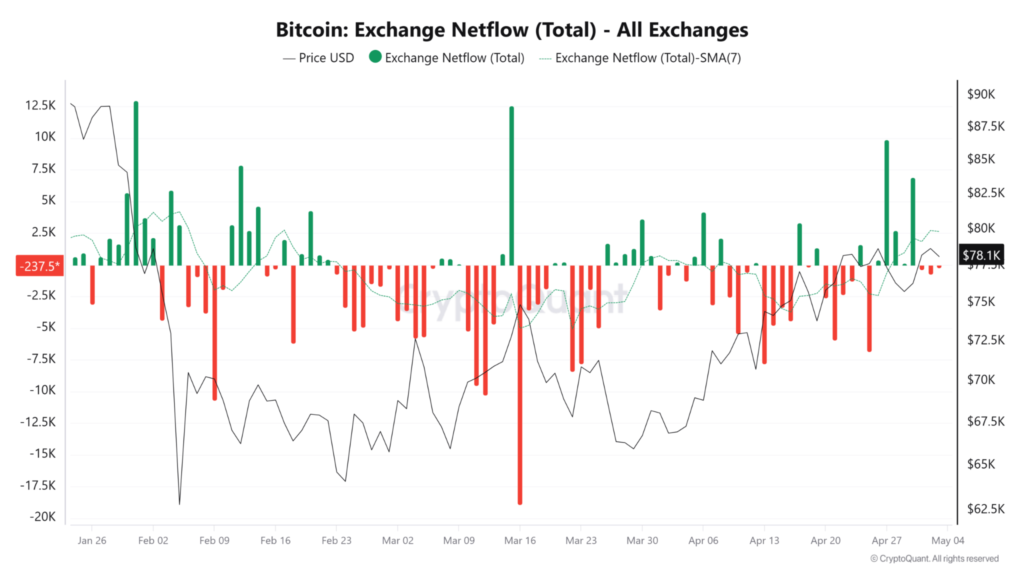
For most of 2026, this metric has been negative, showing indecisive demand trends. Since mid-February, the 7-day Moving Average of Bitcoin net flows to exchanges has been negative, except for a brief spike in late March. Over the past week, the 7-DMA of the metric moved into positive territory with greater confidence.
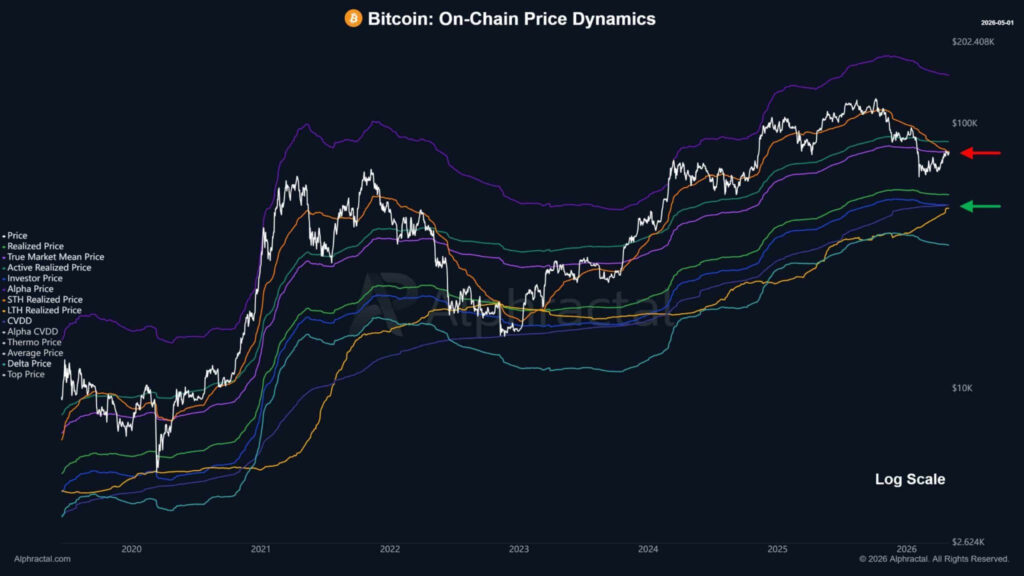
Exchange inflows generally indicate increased selling pressure, which aligns well with the idea that holders were becoming more defensive as BTC pushed toward $80K. Joao Wedson, founder and CEO of Alphractal, outlined decisive price markets in a post on X.
He advised betting against BTC at its current retest of the short-term holder realized price, while looking to buy at the retest of the long-term holder realized price.

It might really be as simple as selling Bitcoin now and buying in the $50K-$55K range.
Zypto spotlights premium crypto cards
Zypto’s range of premium crypto cards are positioned as a zero-monthly-fee solution for users looking to spend digital assets globally, amid intensifying competition in the crypto off-ramp market.
The platform’s premium cards, available in both physical and virtual formats, allow users to convert cryptocurrencies to fiat and spend them anywhere major card networks are accepted, spanning multiple countries.
The cards are designed to eliminate recurring costs typically associated with financial products, with no monthly or inactivity fees. It also maintains a transparent fee structure for transactions and currency conversions, as well as high limits, and luxury benefits, without tiered levels.
Zypto’s premium physical card is marketed toward high-volume users, supporting ATM withdrawals of up to $22,500 per month and transaction limits of $1 million in monthly spending, positioning it for business use cases and high-net-worth individuals.
Meanwhile, the virtual version targets frequent payments and everyday usage, alongside integration on Apple Pay and Google Pay. It offers instant usage for online, in app or in store transactions, complete with 3D Secure support for extra protection.
Zypto emphasizes interoperability, noting that users can fund their cards using over 100 cryptocurrencies from both its native wallet and external platforms, aligning with broader industry trends toward self-custody and multi-chain access.
Find out more here.
Closing remark
Crypto card usage has surged as stablecoins like USDT and USDC transform crypto from a volatile asset into a widely accepted payment method for everyday spending. Tether Investment has proposed a three-way merger into a publicly listed Bitcoin-focused firm.
Meta is piloting direct creator payouts in USDC across Solana and Polygon in certain emerging markets. X has rolled out the web version of Cashtags; it remains to be seen how the consensus will be.
Bitcoin is struggling to break past the $80K resistance, as rising defensive positioning, weak apparent demand, and increasing exchange inflows signal cautious investor sentiment.
Recent studies have found that tourists, millennials, and Gen Z prefer locations that accept cryptocurrency. So, many eateries are converting Bitcoin to cash or keeping it as a treasury asset.
Zypto’s launch reflects a broader push across the crypto industry to bridge digital assets and everyday payments, as providers compete on lower fees, higher limits, and global usability to attract both retail users and institutional spenders.
What do you think about this week’s developments? Let us know in the comments section.
FAQs
How high has crypto card spending reached?
As of this writing, crypto card usage has surged more than 500% since September 2024.
How many customers has Steak ‘n Stake gotten due to Bitcoin?
Steak ‘n Stake has added roughly 2 million new customers since launching BTC payments in May 2025.
Which countries are the Meta USDC payout available to?
The Meta USDC payments feature is currently available to a limited group of creators in Colombia and the Philippines.
Which companies want to merge to form a Bitcoin platform?
Tether Investments announced proposals for a triple merger combining Twenty-One Capital, Strike, and Elektron Energy.