Gm frens, welcome to our second crypto round-up of February.
Axie Infinity is preparing a new token airdrop for AXS stakers, ai.com made a Super Bowl splash, and Kalshi strengthened its surveillance stack. Pump.fun acquired trading platform Vyper, Polymarket is shifting to native USDC settlement, and Ripple expanded its institutional custody infrastructure. Zypto also teased a major defi cross-chain integration.
Let’s get to it.
Axie Infinity token to be airdropped to AXS stakers
Axie Infinity, the popular blockchain game, will airdrop a new game token called “bonded AXS” (bAXS) to eligible wallets based on a social media post from its official X page.
The airdrop will consist of 100,000 bAXS tokens backed 1:1 with its existing AXS token and will be distributed to wallets that have staked at least 10 AXS, or about $16.90 worth of the existing Axie Infinity ecosystem token.
Among those who have staked 10 AXS, their Axie Score and the amount of staked AXS will impact a player’s airdrop allocation.
When launched, bAXS will act exactly like the game’s original token, allowing players to evolve and breed Axie monsters and spend them on the secondary marketplace.
Aside from the first airdrop, bAXS will also be distributed to players of the game’s upcoming land-based game, Terrariums. With the launch of Terrariums, there is an expectation for more AXS and bAXS spending.
The land game’s launch is expected sometime in Q2, after the launch of bAXS and two separate bAXS airdrops, the second of which has not yet been detailed.
The new token launch follows a volatile period for Axie’s existing token (AXS), which has jumped 57% over the last 30 days to change hands at around $1.55. Despite the surge, the token remains down 99% from its 2021 all-time high price of $164.90.
The all-time high price was established as its Pokémon-inspired game surged to more than 1 million daily active players at its peak. Axie Infinity’s play-to-earn economy struggled thereafter, while the broader blockchain gaming space has seen substantial turmoil of late.
Axie Infinity is built on Ronin, a gaming-centric Ethereum scaling network developed by Sky Mavis. The franchise will expand further with Axie Infinity: Atia’s Legacy, a new massive multiplayer online (MMO) game that was first revealed last year.

AI platform launches ad during Super Bowl
AI platform ai.com, founded by Crypto.com co-founder and CEO Kris Marszalek, announced the launch of its autonomous AI agent for retail consumers.
The agentic AI will be able to execute functions including trading stocks, workflow automation, and simple tasks like calendar updates and managing changes to online social profiles.
Marszalek bought the “ai.com” domain for $70 million in cryptocurrency from an unknown seller and aired a 30-second ad during the fourth quarter of Super Bowl 60, one of the biggest sporting events in the US.
Unsurprisingly, the website crashed due to the tremendous traffic. Once it came back online, users could sign up to create their personal AI agent.
AI agents have garnered significant attention from users over the last year, with 23% of respondents in a survey by investment research firm McKinsey indicating that their organizations were expanding the use of AI agents.
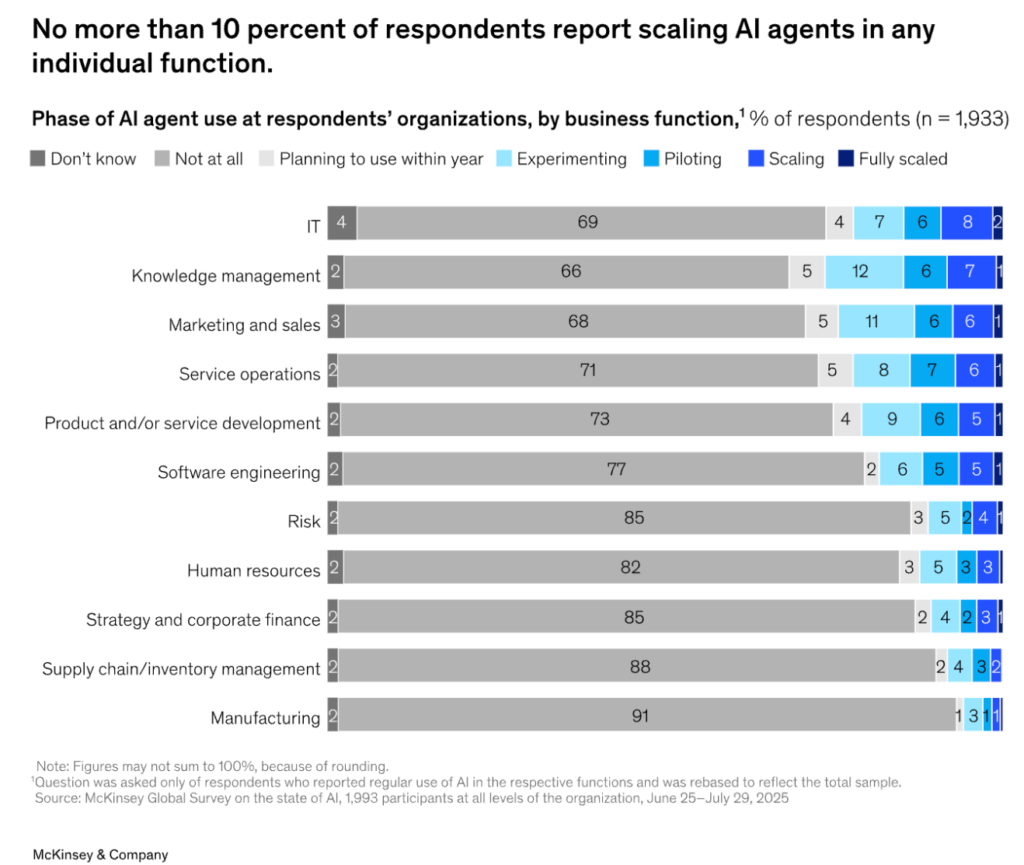
The growth of autonomous AI agents can automate crypto trading strategies and wallet management, removing the technical barrier-to-entry for new users unfamiliar with blockchain systems and on-chain transaction execution, proponents of the technology say.
Also, agents will feature segregated user data, secured by encryption keys unique to each user, and run according to user-set restrictions on what the agent is allowed to do.
Agentic AI can abstract away the technical complexity of cryptocurrencies by selecting the cheapest and fastest execution pathways and simplifying stablecoin usage.
According to the company, the new platform allows retail users to deploy “agentic” AI tools in under 60 seconds without technical coding knowledge. The interface targets mainstream consumers, though the long-term vision has been described as a “decentralized network” where billions of agents self-improve and share capabilities.
By launching with a Super Bowl spot, Marszalek is betting that mainstream appetite for automated personal assistants will outpace fatigue around crypto-adjacent projects. The trajectory points toward a hybrid business model that blends subscription tiers with transaction-based economics.
Kalshi partners with a crypto surveillance platform
Kalshi has expanded its surveillance on its prediction markets platform through an independent advisory committee and partnerships to detect insider trading and market manipulation.
Kalshi affirmed that the committee would give a quarterly rundown to the company’s outside counsel and publish statistics on investigations into suspicious activity on the platform.
It is also teaming up with crypto trading surveillance platform Solidus Labs and Daniel Taylor, director of the Wharton Forensic Analytics Lab, “to detect, investigate, and address market abuse.”
Alongside Wharton’s Taylor, Kalshi’s surveillance committee also includes Lisa Pinheiro, a managing principal and data scientist at Analysis Group, who focuses on market manipulation.
Kalshi’s lawyer, Robert DeNault, was also appointed head of enforcement to coordinate with the new committee. Brian Nelson, a former US Treasury official, was hired to advise on trading surveillance and compliance issues.
The company has moved to boost oversight amid scrutiny of prediction markets by US state regulators who claim that sports event contracts constitute illegal gambling.
Furthermore, the Financial Times reported that Kalshi is seeking regulatory approval to offer margin trades in the US. Kalshi has reportedly been in talks with the Commodity Futures Trading Commission for several months.
Pump.fun acquires crypto trading platform Vyper
Pump.fun has acquired crypto trading terminal Vyper, which will wind down its standalone product and migrate its infrastructure into the Solana memecoin launchpad’s ecosystem.
Over the weekend, Vyper confirmed that core parts of its product will begin shutting down, while limited functions will remain accessible. Users were directed to Pump.fun’s Terminal (formerly Padre) to continue using the tools.
The move reflects a broader strategy by Pump.fun to consolidate more of the trading workflow, from token launches to execution and analytics, as memecoin activity cools from the speculative frenzy of late 2024 and early 2025.
Pump.fun’s acquisition of Vyper follows earlier moves into trading infrastructure.
On October 24, Pump.fun acquired trading terminal Padre to strengthen liquidity and improve execution for tokens launched on its platform. Padre was later rebranded and now operates as Terminal.
In January, Pump.fun also launched an investment arm called Pump Fund, marking what the company described as a pivot away from a pure memecoin focus. Pump Fund debuted alongside a $3 million hackathon aimed at backing early-stage projects, including those not directly related to crypto.
The expansion comes as memecoin activity has fallen from peaks when celebrities and several government leaders launched their tokens. Pump.fun’s growth was driven by intense speculative activity on Solana, but revenue has since fallen as the popularity of memecoins weakened.
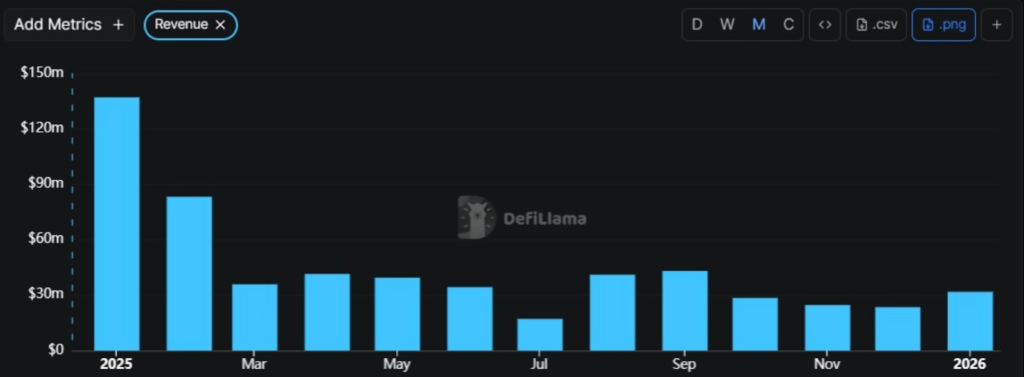
Data from DefiLlama shows that Pump.fun’s monthly revenue peaked at more than $137 million in January 2025. That figure fell 77% over the following year, with the platform generating about $31 million in January 2026.
In December 2024, the estimated market capitalization of memecoins tracked by CoinMarketCap surpassed $100 billion. At the time of writing, the sector was valued at about $28 billion.
Polymarket to migrate from Polygon to Circle USDC settlement
Circle Internet Group has partnered with Polymarket to transition the prediction market’s settlement infrastructure to native USDC, replacing bridged stablecoin collateral used for trading on its platform.
According to the announcement, Polymarket currently uses bridged USDC (USDC.e) on Polygon as trading collateral and plans to migrate to Circle-issued native USDC over the next few months.
Native USDC is issued by Circle’s regulated entities and can be redeemed one-for-one for US dollars, offering a “capital-efficient” and scalable alternative without relying on cross-chain bridges.
Cross-chain bridges are protocols that transfer tokens between blockchains by locking assets on one network and issuing corresponding representations on another. However, secure cross-chain communication introduces trade-offs in security, trust, or flexibility that are not present on a single blockchain.
Shayne Coplan, founder and CEO of Polymarket, said using USDC will support “a consistent, dollar-denominated settlement standard that enhances market integrity and reliability as participation on the platform continues to grow.”
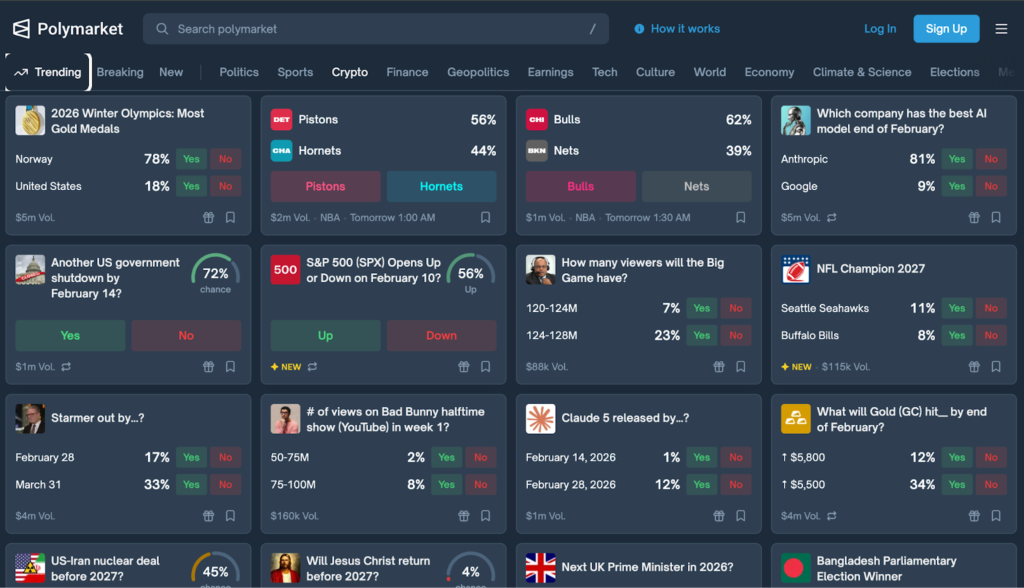
Polymarket is an on-chain prediction market where users trade contracts tied to the outcomes of real-world events using stablecoins as collateral, including markets on cryptocurrency prices, political outcomes, and other events.
While Polymarket and Kalshi remain the leading prediction market platforms, several major crypto exchanges have recently entered the space.
In mid-December, Gemini launched its in-house prediction market, Gemini Predictions, making event-based trading available across all 50 US states following regulatory approval, while Coinbase announced a prediction market in partnership with Kalshi a day later.
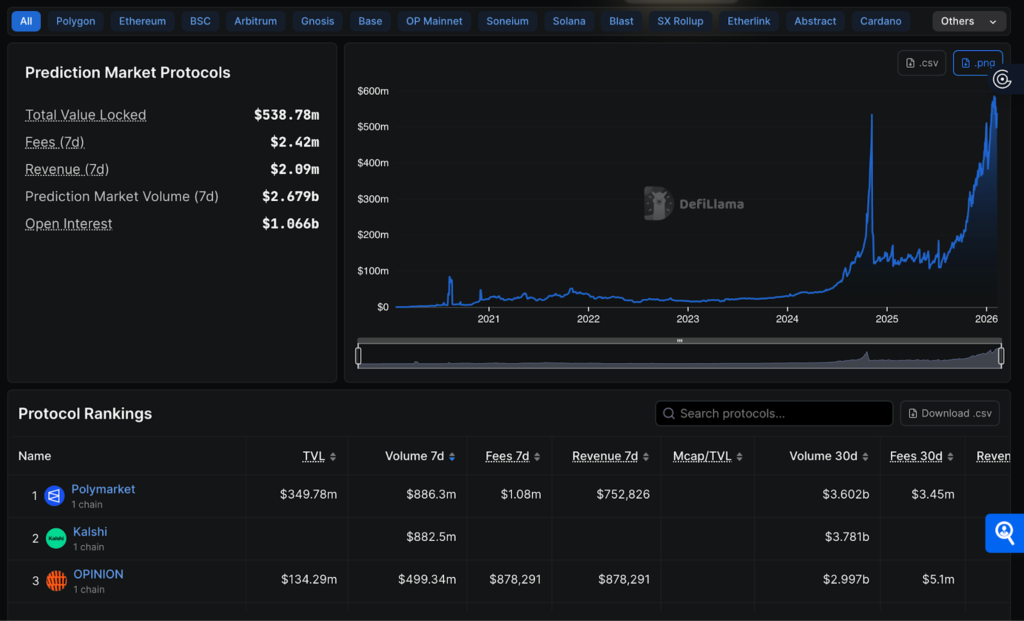
Last week, Crypto.com launched its prediction markets business as a standalone platform, OG, operated by its Derivatives North American arm and available only to US users.
Also, retail brokerage Robinhood and sports betting platform DraftKings rolled out prediction markets in 2025. This further crowded a category that first gained significant momentum during the 2024 US presidential election.
Despite the growing popularity of prediction markets, some analysts have raised concerns that they may be vulnerable to insider trading, citing instances in which traders appeared to profit from nonpublic information or by influencing data used to set market prices.
US states have also raised challenges, with Kalshi facing legal scrutiny from gaming regulators in Massachusetts, New York, and several other states over whether its event contracts constitute gambling.
Ripple expands institutional custody stack
Ripple has announced an expansion of its institutional custody platform through new integrations with Securosys and Figment, according to this press release.
The company said it is adding hardware security modules to enable banks and custodians to deploy custody services and offer staking without necessarily operating their own validator or key-management infrastructure.
Building on Ripple’s recent acquisition of Palisade and the integration of Chainalysis compliance tools, the custody upgrades allow regulated institutions to manage cryptographic keys using on-premises or cloud-based HSMs and to offer staking on networks such as Ethereum and Solana, with compliance checks embedded directly into transaction workflows.
The company has been pushing further into institutional infrastructure activity as it expands beyond payments with custody, treasury and post-trade services for regulated companies.
This update comes weeks after the company launched a corporate treasury platform that integrates traditional cash management systems with digital asset infrastructure.

Zypto teases cross-chain expansion for its crypto wallet app
Zypto has revealed plans for a significant upgrade to the cross-chain capabilities within its mobile crypto wallet, signaling a broader push toward simplifying asset movement across blockchain networks.
In a recent announcement, the company said it is preparing to introduce a “major expansion” aimed at enhancing how users transfer digital assets between supported chains.
The feature will build on existing cross-chain swap and routing functionality already available in the Zypto App, potentially offering users additional flexibility without changing the core user experience.
While specific technical details remain undisclosed, Zypto indicated that the new capability would represent functionality not typically integrated directly into wallet applications.
The upgrade is expected to allow more smooth asset movement across multiple blockchain ecosystems, a key focus area as decentralized finance (DeFi) activity continues to expand across networks.
Also, the new functionality will operate alongside the app’s current cross-chain features, suggesting an incremental expansion rather than a complete overhaul of existing workflows.
Closing remark
The new bonded token by Axie Infinity is primed to encourage and incentivize use within the game’s economy. Are we witnessing a resurgence of the NFT space? Time will tell.
The AI agent move by ai.com signals a high-stakes capital commitment to the convergence of blockchain technology and generative AI. It underscores a broader trend of crypto executives seeking new growth narratives as the digital asset market matures.
Kalshi’s partnership with Solidus Labs and Wharton Forensic Analytics Lab to detect insider trading is a masterstroke. Its plan to smooth things over with the CFTC may be part of a move to open up to more institutional investors.
Pump.fun’s acquisition of Vyper suggests a new direction in which the memecoin platform is headed. When complete, the shift to the native USDC infrastructure will move Polymarket’s collateral to a stablecoin issued and redeemed directly by Circle, rather than a bridged representation.
Ripple confirmed that the integrations are intended to reduce deployment complexity and support faster rollout of custody services for institutional clients. Zypto’s forthcoming update may indicate a broader shift toward embedding complex interoperability features directly into consumer-facing crypto applications.
Super Bowl drama. Airdrops. Partnerships. This week had it all. What do you think? Let us know in the comments section.
FAQs
How much was the AI platform domain purchased for?
Marszalek bought the “ai.com” domain for $70 million in cryptocurrency from an unknown seller.
Which crypto surveillance company did Kalshi partner with?
Kalshi partnered with crypto trading surveillance platform Solidus Labs and Wharton Forensic Analytics Lab.
Which company did Pump.fun acquire?
Pump.fun acquired crypto trading terminal Vyper.
Where is Polymarket migrating to?
Polymarket plans to migrate from bridged USDC (USDC.e) on Polygon to Circle-issued native USDC over the next few months.