Welcome to another roundup of your favourite crypto news.
Firstly, Ethereum is on a high as whales moved $667M, while Ethereum ETFs broke the $1 billion mark. Chainlink signaled a bullish shift, and Ripple plans to buy Rail for $200 million. The memecoin market reclaimed the $80B mark, and SUI partnered with Swiss crypto bank Sygnum.
Let’s dive in.
Ethereum whales move $667M
On-chain data on Lookonchain has indicated that a mysterious whale has increased its ETH accumulation spree. In just hours, the entity made a fresh wallet and received 10,396 ETH ($40.6 million) from FalconX.
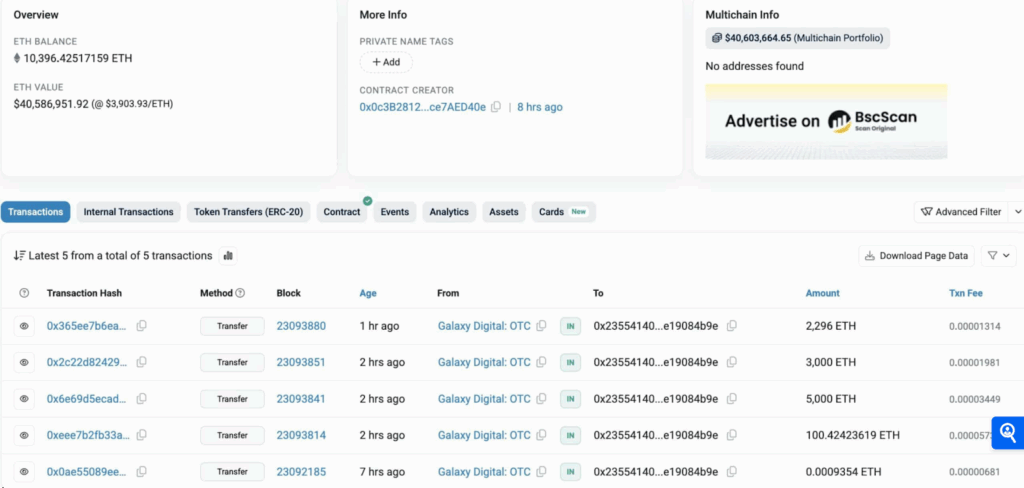
This comes in the wake of a four-day buying blitz that saw new wallets amass 171,015 ETH ($667 million) from FalconX, Galaxy Digital, and BitGo. The aggressive on-the-counter (OTC) inflows suggest a strategic long-term position rather than short-term speculation.
Over the weekend, ETH surged past $4,000, reaching $4,200 – its highest since December 2021. It was fueled by heavy trading and $207 million in short liquidations,
its largest liquidation in months.
Some analysts opined that ETH gains could spur altcoin buying, but Santiment cautioned that retail FOMO could transform momentum.
According to CryptoQuant data, Ethereum’s circulating supply has officially crossed the 121 million mark, a milestone reached nearly three years after hitting 120 million in August 2022.
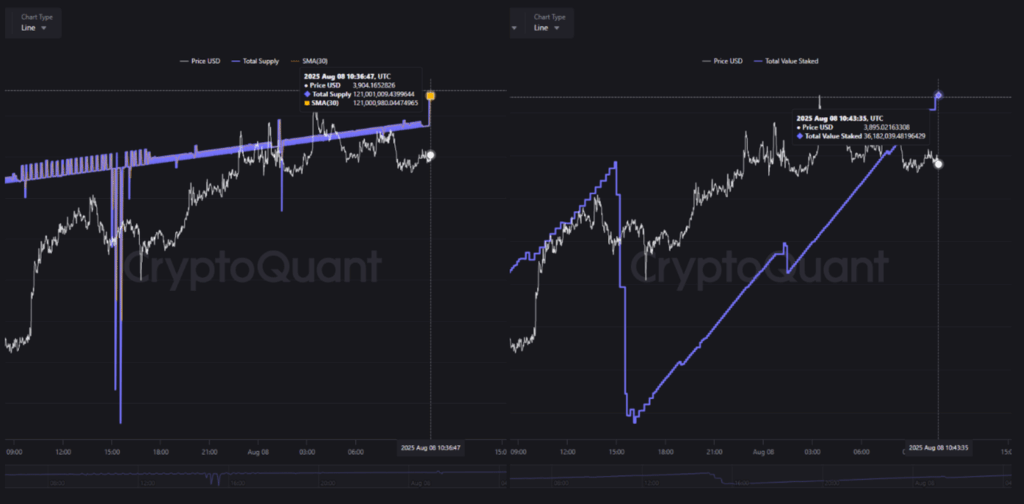
The network currently mints between 2,500 and 3,000 ETH daily, despite protocol changes and upgrades implemented over time.
Yet, staking activity keeps offsetting a portion of this issuance, with over 36.18 million ETH locked. Staking withdrawals influence ETH’s inflation profile by easing the effects of increased circulation.
Although the recent rise in supply challenges the deflationary narrative, overall network demand and staking participation remain essential factors in determining whether this expansion will support or weigh on ETH’s price.
Chainlink signals bullish shift
Chainlink is showing signs of entering a new bull cycle as the project keeps hitting strategic milestones and attracting inflows from whales and institutional wallets.
The official launch of Chainlink Reserve, a strategic reserve fund aimed at long-term LINK accumulation to support the ecosystem’s development, marks a significant move. According to the official announcement, Chainlink Reserve is a decentralized accumulation mechanism for Chainlink (LINK).
The LINK tokens allocated to the Reserve are not expected to be withdrawn for several years. This sends a strong message about the project’s long-term strategy and reflects its commitment to maintaining a stable resource pool for incentive programs, development, and integration efforts.
Additionally, the absence of any short-term withdrawal plans for LINK from Chainlink Reserve may help ease sell pressure in the market. It acts as a ‘blackhole’ that absorbs liquidity, setting the stage for the next bullish cycle.
Data from Santiment reveals that in August, the number of wallets holding between 100,000 and 1 million LINK increased by 4.2%. Additionally, 0.67% of LINK’s total supply was accumulated in just a few days.
This indicates that whales and institutions are accelerating accumulation despite the market not entering a bullish phase.
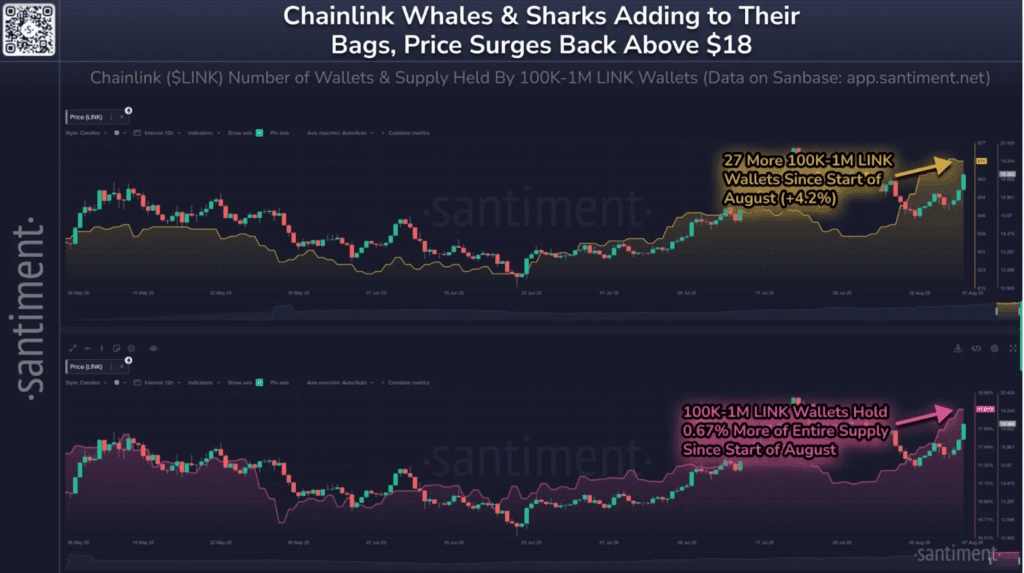
Generally, accumulation behavior from large wallets occurs during periods of uncertainty or low liquidity. If this trend continues, LINK’s price could receive strong foundational support from major investors’ deep buying levels.
Ripple to buy Rail for $200 million
Ripple has announced that it will acquire stablecoin-powered payments platform Rail for $200 million, with the deal expected to close in the fourth quarter of 2025.
The company expects the acquisition to enable it to offer stablecoin on and off ramps without requiring customers to hold cryptocurrency, and to facilitate customers in managing multiple payment types on behalf of themselves and their internal treasury flows.
Similarly, it also envisions expanding its enterprise-grade digital asset infrastructure, starting from Ripple USD (RLUSD) and XRP. The platform will also streamline third-party and treasury payments, virtual accounts, collections, 24/7 integration via a single API, enterprise-grade compliance, and access to a multi-bank partner network.
Rail CEO Bhanu Kohli noted that the company is projected to process more than 10% of global stablecoin payments in 2025, a market estimated to reach $36 billion worldwide.
Overall, the acquisition further strengthens Ripple’s long-term strategic expansion through mergers, following an estimated $3 billion in investments to date. It marks Ripple’s latest move to expand into the growing stablecoin sector following its launch of the RLUSD stablecoin and partnership with crypto exchanges like Uphold, Bitstamp, MoonPay, Bitso, and others last year.
In April, Ripple acquired crypto-friendly prime broker Hidden Road in a $1.25 billion deal. Two months later, reports were rife that RLUSD was making its way to self-custodial wallets like Xaman and integrations with developer platforms like Transak. In the same month, Ripple confirmed its intention to pursue a Markets in Crypto-Assets Regulation (MiCA) license to expand into the European Union.
Ripple rose past $3 for the first time in over a week. Investor confidence was further strengthened by expectations that the US Securities and Exchange Commission (SEC) may drop its long-standing case against them.

The memecoin market reclaims the $80B mark
The memecoin market has reclaimed the $80 billion mark, led by Dogecoin (DOGE) at $35 billion, Shiba Inu (SHIB) at $7.9 billion, and Pepe (PEPE) at $5.1 billion. Ethereum-based memecoins drove the push as ETH reclaimed the $4,000 level.
Over the weekend, naturally, PEPE rallied 10.8% to $0.0000124. Month-to-date gains stood at 18.3%, though the token remained 36% lower on a year-to-date basis. Analyst Galaxy suggested PEPE was mirroring a 2024 setup that delivered a threefold surge $0.000010 to $0.000032.
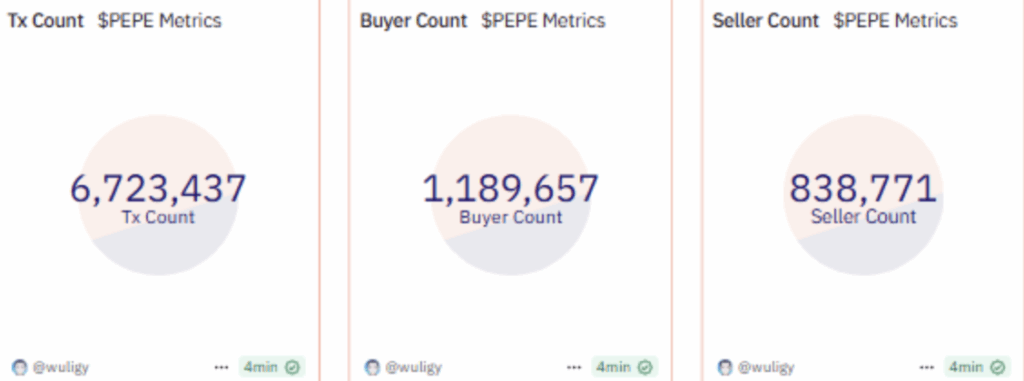
IntoTheBlock data signaled growing retail accumulation, with addresses holding $10 to $1 million worth of PEPE hitting new highs. Whales, however, stayed flat. Meanwhile, Dune data recorded 6.72 million total transactions, with 1.19 million buyers and 838,771 sellers.
The rally lifted profitable holders to 68%, cutting ‘Out of the Money’ addresses to roughly 32%, at the time of writing.
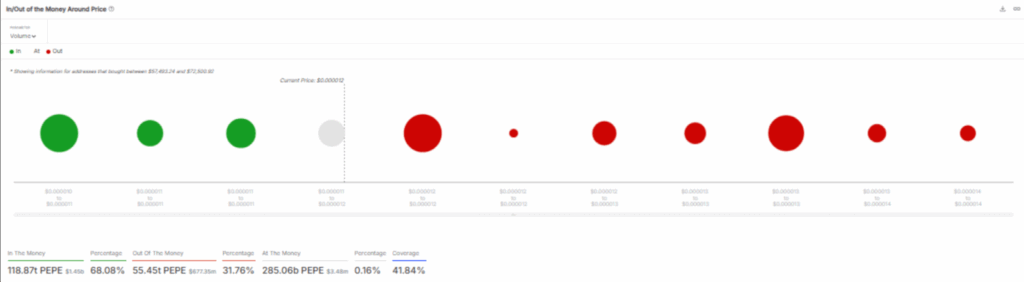
The largest token concentrations sat at $0.000012, holding 38.87 trillion PEPE, and $0.000013, with 31.38 trillion tokens. Without a doubt, how holders react to these bands could decide if PEPE’s 2025 mirrors its 2024 rally.
Ethereum ETFs break the $1 billion mark
US spot Ethereum ETFs reached a milestone, recording a combined $1.01 billion in net inflows on August 11. It marks the largest single-day haul since their launch, with BlackRock’s iShares Ethereum Trust (ETHA) leading the charge.
Data on SoSoValue shows BlackRock’s ETHA recorded $640 million in net inflows on Monday, while Fidelity’s product also hit new highs.
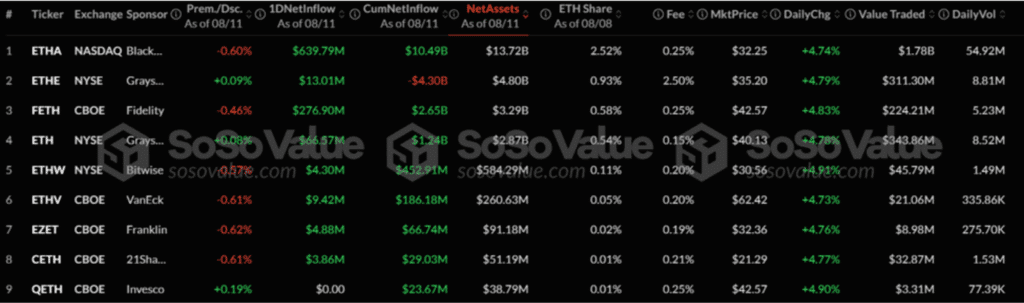
By comparison, spot Bitcoin ETFs brought in $178 million on the same day, with BlackRock’s IBIT contributing $138 million. The data marks Ethereum’s first daily inflow over the billion-dollar mark, setting fresh records for both iShares and Fidelity Ethereum ETFs.
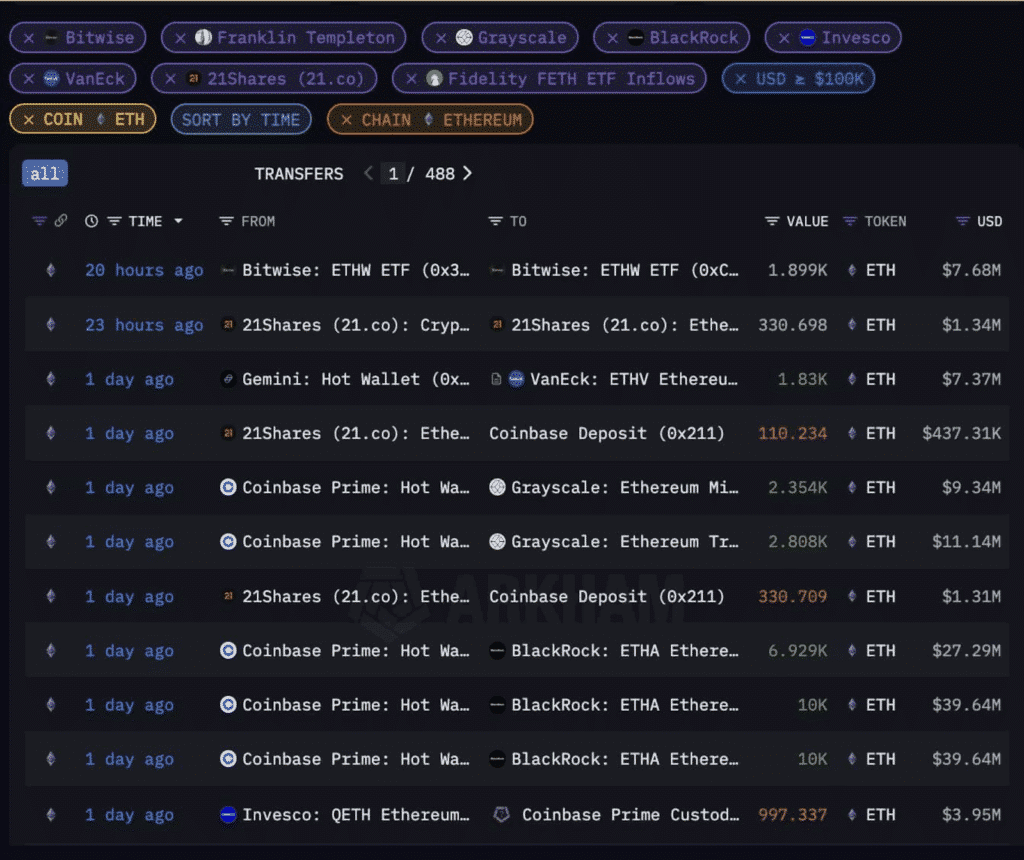
Days before, there was an ETH surge led by institutional titans like BlackRock, which scooped up $250 million worth of ETH, Fidelity adding $130 million, and Grayscale following with $60 million. It was one of the strongest single-day institutional buying waves ETH has seen this year.
Glassnode data indicated a sharp rise in first-time buyers and momentum traders, pushing new demand higher.
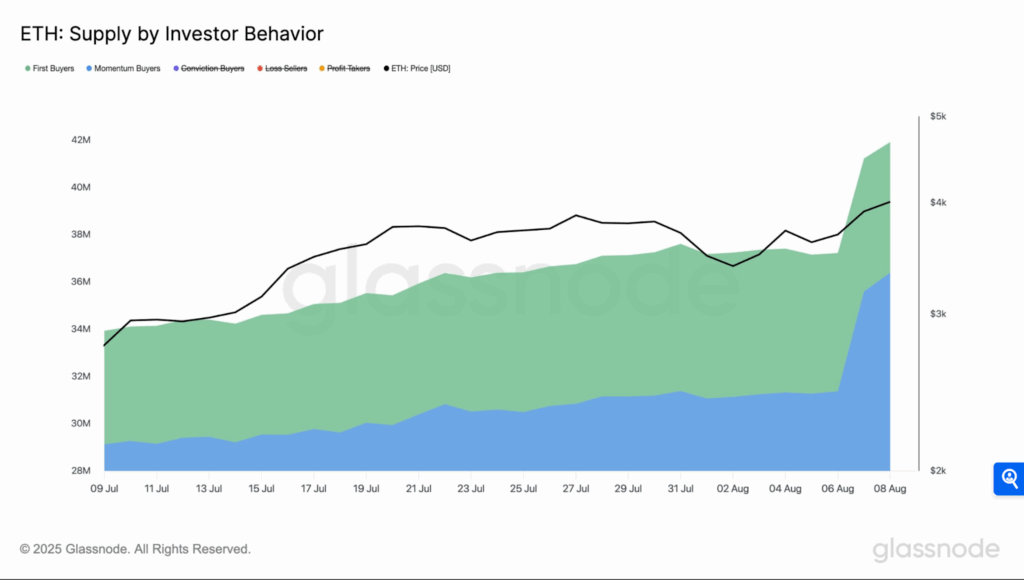
That said, conviction buyers – those raising their cost basis despite elevated prices – also grew, signaling deeper market commitment. Furthermore, this mix of fresh inflows and seasoned holder conviction could set the stage for an aggressive leg upward if buying pressure persists.
According to Nate Geraci, president of the ETF Store, the surge reflects a fundamental shift in traditional finance’s (TradFi’s) understanding of Ethereum’s value proposition. His comments suggest that Ethereum’s learning curve is paying off, with the billion-dollar inflow signaling growing institutional conviction.
Open interest in Binance ETH’s futures has surged to $10 billion, up 46% in the past month, while short positions have jumped 500% year-on-year (YoY). A renowned KOL, Crypto Patel, noted that sustained price action above $4,400 could trigger a major short squeeze, with whale accumulation and ETF-driven demand as essential catalysts.
The institutional appetite is also unfolding against a backdrop of legacy ETF industry changes. This seems like the case with seemingly obsessed Wall Street and corporate players joining the fold. This positions Ethereum ETFs as a potential growth engine for the broader market.
ETFs are snapping up more Ethereum than Bitcoin, with a recent single-day haul of $461 million in ETH products compared to $406 million for BTC, according to Arkham Intelligence.

SUI partners with Swiss crypto bank Sygnum
Switzerland’s leading crypto bank, Sygnum, has announced full support for Sui’s native token, $SUI. Now, institutions can efficiently and securely access custody, trading, staking, and lending services for $SUI.
The integration enables clients to operate with SUI under bank-grade custody, execute spot and derivatives trades, and soon stake to earn yields. By the end of the year, the bank also plans to launch Lombard loans backed by the blockchain, providing liquidity without selling the asset.
This partnership makes Sygnum a legal and regulated entry point for investors seeking exposure to SUI through a Swiss bank. The bank provides infrastructure designed to handle digital assets under the same regulatory standards applied to traditional financial instruments, lowering access barriers for entities operating under strict compliance requirements.
As a fully regulated Swiss bank managing over $1 billion in assets, Sygnum plays a big role in bridging traditional finance and digital assets. Thus, by offering a full suite of services for $SUI, the bank is not only expanding its portfolio but also helping institutions dive into promising new blockchain ecosystems.
With this development, Sygnum is making it easier for investors, asset managers, and high-net-worth individuals to engage with the Sui blockchain. This reflects growing demand for trusted blockchain access in the institutional world.
Sygnum holds a banking license in Switzerland and also possesses regulatory approvals in Singapore, Abu Dhabi, Luxembourg, and Liechtenstein. Its presence in multiple jurisdictions allows it to serve an international client base with diverse needs.
With the addition of SUI, the bank expands its digital asset portfolio and strengthens its position as a provider of financial solutions that combine the security of traditional banking with blockchain innovation. Assets are held off the bank’s balance sheet and protected from bankruptcy, adding a layer of security uncommon in the sector.
What makes SUI a perfect fit for this?
Sui is a layer-1 network that processes transactions in parallel, delivering high scalability and response times comparable to cloud services. It supports decentralized finance (DeFi), instant payments, tokenization of real-world assets, NFT projects, and gaming.
SUI has also taken a prominent role in BTCfi, enabling Bitcoin holders to lend, earn yields, and trade without surrendering control of their private keys. Then, there’s its programming language, “Move.” It was designed to help developers create apps that are powerful, secure, and less likely to be hacked.
Many large investors have started exploring options beyond Ethereum and Bitcoin. They’re drawn to newer networks that offer better scalability and lower costs. Yet, institutions need more than hype; rather, they need regulation, reliability, and security. That’s where Sygnum comes in.
The Zypto VKC emerges as a leading cold crypto wallet option
The Zypto Vault Key Card is redefining what a cold crypto wallet can be.
Supporting over 24,000 assets and up to three separate wallets in one device, it brings unmatched protection through 3FA security and split-key architecture – all in a sleek, tap-to-sign, wallet-sized card.
Forget USB sticks and firmware updates. This is mobile-first cold storage built for 2025. Find out more here.
Closing remark
Ethereum was on a high with its whales’ massive accumulation and institutional activity. Unsurprisingly, this had a tangible impact as the number of first-time buyers and momentum traders increased.
While it’s too early to confirm, the similarities in chart patterns and on-chain behavior increase investor expectations for a fresh bullish run for Chainlink.
Ripple’s acquisition of Rail further strengthens its long-term strategic ecosystem expansion. This follows the RLUSD stablecoin launch, crypto exchange partnership, and wallet integrations.
By supporting $SUI, Sygnum gives its clients a trusted path into the Sui ecosystem without needing to manage everything themselves. This provides more credibility for an emerging platform like Sui while reducing risk and unlocking new opportunities for returns.
And finally… if you’re still relying on USB sticks or browser wallets, it might be time to level up – the Vault Key Card is setting a new standard for what a cold crypto wallet should be.
There you have it, folks, this week’s crypto news! What are your thoughts on it all?

FAQs
Which large purchase did ETH whales make?
A four-day buying blitz saw new wallets amass 171,015 ETH ($667 million) from FalconX, Galaxy Digital, and BitGo.
Which project did the Chainlink ecosystem launch?
Chainlink launched the Chainlink Reserve, a strategic reserve fund aimed at long-term LINK accumulation to support the ecosystem’s development.
Which company does Ripple want to buy?
Ripple has announced that it will acquire stablecoin-powered payments platform Rail for $200 million by Q4 2025.
Which milestone did memecoins cross?
The memecoin market has reclaimed the $80 billion mark, led by the likes of Dogecoin (DOGE), Shiba Inu (SHIB), and Pepe (PEPE).
Who did SUI partner with?
SUI has partnered with Switzerland’s leading crypto bank, Sygnum, to integrate its native token, $SUI.