Welcome to the second crypto news report of July, as Bitcoin revisits its all-time-high.
Tether makes plans for possible mining in Brazil, Hong Kong could be shaping up to be a new regional crypto hub, XRP Ledger plans a gigantic deal with Mercado Bitcoin, Ethereum seems to be enjoying investor sentiment over Bitcoin and corporate BTC acquisition is on the rise.
Let’s get to it.
Tether’s mining ambition in Brazil
Tether signed a Memorandum of Understanding (MOU) with Adecoagro, a renewable energy firm in Brazil. This was announced in an official social media post as the two companies plan to explore the viability of mining in a pre-existing 230 MW power generation infrastructure.
The MOU doesn’t involve firm investment commitments from either party, and Tether mainly seems to be providing software and expertise. Still, it could provide valuable information about new areas of expansion.
Tether, the world’s largest stablecoin issuer, has already been involved in the Bitcoin mining business for several years. Notably, it made commitments to the sector earlier this year.
Still, according to the company’s press release, Tether hasn’t made a firm commitment to invest a specific amount in Brazilian crypto mining. So far, it’s only signed an MOU vowing to explore the viability of mining with renewable energy. This involves stabilizing Adecoagro’s power generation and possibly increasing its crypto exposure.
Mariano Bosch, co-founder and CEO of Adecoagro claimed,
“We’re excited to explore innovative ways to maximize the value of our renewable energy assets. This project opens the door to stabilizing a portion of the energy we currently sell on the spot market, locking in pricing, while also gaining exposure to the upside potential of Bitcoin.”
Currently boasting a substantial electrical generation capacity, Bitcoin could help Adecoagro convert surplus power into fungible assets. Several sites will use Tether’s mining OS to manage these operations. At the moment though, it seems that Tether views this as a learning opportunity, a useful test of integrating crypto with pre-existing infrastructure.
These experiments could help Tether navigate a troubled mining industry under stress from several geopolitical concerns. Yet, Brazil remains an interesting choice for this collaboration. Why?
Although the country is quite crypto-friendly, it recently increased crypto taxes and may levy additional fees and restrictions on mining. For now, however, this is merely an experiment.
Tether is investing in multiple novel business ventures alongside its US regulatory compliance efforts. The company has yet to commit many financial resources to Adecoagro and may not even directly reap profits. New research may simply complement Tether’s long-term goals in the mining sector.

Could Hong Kong become a new regional crypto hub?
With Hong Kong unveiling a new legal framework for encouraging investment, it may have an opportunity to attract crypto investment from across the region. China is also liquidating seized assets, possibly giving Hong Kong-based firms an opportunity to buy these products cheaply.
On the other hand, Singapore has been cracking down on crypto exchanges. This has led to fears of capital flight, although the country has maintained an image as a crypto-friendly country.
Its new, tougher guidelines took effect this week, possibly creating obstacles to the nation’s industry. However, Hong Kong could be poised to take Singapore’s place as a regional crypto hub.
On the surface, Hong Kong seems like a strange choice to replace Singapore. Sure, it approved Bitcoin ETFs, but China’s hostility to crypto is quite well-established.
However, the city could benefit from a few recent developments. Hong Kong passed new stablecoin laws while China is liquidating seized tokens, potentially creating an opportunity for firms to acquire new assets.
Singapore’s new regulation aims to severely crack down on unregistered exchanges and make the licensing process more difficult. The government is taking a harsh view on crypto crime, with cabinet ministers outrightly warning citizens to stay away from the industry entirely.
Singapore may have a head start in terms of crypto licenses, but Hong Kong has been accelerating approvals. Last week, Hong Kong unveiled its new LEAP framework, explicitly aimed at encouraging crypto investment. If these two cities both continue their ongoing trends, a realignment seems plausible.
Still, there are many contingent factors, and this move is by no means guaranteed. Singapore may have stricter licensing requirements, but it is nonetheless approving some requests.
Earlier this week, Robinhood’s BitStamp platform announced that it obtained such a license under the new rules. Major firms are still making fresh expansions into Singapore.
By and large, Hong Kong may take some of Singapore’s market share, but this switch might never materialize. Ideally, both cities will remain regional crypto hubs, each contributing to the global ecosystem.

XRP Ledger plans $200 million Mercado Bitcoin deal
Mercado Bitcoin, one of Latin America’s largest cryptocurrency platforms, has unveiled plans to tokenize over $200 million worth of permissioned real-world assets (RWAs) on the XRP Ledger.
This marks one of the region’s most ambitious blockchain tokenization projects to date and reflects the company’s growing focus on global expansion.
The tokenized assets will include fixed-income and equity-based instruments. The initiative is designed to improve access to regulated digital products across South America and Europe.
According to Silvio Pegado, Ripple’s LATAM managing director, the integration highlights the growing trust institutions place in public blockchain networks. He also said,
“With the kind of infrastructure the XRPL offers, it’s now possible to bring these assets on-chain in a way that meets institutional expectations for cost, speed, and compliance.”
Generally, tokenization refers to the process of issuing digital versions of traditional assets, such as securities or bonds, on blockchain networks. Analysts believe the market for tokenized assets could surpass $600 billion by 2025 and climb toward $19 trillion by 2033.
A report from Ripple and Boston Consulting Group attributes this growth to rising institutional demand and improvements in blockchain infrastructure.
Notably, several traditional financial institutions, such as BlackRock and Guggenheim Partners, have already shown interest in this space. This further validates the role that tokenized assets will play in the global financial system in the future.
Considering this, several blockchain networks are racing to secure a share of the market to meet these evolving demands. Currently, Ethereum leads the sector with $7.5 billion in tokenized asset value, while XRP Ledger was placed at number 10, hosting about $157 million in tokenized assets.
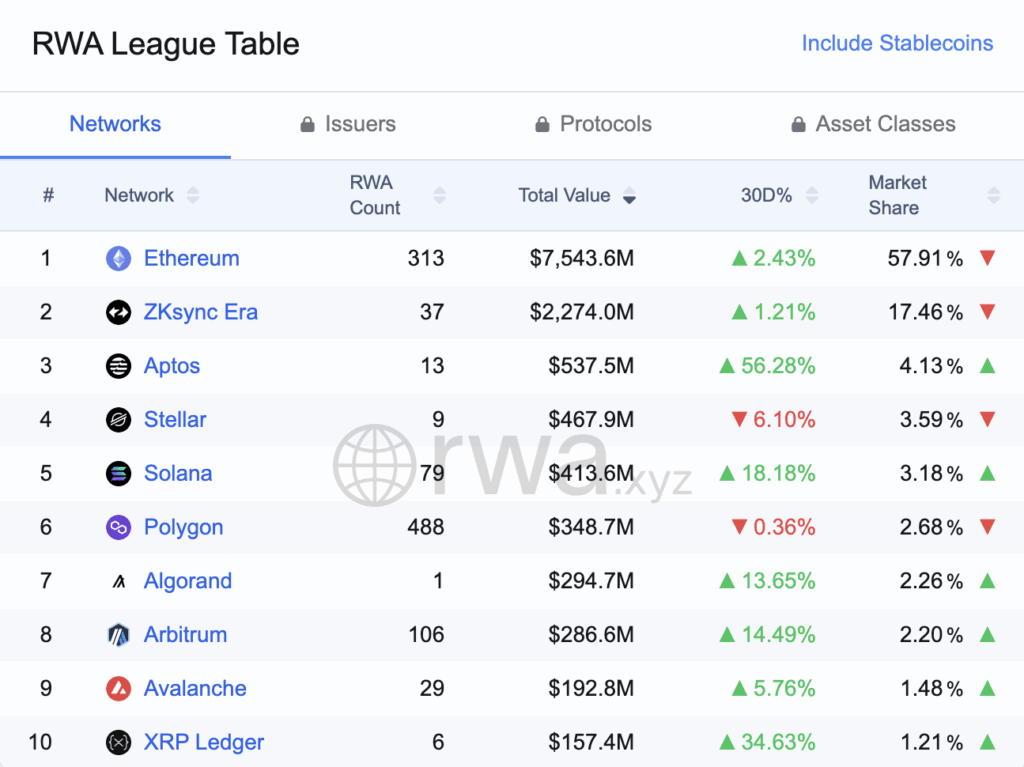
Despite the gap, Ripple executives say that XRPL’s infrastructure could help it close the distance soon. Pegado noted that XRPL’s consistent performance is a major strength. He also pointed out that the network’s low-cost, high-speed structure meets the needs of institutions seeking compliant blockchain networks.
“With the kind of infrastructure the XRPL offers, it’s now possible to bring these [RWA] assets on-chain in a way that meets institutional expectations for cost, speed, and compliance.”
Moreover, the network’s recent upgrades could further accelerate its adoption for asset tokenization. XRPL’s recent introduction of an Ethereum Virtual Machine (EVM)-compatible sidechain opens the door to Ethereum-native decentralized applications.
Furthermore, the introduction of features like batch transactions, cross-chain interoperability, permissioned decentralized exchanges, and token escrow aims to improve the overall user experience.
Investor sentiment favors Ethereum over Bitcoin
Crypto inflows keep extending their multi-week streak, with Bitcoin (BTC) and Ethereum (ETH) still leading despite broader market caution. However, ETH remains an outlier, demonstrating higher investor interest than BTC.
For context, crypto inflows hit $1.04 billion last week, and while this was lower than the previous week’s $2.6 billion, it marks the 12th straight week of positive inflows.
The latest CoinShares report indicates that last week’s crypto inflows pushed assets under management (AuM) to $188 billion. The US accounted for most of the flows, recording over 98% with $1.025 billion.
More closely, Bitcoin recorded the lion’s share, with $790 million out of the $1.042 billion crypto inflows. This was a notable slowdown to its previous week’s inflows of $2.2 billion.
James Butterfill, head of research at CoinShares, ascribes this to investor caution, which is probably delaying Bitcoin’s climb to a potential new all-time high.
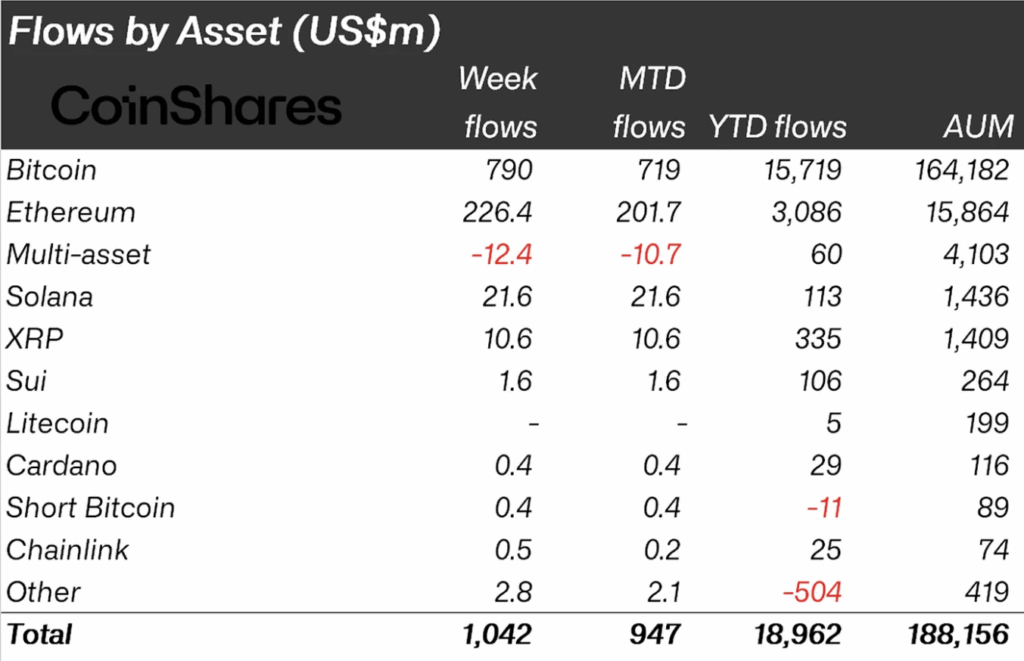
Meanwhile, Ethereum remains an outlier, marking its 11th consecutive week of positive flows. On a proportional basis, weekly crypto inflows for Ethereum have averaged 1.6% of AuM, significantly higher than Bitcoin’s 0.8%.
Butterfill added,
“This [emphasizes] a notable shift in investor sentiment in favor of Ethereum.”
Analysts ascribe Ethereum’s improving sentiment to the convergence of several catalysts. After Ethereum’s price recently reclaimed above $2,500, analysts cite validator upgrades, improving staking efficiency, and reducing supply.
MEXC Research noted that,
“Ethereum is staging a strong comeback from the recent bout of volatility triggered by the escalating tensions in the Middle East, as investor confidence renews…tracking toward the $3,000 mark.”
Similarly, Bitget Chief Analyst Ryan Lee noted Ethereum price pulling toward the psychological level, citing ETF inflows, staking upgrades, and reduced supply. This aligns with bullish forecasts from Bitwise CIO Matt Hougan, who predicted an explosive H2 2025 for Ethereum ETFs.
Furthermore, on-chain fundamentals remain strong, with applications built on Ethereum generating over $26 billion in user-paid fees since inception. MEXC Research highlighted that it was a testament to the platform’s real-worl utility with Tether, Uniswap, and Circle all playing big roles in the milestone.
Then, regulatory clarity is another tailwind, with the recent movement regarding the GENIUS Act, with Ethereum benefitting due to “its role in supporting the stablecoin infrastructure.”
Corporate BTC acquisition increases
A huge number of companies bought or planned to buy BTC recently, displaying an accelerated global trend of corporate acquisition. It’s unclear what impact this growing movement will have on BTC’s ecosystem.
Last week, public firms spent $275 million on BTC, while Metaplanet alone nearly equaled this amount. Strategy, Semler Scientific, Genius Group, and more also made commitments as well.
More companies globally are buying and stockpiling Bitcoin, outpacing even the BTC ETF issuers in that regard. Today alone, several firms have announced massive new acquisitions or plans to carry them out, providing a sense of the trend’s massive scale.
One is Strategy (formerly MicroStrategy) which plans to raise $4.2 billion for BTC buys. According to its press release, Strategy plans to sell a vast quantity of STRD, a new stock offering, to afford more Bitcoin. It has purchased more than $1 billion in BTC several times this year, but this massive commitment exceeds them all, as well as other companies.
Also, Metaplanet, one of the top five public companies by Bitcoin holdings, purchased 2,205 BTC. At current prices, that is an estimated $238.8 million. Last week, all the corporate acquisitions put together totaled $275 million, so Metaplanet nearly surpassed this alone in one day.
Furthemore, Genius Group increased its goal for a BTC stockpile to 10,000 today when it previously aimed for only 1,000. Last week, the company spent $2.1 million on Bitcoin, and it plans to use a “balanced mix of funding sources,” including revenues, BTC yields, and stock sales, to significantly expand its operations.
These are some of the most ambitious firms, but the number of aspiring corporate whales is growing at a fast rate. DDC Enterprises announced a purchase of 230 BTC, while it only held 122 BTC beforehand. Semler Scientific spent $20 million on acquisitions, maintaining a fast pace for steady growth. Several more companies bought smaller amounts.
All these companies are leaving the community with one question: what could this behavior do to Bitcoin? Some experts are already raising fears of a bubble, especially because some of these corporate holders are outperforming BTC itself.
Zypto launches mobile topups with crypto
Zypto has officially launched mobile top-ups with crypto, allowing users to purchase airtime, data and bundles in over 100 countries directly through the Zypto App.
Supporting payments with stablecoins, popular memecoins, and over 100 other digital assets, the new feature further expands Zypto’s ecosystem of real-world crypto utility and convenience. This launch marks another step in the platform’s ongoing mission to make everyday spending with digital assets both practical and accessible.
Find out more here.
Closing remark
Although nothing is set in stone between Tether and Adecoagro, the possibility of a collaboration signals the former’s interest in expansion. Hong Kong’s recent exploits (approving crypto licenses, passing new laws) is proof of its commitment to encouraging crypto investment. Still, the Asian region is stronger if Singapore remains committed to the same plan.
The Mercado Bitcoin deal with XRP Ledger is a step in the right direction. Thus, Ripple’s upgrades are also designed to enhance the network’s appeal to institutional participants.
With risk appetite improving and geopolitical risks stabilizing, ETH looks well-positioned for further gains in the coming weeks. While it is tricky to speculate how the market will react to this trend, one thing seems clear. These firms keep speeding up and not slowing down in their acquisition of BTC.
Finally, with mobile top-ups now available in over 170 countries, Zypto brings everyday crypto spending even closer to home – turning digital assets into real-world connectivity.
What’s your favorite news this week? Kindly share your thoughts with us in the comments.

FAQs
What is Tether’s ambition in Brazil?
Tether signed an MOU with Adecoagro, a renewable energy firm in Brazil for possible mining.
How has Hong Kong encouraged crypto investment?
Hong Kong passed new favorable stablecoin laws and approved crypto licenses.
What plan does XRP Ledger have?
Mercado Bitcoin plans to tokenize over $200 million worth of RWAs on the XRP Ledger.
Why does investor sentiment favor Ethereum over Bitcoin?
This can be ascribed to various reasons such as ETF inflows, staking upgrades, and reduced supply.
Which corporations have been buying BTC lately?
They include Metaplanet, Strategy, Semler Scientific, Genius Group, among others.