Welcome to the first news report of December!
Telegram launches a privacy-first decentralized AI, crypto firms sponsor one-third of European football clubs, Luana Lopes becomes a self-made billionaire, Antix launches a digital human platform, and Brave Browser surpasses 101 million users.
Come along.
Telegram’s Cocoon launches private and decentralized AI network
Telegram co-founder Pavel Durov announced last weekend that the Cocoon decentralized confidential network is officially live. This marks a major step toward bringing privacy-first Artificial Intelligence (AI) to humanity and the Web3 space.
Built on The Open Network (TON), the layer-1 blockchain associated with the messaging giant Cocoon, serves as a distributed computing platform for processing AI queries with complete confidentiality.
Cocoon is simply a decentralized platform for AI operations on TON. The platform creates a marketplace for computational power, enabling GPU owners to contribute their hardware to the network and earn Toncoin ($TON) for processing user requests.
Durov stated,
“The first user requests to artificial intelligence are processed by Cocoon with 100% confidentiality. Owners of GPU are already earning TON.”

Telegram plans to be Cocoon’s first major customer, leveraging its capabilities to power private user interactions within the messaging application and serve as the primary demand engine for the nascent network.
Cocoon’s core value proposition is protecting user privacy and data confidentiality. It leverages confidential computing, specifically Trusted Execution Environments (TEEs) such as Intel TDX, to securely connect GPU providers to privacy-conscious applications.
This framework ensures that the AI models are executed in an attested and verifiable manner, but without exposing the user’s sensitive data to the GPU provider. Durov framed the launch as a move toward digital freedom, positioning it against the centralization of AI, which he argues risks the internet becoming “the ultimate tool of control.”
This network offers a privacy-preserving alternative to the “expensive intermediaries” of centralized tech giants like Amazon and Microsoft, directly countering the centralization of power that Durov warns could turn AI into “the ultimate tool of control.”
This move mirrors his recent rejection of political censorship demands underscoring the ongoing conflict between centralized pressure and the platform’s dedication to free expression.
Cryptocurrency firms sponsor one-third of European football clubs
An analysis by Investigate Europe has revealed that cryptocurrency and online trading companies have become major players in European football sponsorships, now appearing on the shirts of more than one-third of clubs across the continent’s top leagues.
According to the report, the Premier League leads the way, with 70% of its clubs holding sponsorship deals with cryptocurrency or trading platforms. Similar partnerships have been identified in around 30% of clubs in Spain’s La Liga, Germany’s Bundesliga, and Italy’s Serie A.
The trend is reshaping the commercial landscape of the sport, and raising fresh concerns about regulation, transparency, and consumer protection.
In Italy, seven Serie A clubs have sponsorships with 11 different crypto and trading firms. Inter Milan, for instance, has deals with Gate.io and Ultima Markets, and insists its agreement is focused on Asia, though advertising has appeared domestically.
With traditional gambling sponsorships increasingly restricted across Europe, crypto and trading firms have filled the void, often offering comparable financial incentives.
According to sports marketing agency SportQuake, cryptocurrency companies invested around $565 million in sports sponsorships last season, with football accounting for 59% of that figure.
Experts warn, however, that many fans lack the financial literacy to navigate complex digital investments. As online trading brands triple their sponsorship spending, regulators and clubs alike face growing pressure to ensure these partnerships don’t expose fans to financial risk.
At present, no clubs have been accused of wrongdoing, but the report underscores a clear message: as crypto’s footprint in football expands, responsibility and regulation must keep pace.

Luana Lopes becomes youngest female self-made billionaire
Luana Lopes Lara, co-founder of the prediction market Kalshi, has become the youngest female self-made billionaire after her company announced a fresh $1 billion funding round recently.
The raise, led by crypto-focused venture firm Paradigm, valued Kalshi at $11 billion and drew participation from Sequoia Capital, Andreessen Horowitz and Y Combinator.
At 29, Lopes Lara overtakes previous titleholder Lucy Guo of Scale AI and pop icon Taylor Swift, who briefly held the distinction earlier this year.
Lopes Lara, born in Brazil and a computer science graduate of MIT, co-founded Kalshi in 2019 with Tarek Mansour, who also now joins the billionaires list at the same age.
Still, both Kalshi founders were edged out in the youth race by Shayne Coplan, 27, founder of rival prediction platform Polymarket, who became the youngest self-made billionaire in October.
Coplan’s rise followed a $2 billion investment commitment from Intercontinental Exchange (ICE), the owner of the New York Stock Exchange, into Polymarket at an $8 billion valuation.
Kalshi allows users to trade on the outcome of real-world events, such as election results, interest rate changes or even celebrity divorces, through regulated and event-based contracts. The platform became registered with the Commodity Futures Trading Commission (CFTC) in November 2020, giving it a formal regulatory status rarely seen in prediction markets.
Polymarket, by contrast, is a blockchain-based prediction market that uses USDC stablecoins to let users bet on event outcomes without traditional financial regulation.
It has gained popularity for its wide range of topics and faster market responses, but has had to navigate legal hurdles, including a 2022 settlement with the CFTC.
Both companies are reshaping how people engage with information and risk. What used to be informal bar bets, on who would win the World Cup or when inflation would cool, are now billion-dollar businesses.

Antix launches a hyper-realistic digital human platform
AI-powered digital human platform Antix launches AIGE to generate hyper-realistic, emotionally intelligent digital twins. This was confirmed via a social media post on Antix’s X account.
AIGE – Adaptive Intelligence for Generative Expression – is the AI engine that makes it easy to create digital humans who look and act like real people with a few photographs or prompts. They can talk in different languages on social media, in the metaverse, in games, and in customer service.
As part of this vision, Antix is collaborating with privacy-focused social network MeWe on a smooth co-integration between their products. Over 21 million MeWe users will gain an AI-powered layer for content creation, so that they can try new forms of social storytelling and generate unique content for one another.
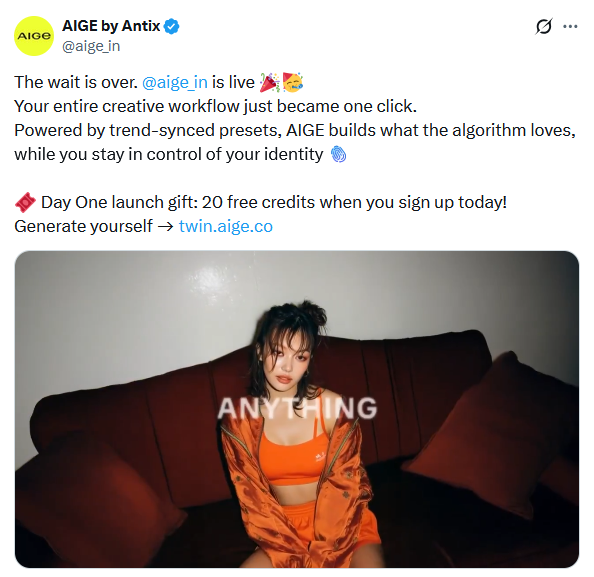
The AIGE platform will also provide a dedicated preset pack for MeWe, helping people produce images and videos quickly within the app, which enhances real-time interaction and creativity across the community.
Antix generates these avatars as digital twins, which are digital copies of a person or business. It turns faces and objects into 3D images that show nano-facial expressions with voice lip-syncing and emotion recognition. This enables users to pick qualities, styles, and behaviors that match their identity and values.
Acting as the authenticity layer, Antix anchors every AIGE-created identity through a unique non-fungible token (NFT) passport that secures identity, authenticity, and provenance and that adds blockchain-backed deepfake protection.
Antix enters the AIGE launch following a $9 million presale and growth to a community of over 400,000 members. The roadmap extends into gaming, e-commerce, brand integrations, and enterprise automation as Antix positions itself as an infrastructure layer that bridges Web2 and Web3.
From Q1 to Q3 2026, the team plans integrations with clothing marketplaces, brands, games, and platforms. It also plans to develop comprehensive APIs so digital humans can power chatbots, websites, and social channels while digital assistants support onboarding, internal communication, and personal tasks from travel planning to everyday admin.
Brave surpasses 101 million monthly users
Brave Browser surpassed 101 million monthly active users in September. At the same time, Basic Attention Token (BAT) has surged more than 100% since October 11, approaching a new 2025 high.
For context, the Brave Browser is the platform for earning and using the BAT token. Users can earn BAT by viewing privacy-respecting Brave Ads, which they can then use to tip content creators or exchange for other currencies.
Brave’s 101 million monthly active users (MAU) reflect fast growth. The privacy-first browser has also added approximately 2.5 million net new users each month for two years. With 42 million daily active users (DAU), the DAU/MAU ratio stands at 0.42, showing high engagement and retention.
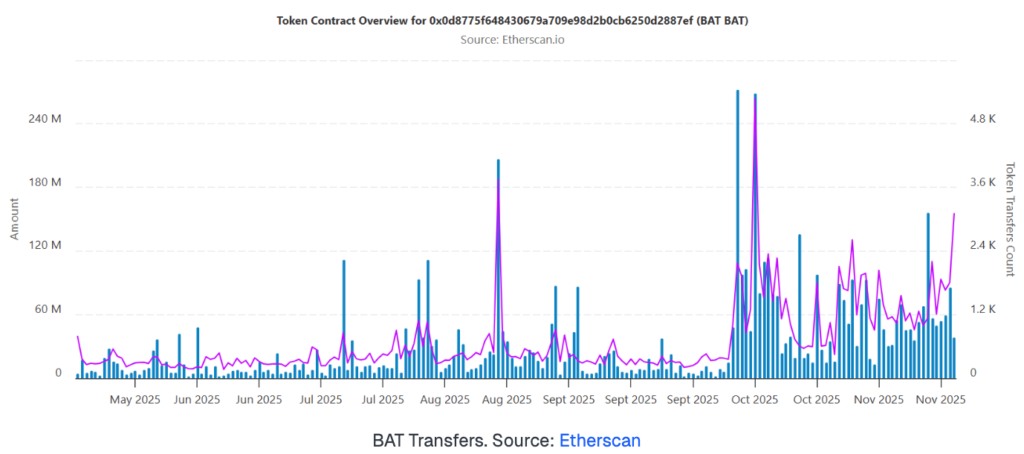
BAT’s market capitalization is over $397 million, with its recent momentum drawing the eyes of retail traders. Trade volume is up significantly, as Etherscan noted 3,107 transfers recently. On-chain analytics show BAT has 437,801 holders.
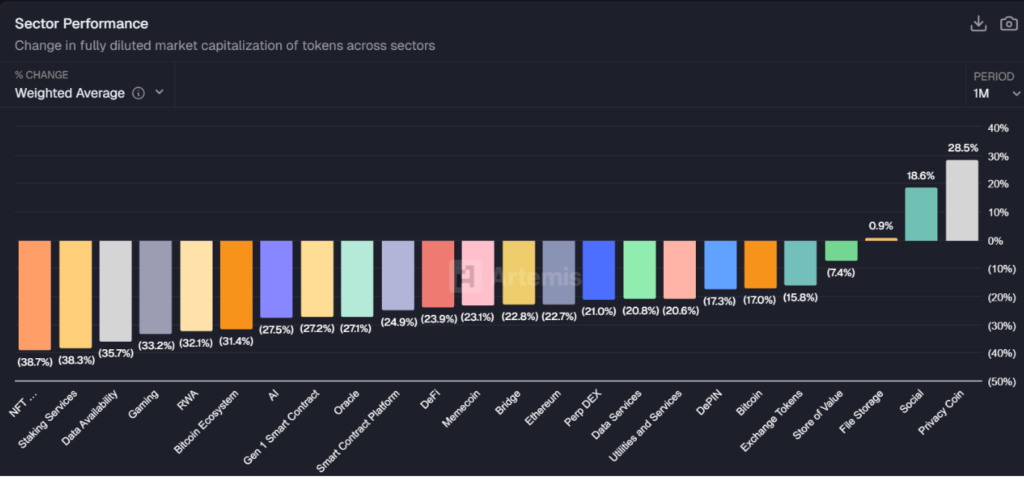
The rally positions BAT’s Social token category as the second-best performing sector over the past month, trailing only Privacy Coins. The growing adoption of privacy-focused platforms and sustained BAT accumulation reflect a trend toward privacy-first digital ecosystems.
Integrated with Brave, the Brave Search engine processes nearly 20 billion queries annually, including 1.6 billion monthly searches and more than 15 million daily AI-generated answers.
The platform also offers Leo, a privacy-centric AI assistant, plus a VPN with approximately 100,000 subscribers. Its integrated Brave Wallet supports shielded Zcash transactions and Web3, strengthening its decentralized offering. Content creators are compensated through the Brave Creators program, bypassing traditional ad networks.
BAT powers Brave’s rewards system. Users earn BAT for viewing privacy-respecting ads from major brands such as Amazon, Ford, and eBay. BAT’s wide reach is reflected in its position as the 14th most distributed token on-chain.
Closing remark
Analysts note that football’s global visibility and emotional fan connection make it an ideal platform for crypto companies seeking legitimacy and trust.
Cocoon’s launch of a decentralized, confidential AI network on The Open Network ($TON) is a critical move that extends Telegram founder Pavel Durov’s commitment to digital freedom.
For Web3 and AI enthusiasts, AIGE highlights how AI-native digital humans can transition from novelty to everyday infrastructure. A complete stack gives developers and enterprises a foundation for the next wave of digital experiences.
Brave’s transition from a privacy-focused tool to a broad digital ecosystem allows it to compete directly with mainstream browsers and search engines. BAT’s role as both a privacy tool and a social rewards mechanism places it at the center of two trends, social tokens and privacy coins.
What do you think about this week’s crypto news stories? Let us know in the comments section.
FAQs
Which football league holds the highest crypto sponsorship?
Premier League leads the way, with 70% of its clubs holding sponsorship deals with cryptocurrency or trading platforms.
What did Telegram launch?
Telegram launched Cocoon, a decentralized and private platform for AI operations on TON.
Who is Luana Lopes?
Luana Lopes Lara, co-founder of the prediction market Kalshi, has become the youngest female self-made billionaire in the world.
What is AIGE all about?
AIGE is an AI engine that creates digital humans who look and act like real people with a few photographs or prompts.