Welcome to this week’s crypto news report.
The crypto industry has been in a strong position this week, with fundraising exceeding $10 billion, and an all-time high (ATH) in weekly inflows.
TRON’s stablecoin supply hit $80B, BNB Chain plan infrastructure upgrades, as Tether eyes a $1 trillion USDT milestone. Pi Network launched a new direct buy feature, and Zypto expanded it’s crypto bill pay service to over 120 countries.
Let’s get into it.
TRON’s stablecoin supply hit $80B
TRON’s total stablecoin supply has now surpassed $80 billion, making it one of the biggest infrastructures for stablecoins across public blockchains.
This milestone underscores TRON’s increasing role as a fast and low-cost settlement layer for digital assets, particularly Tether (USDT). The expansion reflects increasing network usage and trust, which are key drivers for future TRX price growth.
USDT transfers via TRON (TRX) to centralized exchanges soared from $1.5 billion on July 9 to over $2.9 billion by July 16, marking a 93% jump. Binance alone accounted for 70% of this volume, reinforcing its dominance as the major hub for TRON-based stablecoin liquidity.
The strong concentration of capital in Binance reflects growing retail and institutional positioning, suggesting a preparation phase for possible market moves. This sharp increase in on-chain flows could signal bullish intent, especially when supported by stable underlying network fundamentals.

Over the weekend, TRX recorded net inflows of $25.7 million at press time, flipping from the negative trend seen in recent weeks. This positive netflow signals growing investor confidence and possible accumulation behavior.
Historically, sustained inflows have foregone upward price movement, especially when they align with broader ecosystem strength. While the inflow alone doesn’t confirm a breakout, it adds to the bullish confluence supported by stablecoin expansion and exchange activity.
Therefore, the latest capital shift into TRX spot markets could reflect early positioning ahead of a potential rally. TRX’s Open Interest (OI) reached $465.68 million, which reflects growing speculative demand and leveraged trading activity.
This metric indicates that traders are increasingly positioning for price volatility, which could drive sharp moves in either direction. However, when paired with stablecoin accumulation and positive netflows, this increase in OI may tilt bullish.
It reflects rising anticipation and capital deployment into TRX futures markets, especially as traders await breakout confirmation following increased CEX flows and supply expansion.
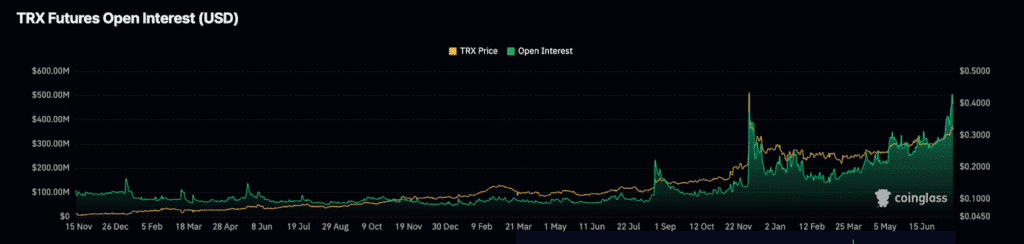
TRON’s on-chain momentum is gaining strength, supported by a record-high $80B stablecoin supply, rising CEX inflows, and an increase in OI. Despite weak sentiment and social buzz, the combination of growing network activity and accumulation hints at strategic positioning.
Crypto fundraising exceeds $10B
The latest report from data platform CryptoRank reveals that in Q2 2025, the total amount raised in the global cryptocurrency market surpassed $10 billion.
Backed by supportive U.S. government policies and large-scale investment, the crypto industry is experiencing its strongest recovery phase in three years.
This figure serves as a symbolic marker and a clear signal that the crypto industry is entering a phase of strong recovery and reshaping. It reflects the growing involvement of institutional investors and increasing support from governments.
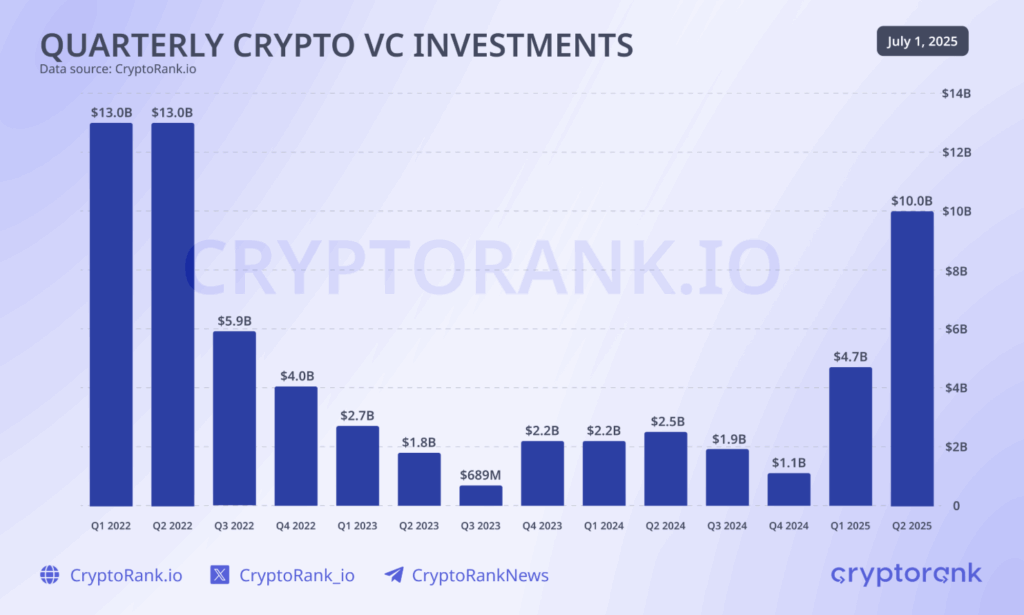
One of the foundational drivers is the more crypto-friendly policies of the new U.S. administration. After years of regulatory uncertainty and even hostility during 2022-2023, the market is now experiencing renewed support for expansion by attracting capital.
A notable shift is also occurring in the structure of capital flow. No longer are funds being poured into early-stage projects with unfinished products, as seen during the previous bull run.
Instead, the proportion of late-stage financing is rising rapidly. This reflects growing confidence in projects that have demonstrated their ability to build products. It also highlights their success in growing their user base and generating sustainable revenue.
In addition, Initial Public Offering (IPO) and Mergers and Acquisitions (M&A) deals are more active than ever, indicating a significant shift in the market. This suggests that it is no longer a playground for small experimental teams but is transitioning toward the scale of true fintech enterprises.
Deals such as exchanges acquiring DeFi startups demonstrate a growing trend in the industry. Additionally, blockchain infrastructure companies like Circle, now trading in the US markets, prove that crypto fundraising is becoming more ‘mainstream’ in the eyes of traditional finance.
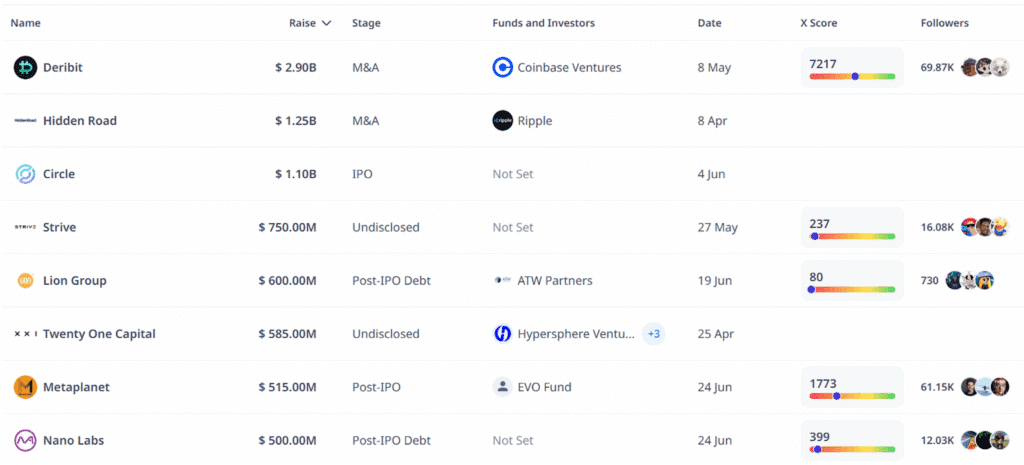
This maturity is driving more selective and high-quality capital flows. Investors are no longer chasing short-term ‘trends’ but are increasingly evaluating operational efficiency, business models, and the ability to generate real-world value..
BNB Chain plans infrastructure upgrades
BNB Chain has outlined plans for a new blockchain network that could match the speed of centralized exchanges (CEXs).
In a blog post, the team proposed significant upgrades aimed at boosting speed, efficiency, and scalability. These developments are pivotal for the entire BNB Chain ecosystem, from DeFi to GameFi, and could have a substantial impact on the price prediction of its native coin, BNB.
First, BNB Chain targets infrastructure that can support up to 5,000 decentralized exchange (DEX) swaps per second and 20,000 transactions per second (TPS) with sub-150-millisecond confirmation times.
Then, BNB Chain recently implemented its Maxwell hard fork, a monumental upgrade that slashed block production times. It reduced block times from 1.5 seconds to an impressive 0.8 seconds. This translates to “Fast Finality,” wherein transactions settle and become irreversible in under 4 seconds.
BNB Chain is rolling out various scalability solutions like the advanced Rollup-as-a-Service (RaaS), a Rust-based client for higher throughput and an upgradable virtual machine designed for extensive parallel execution. These will lower costs, making crypto treasury management more accessible for Small and Medium Enterprises (SMEs).
Furthermore, the network is committed to native privacy at the protocol level. This allows token transfers and smart contract interactions to happen discreetly, protecting sensitive user data. Similarly, BNB Chain is enhancing its platform with user-friendly features like multi-signature wallets and smooth authentication flows.
The ongoing infrastructure upgrades on BNB Chain, such as the Maxwell hard fork and ambitious future plans, are set to enhance its performance and competitiveness. By prioritizing speed, scalability, and user experience, BNB Chain aims to solidify its position as a prominent blockchain ecosystem.

Crypto records $4.39 billion weekly high
Ethereum (ETH) remains in the spotlight for the third week in a row, benefiting from a surge in institutional interest. Amid growing interest in Ethereum reserve strategies, the largest altcoin has pushed crypto inflows to a record weekly high.
The latest CoinShares report indicates crypto inflows reached $4.39 billion last week. It marks an all-time high (ATH) in weekly inflows, bringing year-to-date (YTD) positive flows to $27 billion. Meanwhile, assets under management (AuM) are at a record $220 billion.
This marks a significant upscale, after the week ending July 12 saw crypto inflows top out at $3.7 billion. It also extends the streak of positive flows, marking the 14th consecutive week of crypto inflows.
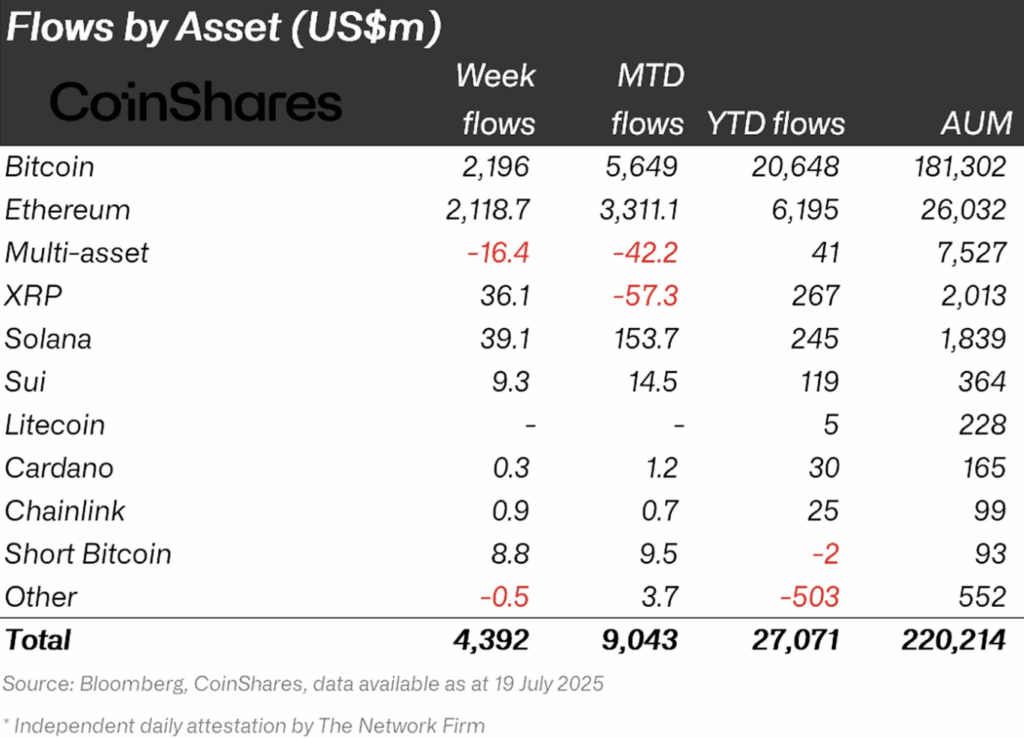
As indicated in the chart, Bitcoin (BTC) led, recording up to $2,196 billion in crypto inflows. However, Ethereum remains the outlier with $2,188.7 billion. This is more than double its inflows in a week.
The increase in Ethereum inflows is unsurprising, coming on as institutional interest in the pioneer altcoin accelerates. Among them are Sharplink Gaming and BitMine, which now hold over $1 billion in Ethereum. Its use in tokenization, stablecoins, and on-chain finance reinforces its monetary status.
Additionally, the altcoin’s market cap has surged to over $460 billion, exceeding that of Goldman Sachs and the Bank of China combined. More impressively, this makes it the 25th most valuable asset globally.
Whales and ETFs have also been pouring billions into the Ethereum market, with analysts highlighting a possible all-time high (ATH) soon.

Tether eyes $1 trillion USDT milestone
Tether CEO Paolo Ardoino says the company could grow its USDT supply tenfold, possibly surpassing $1 trillion. His comments on social media follow the passage of the GENIUS Act, a sweeping stablecoin bill signed into law by President Donald Trump on July 18.
The legislation is the first federal framework for stablecoin regulation in the US. It authorizes the Federal Reserve to license and supervise dollar-backed stablecoin issuers.
It also mandates full reserve backing, regular audits, and anti-money laundering (AML) compliance for all entities offering these tokens in the US. In a statement, Ardoino said the regulatory clarity could unlock a new level of adoption for USDT, the world’s largest stablecoin.
He stated,
“Now that President Trump has led the United States to embrace digital assets, we believe we can increase tenfold and cement the dollar’s global dominance.”
Tether currently reports over $160 billion USDT in circulation across more than 500 million users globally. A tenfold increase would bring its supply to $1.6 trillion, a milestone that would further entrench the token’s role in global crypto markets.
Ardoino’s goals are unsurprising considering USDT is the dominant stablecoin in the market. According to available market data, the digital asset currently accounts for 73% of global stablecoin transaction volume.
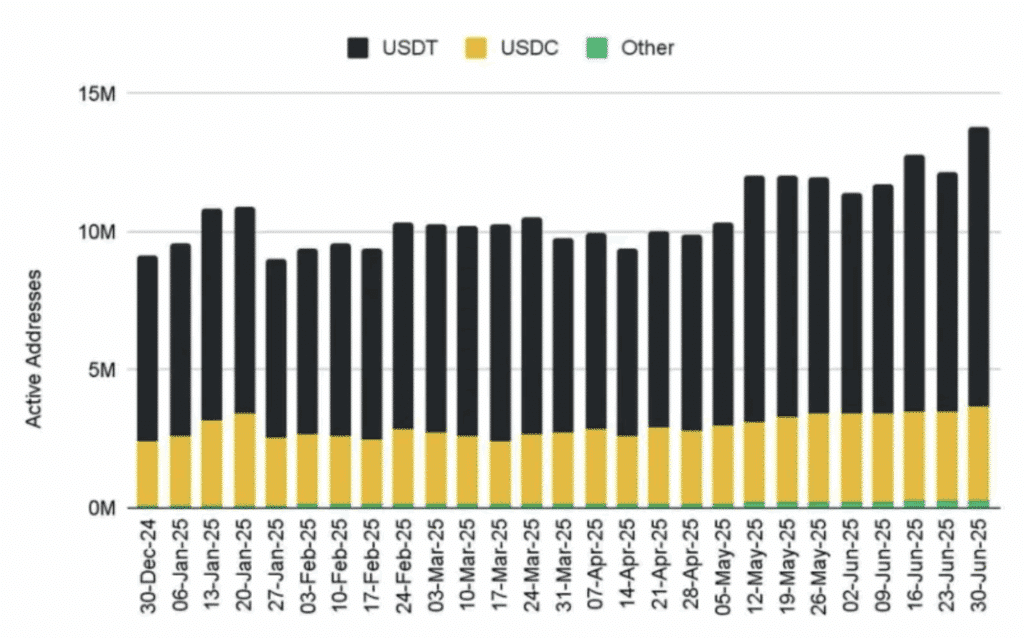
Meanwhile, despite the optimism, the GENIUS Act significantly raises the regulatory compliance bar for Tether. Under the new law, Tether, which operates out of El Salvador, must meet US standards on licensing, AML procedures, and reserve disclosures.
These requirements are essential for the company to maintain access to the American market.
Pi Network launches direct buy feature
The Pi Network team has added to its list of innovations to improve the user experience for Pioneers and its broader community.
Barely a month after unrolling Pi Desktop enhancements and full account management in Pi Browser, the network has unleashed “Buy Pi.” The new feature lets users buy Pi Coin directly on Pi Wallet, leveraging an on-ramp.
Users can purchase using fiat currency through various payment methods, including credit cards, Apple Pay, and Google Pay.
According to Dao World, one of the Pioneers, Pi Network’s move to integrate an on-ramp ecosystem enables a smooth user experience, eliminating third parties such as crypto exchanges.
Dao World explained,
“Pi is currently focused on building an on-ramp ecosystem, one that will let anyone buy Pi anytime, anywhere, without having to go through an exchange.”
In the immediate aftermath of this announcement, the price of Pi Coin leaped by over 14%. The surge came as this feature is expected to make Pi purchases more accessible, possibly driving higher demand.
By and large, Buy Pi is geared toward further enhancing Pi Network’s accessibility and adoption. FireSide, another Pioneer account, alludes to the community calling for a Sell Pi button.
These moves, taken together, suggest Pi Network may be working to secure its place in the broader market rally.

Zypto Expands Bill Pay Coverage to 126 Countries
Zypto has taken another major leap in global crypto adoption, expanding its Pay Bills With Crypto service to 126 countries and over 87,000 billers worldwide.
Users can now settle everyday expenses – utilities, credit cards, mortgages and more – directly in crypto, with no off-ramp needed.
This latest expansion brings powerful new coverage across The US, Latin America, Asia, Africa and Europe, reinforcing Zypto’s mission to turn digital assets into a truly usable currency for daily life.
Find out more here.
Closing remark
With more users seeking high-speed, low-fee environments during volatile market cycles, TRON is well-positioned to benefit from rising transaction volume and broader adoption.
The weekly crypto inflow surge reflects Ethereum’s expanding role as a bona fide financial asset on the global stage, beyond a decentralized computing network.
As multiple Web3 products have progressed beyond experimental stages to serve millions of actual users, the crypto market is undergoing a significant transformation. It is evolving from a “tech lab” into a global financial-technology ecosystem.
BNB Chain’s proposed advancements could be a major catalyst for BNB’s price, drawing in more users, developers, and potentially triggering a rally as its utility and adoption grow.
The possibility of Tether’s market cap growing as high as $1 trillion is well within reach, considering its current trajectory. If this happens, USDT’s status as a leading asset will be further solidified, and that of stablecoins.
Zypto’s expansion of its Pay Bills With Crypto service to 126 countries and 87,000+ billers signals another step toward real-world crypto utility – making digital assets usable for everyday living, globally.
Finally, by leveraging new features and updates, the Pi Network team could create another upside for Pi Coin.
This concludes our crypto news report for the week, dear reader. What are your thoughts? Let us know.

FAQs
Which milestone did TRON cross?
TRON’s total stablecoin supply has now surpassed $80 billion.
What factors led to the huge crypto fundraising amount?
They include supportive U.S. government policies, large-scale investment, and the structure of capital flow.
What are the proposed BNB Chain upgrades?
These include high TPS, native privacy, scalability solutions, and user experience/security enhancements.
Which milestone did crypto inflows record?
Tether CEO Paolo Ardoino says the company could grow its USDT supply tenfold, possibly surpassing $1 trillion.
What new feature did Pi Network launch?
Pi Network has launched a direct buy feature called “Buy Pi.”