Hello frens!
As 2025 comes to a close, attention is starting to shift from what happened this year to what may shape the next.
AI tokens, wallet adoption, evolving market cycles, the mainstreaming of real-world assets, and the growing role of institutions are all emerging as key narratives heading into 2026.
Let’s dive in.
AI tokens may be set to lead the crypto charge
The AI sector is exploding with token launches, seeing impressive traction. Take Aionix (AIONIX), for instance. Launched in August 2025 with a $77.6K market cap and yet, it seemed to be up 6.18% in the last week, as of this writing.
Against this backdrop, an analyst tagging 2026 as the year of “AI tokens” is hard to ignore. With AI momentum in the U.S. accelerating fast, a rotation from memecoins towards AI-driven assets may be increasingly realistic.
From this lens, does this wave of AI token launches really look random? Or is it early investor positioning as capital starts to front-run a much larger AI-driven move heading into 2026?
The edge for AI tokens is tied to the expanding AI narrative in the U.S. At a high level, the U.S. is pushing to establish itself as a hub for both crypto and AI. Notably, that overlap is turning into a real tailwind. In fact, in 2025 alone, nearly $3 billion was directed towards accelerating AI adoption.
That divergence is already visible in price action.
The leading AI token, Bittensor’s (TAO) market cap, is still up around 5% from its early-2025 levels. By comparison, the largest memecoin, Dogecoin (DOGE), is down roughly 50% over the same timeframe.
In this setup, the idea of an AI-token takeover in 2026 doesn’t seem far-fetched, especially with AI assets sitting at the crossroads of two narratives: accelerating crypto adoption and investment into AI.
Wallet market may grow to $686 million by 2026
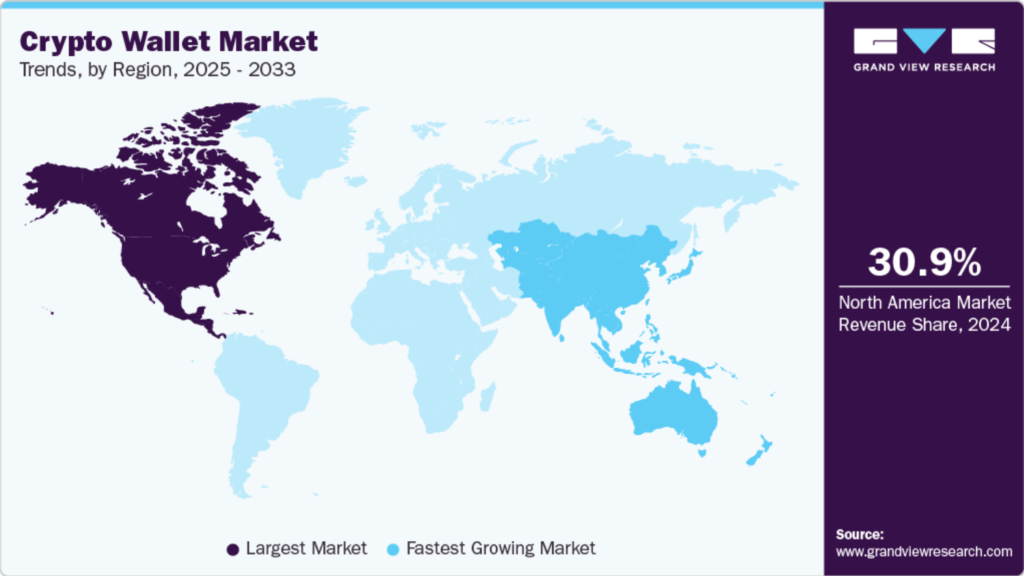
Market research firm Technavio predicts crypto wallet use will grow by $686 million by 2026. The growth will depend on the increase in wireless networks, online transactions, and the evolution of regulations.
Technavio estimates that the unrest in financial markets during the COVID-19 pandemic boosted the creation of digital wallets.
With a 41% share, North America is the biggest market, followed by China, the UK, Germany, and Switzerland. According to a study, the size of the e-wallet market, which includes non-crypto digital currencies, is expected to increase by $163.43 billion by 2027.
During the pandemic, US firms Coinbase and Robinhood Markets offered wallets that made it easy to invest in crypto. Other factors contributing to the rise in crypto wallets were the proliferation of play-to-earn games. Pandemic restrictions encouraged earning crypto income from playing blockchain-based games like Axie Infinity.
As a result, regions like the Philippines saw a dramatic spike in wallet creation as players piled in for a chance to supplement existing income. Around the same period, the amount Indians invested in cryptocurrencies grew from $923 million to $6.6 billion.
However, coordinated efforts to regulate crypto could slow adoption. New regulations in Hong Kong and the recently passed Markets in Crypto-Assets (MiCA) bill can complicate the rollout of new wallets that must comply with money-laundering rules.
Earlier, G20 leaders agreed on the need for a global crypto framework. Also, India commissioned the Financial Stability Board and the International Monetary Fund to release a paper offering recommendations for a global crypto policy.
Among other things, the paper argues that using digital currency hurts monetary sovereignty and weakens central bank policy. Choosing to hold crypto means that investors are less likely to deposit funds that can contribute to local infrastructure.
As a result, it implores countries to act to protect monetary sovereignty.

Bitcoin may reach a potential market peak in 2026
Two long-standing economic models, the Benner Cycle and the 18-Year Real Estate Cycle, both point to 2026 as a potential market peak, directly challenging Bitcoin’s (BTC) four-year halving cycle.
The Bitcoin 4-year cycle is a historical pattern tied to Bitcoin’s halving. It occurs approximately every four years and reduces the mining block rewards by half.
Typically, the cycle moves from accumulation to an uptrend, then into an euphoric peak in the year after the halving, and finally into a bear market. Therefore, if this pattern continues, 2026 may mark the start of a new bearish phase for Bitcoin.
That said, a growing number of analysts believe that this pattern may no longer hold in today’s market. Some analysts suggest that Bitcoin’s price behavior is driven more by shifts in global liquidity than by halving events.
So, if the four-year cycle is “over,” what else could offer clues about Bitcoin’s next phase? Some analysts reference two broader cyclical models in this context: the Benner Cycle and the 18-year real estate cycle.
The Benner Cycle
Samuel Benner, an Ohio farmer, introduced the Benner Cycle in 1875 after his losses during the Panic of 1873. He identified recurring patterns of booms and busts, including periods of panic, prosperity, and phases considered favorable for accumulation.
Historical comparisons suggest that the timing of the Benner Cycle coincides with major market turning points, including events like the 1929 Wall Street crash. Analysts also note that the Benner Cycle’s historical reach surpasses that of the Bitcoin cycle, which has only played out thrice.
Notably, Benner’s original chart labels 2026 as the “Years of Good Times, high Prices, and the time to sell Stocks and values of all kinds.” If the model were to hold, this pattern would suggest that 2026 would be a bull market.

18-Year Real Estate Cycle echoes the trend
The 18-Year Real Estate Cycle theory also describes a recurring pattern of boom-and-bust phases in real estate markets. According to this model, 2026 is again projected as a market peak.
Thus, if historical cycles prove accurate, markets could enter a rally in the coming year. This would offer a much-needed relief for investors, particularly in light of the crypto market’s underwhelming Q4 performance, which fell short of bullish expectations.
However, if the 4-year cycle remains valid, a further downturn may still be on the cards. As 2025 draws to a close, it remains to be seen whether cryptocurrency follows the halving-driven framework or whether time-tested economic cycles shape the new digital economy.
Real-world asset tokenization to go mainstream
Tokenization is moving from pilot experiments to production-scale financial infrastructure. In 2025, on-chain representations of cash, treasuries, and money market instruments crossed $36 billion according to RWA.xyz.
In crypto, real-world assets (RWAs) are conventional financial assets – stocks, bonds, real estate – issued as blockchain tokens that represent ownership rights to the underlying assets.
Tokenization lets managers fractionalize ownership more easily, increasing liquidity and enabling more efficient administration of the asset. A token might represent a small portion of a commercial building or a corporate bond.

Tokens and T-bills
Tokenized T-bills and short-duration T-bills now power emerging on-chain money markets and programmable cash-management tools for funds and corporations.
- BlackRock’s Used Institutional Digital Liquidity fund (BUIDL) surpassed $500 million just months after launching.
- Franklin Templeton’s tokenized funds have scaled past $400 million.
Money market funds are increasingly settling redemptions, subscriptions, and collateral flows directly on-chain. If tokenized T-bills show what tokenization looks like for institutions, prediction markets show what it looks like for consumers.
Tokenization expands beyond treasury
ETF issuers and fund managers are also testing on-chain wrappers to reduce transfer costs and enable intraday settlements. WisdomTree, 21Shares, and Hashnote are all running tokenized fund pilots.
- Polymarket reached $3.7 billion in monthly trading volume in November 2025 and was reportedly valued at $8 billion.
- Prediction market Kalshi reached a reported $11 billion valuation in December 2025.
Crypto-native RWAs are expanding, most visibly in prediction markets, where on-chain tokens represent real-world outcomes and settle automatically.
Equity markets
Even equity markets are experimenting with tokenization. Robinhood, Figure, and Securitize have explored tokenized company stocks. Robinhood has launched tokenized security trading for European users.
The offering allows traders to buy and sell tokenized contracts that track stocks and ETFs over Arbitrum. It plans to expand this offering to US markets, including tokenized secondary trading for still-private companies.
In 2026, there is an expectation for tokenization to expand beyond T-bills into tokenized funds, private markets, and consumer-grade applications, bringing distribution and compliance, not just issuance, but on-chain.
The dawn of the institutional era with digital assets
Many crypto insiders, stakeholders, and analysts expect 2026 to accelerate structural shifts in digital asset investing. It has been underpinned by two major themes: demand for alternative stores of value and improved regulatory clarity, driving institutional investment into blockchain.
Together, these trends should bring in new capital, broaden adoption, and bridge public blockchains more fully into mainstream financial infrastructure.
Grayscale believes that the crypto asset class is in a sustained bull market as documented in this report. Let us consider some of the top crypto investing themes for 2026 below.
Stablecoins to grow
Stablecoins had their breakout moment in 2025: outstanding supply reached $300 billion, monthly transactions averaged $1.1 trillion per month between June and November, and a wave of institutional capital poured into the industry.
In 2026, there is an expectation for practical results. That means stablecoins integrated into cross-border payment services, stablecoins as collateral on derivatives exchanges, stablecoins on corporate balance sheets, and stablecoins as an alternative to credit cards in online consumer payments.

Privacy solutions needed
Privacy is a normal part of the financial system: almost everyone expects that their paychecks, taxes, net worth, and spending habits will not be visible on a public ledger.
However, most blockchains are transparent by default. If public blockchains are going to be more deeply integrated into the financial system, they will need much more robust privacy infrastructure.
Demand for next-gen infrastructure
New blockchains continue to push forward the technological frontier. However, some investors argue that more block space is not needed because there is insufficient demand for existing chains.
Superior technology doesn’t guarantee adoption, but the architectures of these next-gen networks make them uniquely suited for emerging categories such as AI micropayments, real-time gaming loops, and intent-based systems.
Zypto App and the access layer for on-chain finance
As digital assets move deeper into real-world finance, access layers are becoming just as important as the assets themselves.
In 2026, users won’t just be holding tokens. They’ll be interacting with tokenized funds, stablecoin-based payment services, on-chain money markets, prediction platforms, and decentralized applications that increasingly resemble traditional financial infrastructure.
That shift places wallets at the center of the crypto experience.
Zypto App is built around this reality. Rather than operating as a closed ecosystem, it functions as a self-custodial access layer that lets users interact freely with the broader Web3 environment while keeping full control of their assets.
The built-in Web3 browser allows users to explore decentralized applications directly from within the wallet. There’s no need to export keys, switch apps, or compromise custody. dApps, DeFi platforms, NFT marketplaces, and on-chain services remain accessible while assets stay protected inside the wallet.
For applications that support external wallet connections, Zypto App integrates WalletConnect. This enables secure interaction with supported dApps without handing over private keys or account control. Users connect, approve actions, and continue their activity directly from Zypto App.
As on-chain finance expands beyond speculation and into payments, tokenized assets, and institutional-grade products, tools that prioritise interoperability, self custody, and secure access are likely to play a larger role in how users engage with crypto in 2026 and beyond.
Find out more here.

Closing remark
With AI tokens outperforming, positioning suggests early groundwork for a potential AI-led market cycle heading into 2026. As crypto becomes infrastructure, the tools people use to access it will matter just as much as the assets themselves.
As the current year nears its end, investor attention is increasingly turning to historical frameworks. Whether traditional economic cycles or Bitcoin’s halving-driven model will prevail in 2026 remains an open question for now.
In 2026, digital assets will integrate more deeply into payments, market infrastructure, and global commerce. Crypto should be treated as infrastructure moving forward by building around tokenized-asset distribution.
Real-world assets (RWAs) are increasingly seen as a bridge between crypto and traditional finance. This momentum is carrying RWAs into the financial mainstream, while taking the likes of Ethereum and Solana to Wall Street.
Next year is likely to be about deepening the connectivity between blockchain-based finance and traditional finance, and about institutional capital inflows. The tokens seeing institutional adoption are likely to be those with a clear use case, sustainable revenue, and access to regulated trading venues and applications.
There’s a lot taking shape as we head into 2026. What themes do you think will matter most? Let us know in the comments section.

FAQs
Why can AI lead the crypto charge?
This can happen because there is a global acceleration of crypto adoption and investment into AI.
What will determine wallet market growth?
Its growth will depend on the increase in wireless networks, online transactions, and the evolution of regulations.
Which models predict a market peak for Bitcoin?
The two economic models include the Benner Cycle and the 18-Year Real Estate Cycle.
What is the expectation for tokenization next year?
There is an expectation for tokenization to expand beyond T-bills into tokenized funds, private markets, and consumer-grade applications.
How did stablecoins have a breakout year in 2025?
Different metrics point to this: outstanding supply, high monthly transactions, and huge institutional capital.