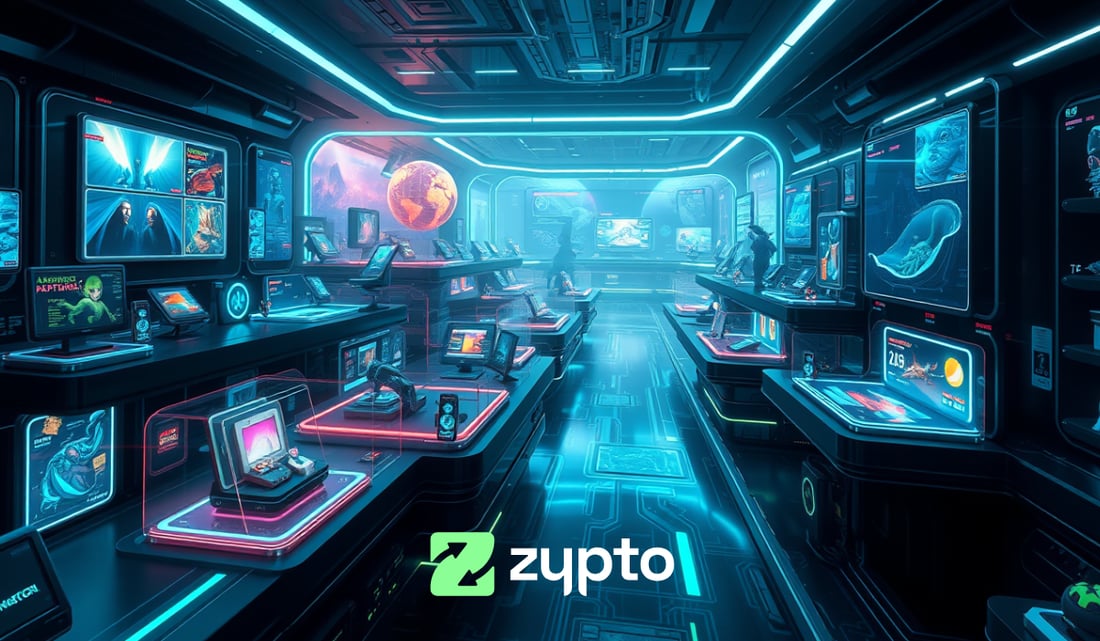
NFT marketplaces remain the core infrastructure behind digital ownership, enabling users to buy, sell, and explore tokenized assets across art, gaming, and digital collectibles.
While the hype cycle has cooled, NFTs continue to evolve into more practical use cases, particularly within gaming ecosystems and creator economies.
This guide highlights the top NFT marketplaces in 2026, focusing on liquidity, usability, and ecosystem strength.
What Are NFT Marketplaces?
NFT marketplaces are platforms where users can create, buy, sell, and trade non-fungible tokens.
These tokens represent ownership of digital assets such as
- artwork
- gaming items
- collectibles
- virtual land
- media and content
Built on blockchain networks, NFT marketplaces provide transparent ownership records and enable direct transactions between users.
Users can browse collections, participate in auctions, or list their own assets for sale depending on the platform’s features.
How NFT Marketplaces Work
NFT marketplaces operate on blockchain networks, with much of the activity historically centered around Ethereum, alongside growing multi-chain support.
When a user purchases an NFT, ownership is recorded on-chain, creating a verifiable and secure record of ownership.
Some marketplaces are open and support a wide range of assets, while others focus on curated collections or specific ecosystems.
Choosing the right platform depends on the type of NFTs and experience users are looking for.
The Top NFT Marketplaces to Watch in 2026
OpenSea
OpenSea remains one of the most widely used NFT marketplaces, offering a broad range of assets across art, gaming, and collectibles.
Its multi-chain support and ease of use make it a common entry point for users, while ongoing updates aim to improve performance and competitiveness.
Why it matters in 2026: Broad asset coverage with strong brand recognition
Watchpoint: Competition from newer, high-performance platforms
Blur
Blur has emerged as a leading marketplace for professional NFT traders.
It focuses on speed, advanced trading tools, and deep liquidity, making it popular among high-volume users. Blur’s interface and features are designed for efficiency rather than simplicity.
Why it matters in 2026: High-liquidity marketplace for advanced traders
Watchpoint: Continued dominance in trading volume
Magic Eden
Magic Eden started as a Solana-based NFT marketplace and has expanded into a multi-chain platform.
It is heavily integrated with gaming ecosystems and supports a wide range of NFT categories. Its user-friendly design and growing ecosystem make it a major player.
Why it matters in 2026: Leading marketplace in gaming and multi-chain NFTs
Watchpoint: Expansion across chains and gaming partnerships
Rarible
Rarible is a flexible multi-chain marketplace supporting Ethereum, Polygon, and other networks.
It allows users to mint, buy, and sell NFTs while offering a balance between accessibility and functionality.
Its multi-chain support helps users reduce costs and explore different ecosystems.
Why it matters in 2026: Multi-chain flexibility with strong creator tools
Watchpoint: Growth of cross-chain NFT activity
Binance NFT Marketplace
The Binance NFT Marketplace integrates with one of the largest crypto ecosystems.
It offers low fees and access to a large user base, supporting NFTs across Ethereum and BNB Chain.
Its exchange integration makes it accessible to users already active in crypto trading.
Why it matters in 2026: Low-cost marketplace with strong ecosystem backing
Watchpoint: Expansion of NFT offerings and integrations
SuperRare
SuperRare focuses on curated, high-quality digital art.
It positions itself as a premium marketplace, selecting artists and collections rather than operating as an open platform.
This creates a more exclusive environment for collectors.
Why it matters in 2026: Premium marketplace for curated digital art
Watchpoint: Balance between exclusivity and accessibility
LooksRare
LooksRare is a community-focused NFT marketplace that introduced rewards-based trading.
It allows users to earn incentives while trading NFTs, creating a different model compared to traditional marketplaces.
LooksRare continues to evolve as part of the broader NFT trading ecosystem.
Why it matters in 2026: Incentive-driven marketplace model
Watchpoint: Sustainability of rewards-based trading
Conclusion
NFT marketplaces continue to evolve as the infrastructure behind digital ownership.
As the ecosystem matures, platforms are shifting toward better user experience, deeper liquidity, and stronger integration with gaming and multichain environments.
Access NFT Marketplaces in Zypto App
NFT marketplaces operate across multiple blockchain networks and typically require wallet connections to interact with them.
Zypto App enables this through its built in Web3 browser and native WalletConnect functionality, allowing direct wallet interaction with NFT marketplaces and digital asset platforms.
Users can create unlimited multichain wallets and manage assets across 20+ blockchains within a single mobile interface.
With support for over 24,000 assets and more than 1 million cross-chain swap routes, Zypto App provides a practical way to access NFT ecosystems alongside broader DeFi and multichain activity.
#FreeYourMoney with Zypto
Explore More Top Crypto Trends
→ Top Blockchain Gaming Platforms to Watch in 2026
→ Top Web3 Trends in 2026 Shaping the Future of the Internet
→ Top 10 Real-world Use Cases of Web3 in 2026
→ Top DeFi Trends to Watch in 2026
→ Top Crypto Trading Bots to Watch in 2026
→ 10 Best Crypto Podcasts to Follow in 2026
FAQs
What are NFT marketplaces?
NFT marketplaces are platforms where users can buy, sell, and trade digital assets represented as non-fungible tokens on blockchain networks.
How do NFT marketplaces work?
NFT marketplaces use blockchain technology to record ownership and transactions, allowing users to trade digital assets securely through connected wallets.
Which NFT marketplace is best in 2026?
The best NFT marketplace depends on user needs. OpenSea offers broad access, Blur focuses on advanced trading, and Magic Eden is strong in gaming and multi-chain ecosystems.
Do I need a crypto wallet to use NFT marketplaces?
Yes, most NFT marketplaces require a crypto wallet connection to buy, sell, and manage digital assets.