GM frens, welcome to this week’s crypto news.
This week, Kraken raised $800M, Paxos launched USDG0, and Tether bought a robotics firm. Harvard backed BlackRock’s IBIT, the Czech National Bank made a crypto move, and Japan slashed its tax rate to 20%.
Zypto also rolled out a full suite of premium VISA card perks, including lounge access and global travel medical cover, with zero annual fees.
Let’s get to it.
Kraken secures $800 million capital
Kraken closed an $800 million funding round on Tuesday with a $200 million investment from Citadel Securities, valuing the crypto exchange at $20 billion. This was disclosed in the company’s announcement.
This substantial funding fuels Kraken’s expansion and product growth across trading, payments, and tokenized assets, showcasing Wall Street’s increased trust in regulated crypto infrastructure.
Kraken’s latest funding round drew strong interest from leading institutional investors. Jane Street, DRW Venture Capital, HSG, Oppenheimer Alternative Investment Management, and Tribe Capital led the raise. Additionally, Kraken co-CEO Arjun Sethi’s family office joined in the investment.
Following the primary tranche, Citadel Securities added a $200 million strategic investment, setting Kraken’s valuation at $20 billion. Their participation offers expertise in liquidity provision, risk management, and market structure, strengthening Kraken’s market leadership and validating its regulated approach.
This sharply contrasts with Kraken’s previous capital strategy. Since its 2011 founding, the company has raised only $27 million. This highlights Kraken’s historically efficient, self-sustained growth.
Both Jane Street and DRW have established themselves in cryptocurrency markets. CoinShares research reveals Jane Street supplied $1.7 billion in Bitcoin ETF liquidity in Q4 2024, while DRW provided $365 million. Their involvement validates Kraken’s push for regulated, institutional-grade infrastructure.
Kraken reported $1.5 billion in revenue in 2024, according to its financial disclosure. It also handled $665 billion in trading volume and managed $42.8 billion in client assets. Exceeding this figure in just the first three quarters of 2025 further highlights the exchange’s accelerating growth.
Recent moves have pushed Kraken beyond traditional crypto trading. The Ninja Trade acquisition added US futures trading. Equities and tokenized equity trading now bridge traditional and digital markets on the platform. Meanwhile, the KRAK app extends Kraken’s reach across payments, savings, and investment solutions globally.
Kraken supports 2.5 million funded accounts as of 2024, ranking it among the world’s largest regulated crypto exchanges. The platform operates globally and holds regulatory licenses in key markets.
Kraken plans to use its new capital on several fronts. Expansion aims at Latin America, Asia Pacific, and EMEA. The company will enhance regulatory integration across its current markets and pursue new licenses. Product development will bring advanced trading tools, broader staking, and more institutional services.
This funding coincides with renewed institutional demand in crypto. Bitcoin ETFs attracted billions of dollars from large institutional investors in 2024 and 2025. With Citadel Securities now backing Kraken, the exchange exemplifies the evolving link between digital and traditional finance sectors.
Tether eyes €1 billion robotics deal
Tether is in advanced talks to invest around €1 billion in German humanoid-robotics firm Neura Robotics, according to recent reports. The proposed investment would value Neura between €8 billion and €10 billion.
However, the scale of the talks underscores a broader pattern.
Tether has spent the past year diversifying into AI infrastructure, robotics, and real-world technology. Earlier this year, the company secured access to a 20,000-GPU compute network to build its AI research environment. It also explored major exposure to Neura’s cognitive-robotics platform, which includes humanoid systems designed for industrial and commercial work.
At the same time, Tether has expanded through financial-market partnerships. Its “Hadron by Tether” platform signed agreements with KraneShares and Bitfinex Securities to accelerate tokenized securities adoption.
The company also deepened its presence in public-sector digital infrastructure through a collaboration with Da Nang city in Vietnam. These moves come as Tether’s reserves grow. The company reported more than $135 billion in US Treasury exposure and expects record profits this year, giving it unusually large liquidity for private-market deals.
That financial capacity appears to be funding its push into AI, robotics, and digital-governance technology.
Yet questions remain. Neither Tether nor Neura has confirmed the final size or structure of the investment. Analysts note that mass-producing humanoid robots carries technical and supply-chain risk, and the projected valuation depends on Neura scaling production quickly.
Still, Tether’s decision is clear. The firm is moving from a stablecoin-only business to a broader technology investor, tying its future to sectors far beyond digital assets.
Czech National Bank makes its first crypto purchase
In a landmark step, the Czech National Bank (CNB) has made its first-ever crypto purchase, investing $1 million in Bitcoin (BTC), U.S. dollar-backed stablecoins, and a tokenized deposit.
The move, made outside its official reserves, is part of an experimental project to gain hands-on experience with blockchain and tokenized finance. Over the next two to three years, the CNB will assess the portfolio’s performance, risks, and technical challenges.
Hence, it looks like a cautious yet significant shift for one of Europe’s most conservative central banks.
That said, the CNB approved its plan to buy digital assets on the 30th of October 2025, after conducting an analysis titled “Possible Investment in Other Asset Classes.” The review showed that global funds and corporations are increasingly adopting cryptocurrencies and tokenized assets.
However, the bank clarified that it will not add Bitcoin or other digital assets to its official reserves for now. Instead, the CNB is running the pilot purely for educational purposes, focusing on building internal expertise in managing digital assets and evaluating its potential role in diversifying its reserves.
In addition to its recent digital asset purchase, the CNB has launched the CNB Lab, an innovation hub designed to explore emerging financial technologies. According to Governor Ales Michl, the CNB Lab will focus on testing blockchain, digital assets, artificial intelligence (AI), and instant payment systems.
This initiative aims to give the bank practical experience in navigating the rapidly evolving digital economy. As part of its efforts, the CNB will use the lab to experiment with Bitcoin and other blockchain-based assets. Key areas of focus include asset management, security protocols, anti-money laundering (AML) compliance, and auditing practices.
Importantly, the CNB is collaborating with the European Central Bank (ECB) and the International Monetary Fund (IMF) to study Bitcoin. However, it has clarified that these assets will not be added to its official reserves. Instead, they will be held internally for research and educational purposes.
Through this initiative, the CNB is actively building in-house expertise and preparing for a future shaped by blockchain-driven financial systems.

Japan to reduce cryptocurrency tax by 20%
Japan plans to reduce its cryptocurrency tax rate from a maximum of 55% to 20%, effective from early 2026, pending legislative approval, potentially transforming its crypto market dynamics.
Japan’s initiative to trim cryptocurrency taxes marks a concerted effort to reposition itself as an attractive hub for digital asset investment. Spearheaded by the Japanese Financial Services Agency (FSA), the proposal suggests classifying 105 “green-listed” digital currencies as financial products subject to the new tax rate.
By aligning crypto tax rates with those of traditional assets, Japan aims to eliminate barriers deterring both retail and institutional participants. This shift, scheduled for early 2026, is seen as a move to boost market liquidity and participation.
Market responses to the announcement have been generally positive.
Binance founder Zhao Changpeng commented that reducing fees represents a “promoting economic growth” move. His comments underscore optimism about Japan becoming a competitive player in the digital currency space.
Japan’s move to reclassify crypto aligns with its approach to stock market taxes, aiming to boost domestic crypto trading much like past reforms enhanced equities. This is against the backdrop of Japan’s Minister of Finance, Katsunobu Kato, confirming that regulators are almost done finalizing the policy.
There are reports that this regulatory change could lead to a 15% increase in market activity, fostering a more vibrant trading environment. By prioritizing well-vetted assets, Japan aims to balance market safety with growth.

Harvard triples its investment in BlackRock’s IBIT
Harvard University has tripled its exposure to spot Bitcoin ETFs, according to a filing submitted on November 14 detailing the U.S. holdings of the world’s largest university endowment.
According to official third-quarter data, Harvard reported holding 6,813,612 shares of iShares Bitcoin Trust (IBIT), BlackRock’s spot Bitcoin ETF. This represents a 257% increase from the 1,906,000 shares previously held in June.
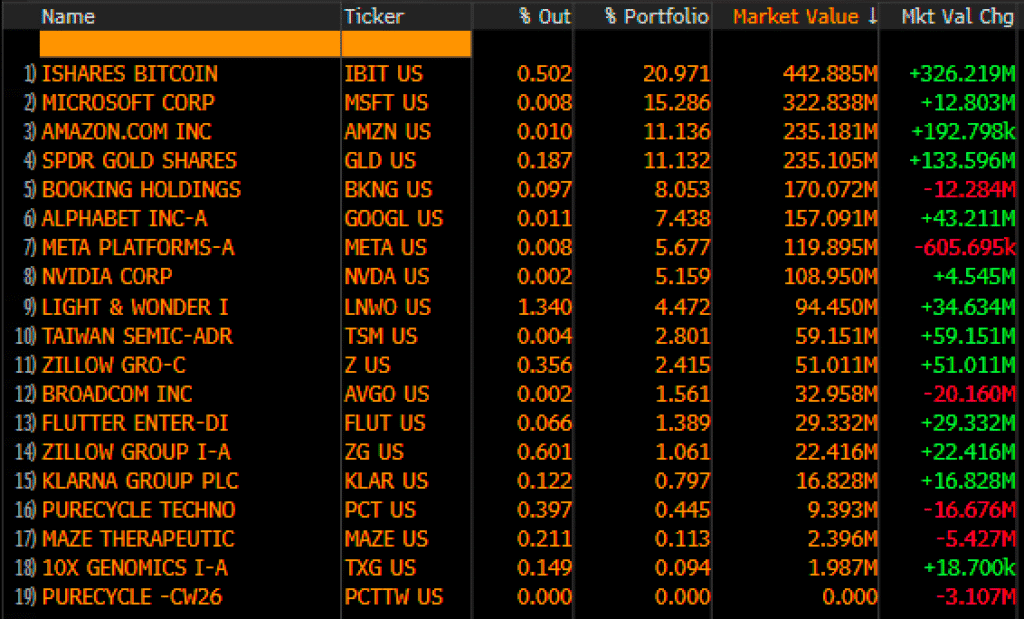
IBIT is now the university’s largest disclosed investment, surpassing giants such as Microsoft, Amazon, and the SPDR Gold Trust. As of September 30, the shares were worth $442.8 million, although their value later fell to around $364.4 million due to Bitcoin’s price decline.
Despite the large amount, the disclosed holdings represent only a small percentage of Harvard’s total endowment, which stands at roughly $57 billion; about 0.6% of its total assets.
AI Warda Investments, a sovereign wealth fund of the United Arab Emirates based in Abu Dhabi, also reported holding BlackRock’s IBIT shares worth $517.6 million as of September 30. This represents an increase of an estimated 230% from June, when the position first appeared.
Eric Balchunas, ETF analyst at Bloomberg, commented on X:
“It’s super rare/difficult to get an endowment to bite on an ETF – esp a Harvard or Yale, it’s as good a validation as an ETF can get.”
BlackRock’s IBIT is currently the leading spot Bitcoin ETF by assets under management (AUM), despite having seen $532.4 million in net outflows over the past week, according to SoSoValue data.
Harvard is not alone in this strategy.
Emory University, a private university based in Georgia, has also increased its holdings in Bitcoin ETFs. As of September 30, Emory holds over one million shares of the Grayscale Bitcoin Mini Trust ETF. The university has boosted its holdings by 91%, up from 535,781 shares at the end of June.
Paxos Labs launches USDG0
Paxos Labs has launched USDG0, an omnichain extension of its regulated USDG stablecoin, bringing fully backed dollar liquidity to Hyperliquid, Plume, and Aptos through LayerZero’s OFT standard.
According to an X post from Paxos Labs on Tuesday, USDG0 extends USDG, a 1:1 dollar-backed stablecoin issued by Paxos and governed by the Global Dollar Network, to new chains without creating separate wrapped versions.
By using LayerZero’s OFT standard, USDG0 can move across blockchains as a single native asset while preserving the same regulatory protections and backing as USDG on Ethereum, Solana, Ink, and X Layer.
Paxos Labs said the initial rollout showcases how different networks can plug into the stablecoin’s economics. On Hyperliquid, USDG0 will support yield-aligned trading and new lending markets, while Plume and Aptos plan to use it to power modular DeFi, tokenized yield, and enterprise-grade stablecoin rails.
The company said the initiative represents
“how regulated infrastructure meets the composability of DeFi and how trusted money becomes truly borderless.”
Since 2018, Paxos has processed more than $180 billion in tokenization activity under the oversight of global regulators. The company oversees three regulated dollar-backed stablecoins: USDP, PYUSD, and USDG.
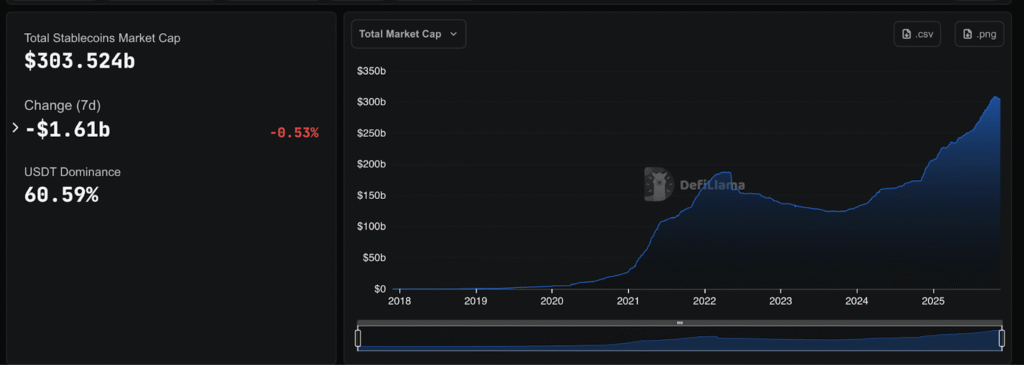
Regulatory clarity in the United States under the GENIUS Act and in Europe through the Markets in Crypto-Assets (MiCA) framework has helped drive a surge in stablecoin adoption. According to DefiLlama data, the stablecoin market cap stands at $303.44 billion, up nearly $100 billion since the start of the year.
While the stablecoin market remains dominated by Tether’s USDT and Circle’s USDC, several other players have entered the market this year from all around the world. In October, Western Union announced plans to launch USDPT, a US dollar-pegged stablecoin issued by Anchorage Digital Bank on Solana.
The token is designed to connect the company’s digital and fiat payment rails and support its global money-movement and treasury operations. The same month, JPYC, a Tokyo-based fintech company, launched Japan’s first yen-backed stablecoin, a 1:1 yen-pegged token supported by bank deposits and government bonds.
In Europe, a consortium of nine banks announced in September that they’ll launch a stablecoin pegged to the euro, competing with the rise of dollar-backed stablecoins. The stablecoin is expected to launch in the second half of 2026.
Zypto launches full suite of travel and lifestyle perks for Premium cardholders
Zypto has launched a full suite of Visa Signature Credit benefits for its Premium VISA cardholders, delivering high-tier lifestyle, travel, and protection perks with no monthly or annual fees.
Included in the new benefits package are global travel health coverage, airport lounge access, luxury hotel upgrades, autorental insurance, baggage delay and loss protection, and on-demand international mobile data through GigSky.
Cardholders also gain extended warranty protection, purchase protection, and price protection on eligible purchases, as well as access to 24/7 concierge services for travel bookings, dining, shopping, and local experiences.
The launch positions Zypto’s crypto-linked cards as a competitive alternative to traditional premium credit cards, blending onchain funding with real-world rewards.
Find out more here.
Closing remark
The Kraken story marks one of crypto’s largest capital raises and underscores tightening links between digital asset platforms and traditional finance leaders. The robotic deal signals one of the clearest shifts yet in Tether’s strategy as the world’s largest stablecoin issuer pushes beyond USDT and into high-technology sectors.
This tax reform aligns digital asset taxation with stock market rates, attracting more investors and possibly driving significant growth in Japan’s crypto sector. Harvard’s and Emory’s investment in BlackRock’s IBIT keeps validating the growing adoption of cryptocurrency.
Across all three ecosystems (Ethereum, Solana, etc.,), USDG0 is designed to enable apps to embed dollar liquidity into their products, earn yield tied to Treasury benchmarks, and transfer value between chains without relying on traditional bridges.
And finally, Zypto Premium VISA cardholders now gain access to a full range of first-class lifestyle benefits, including airport lounge access, global travel health coverage, purchase protection, and exclusive concierge services, all without paying any monthly or annual fees.
There you have it, this week’s news! What’s your favorite? Tell us in the comments below.

FAQs
How did Kraken raise its latest funds?
Kraken closed an $800 million funding round on Tuesday with a $200 million investment from Citadel Securities.
Which deal is Tether working towards?
Tether is in advanced talks to invest around €1 billion in German humanoid-robotics firm Neura Robotics.
Which crypto purchase did the Czech National Bank make?
The Czech National Bank (CNB) invested $1 million in Bitcoin (BTC), U.S. dollar-backed stablecoins, and a tokenized deposit.
What is Japan’s latest cryptocurrency legislation?
Japan plans to reduce its cryptocurrency tax rate from a maximum of 55% to 20%, effective from early 2026.
Which investment did Harvard make?
Harvard University tripled its investment in BlackRock’s IBIT ETF.