The bitcoin market is open around the clock on international exchanges, resulting in constant price discovery and trading activity that is largely unknown to traditional market players.
The Bitcoin Heatmap, which displays trading data using color-coded images that highlight patterns not visible in conventional charts, has evolved into a visualization tool that assists investors in understanding this intricate, constantly evolving market.
Bitcoin Heatmaps Provide Unique Insights
Large volumes of transaction data are transformed into understandable displays by these advanced visual representations, which highlight key purchasing and selling locations at certain price points and times.
Heatmaps, which show institutional activity patterns, define support and resistance zones, and highlight liquidity concentrations that affect future price movements, provide investors navigating Bitcoin’s infamous volatility with insights that raw price charts cannot.
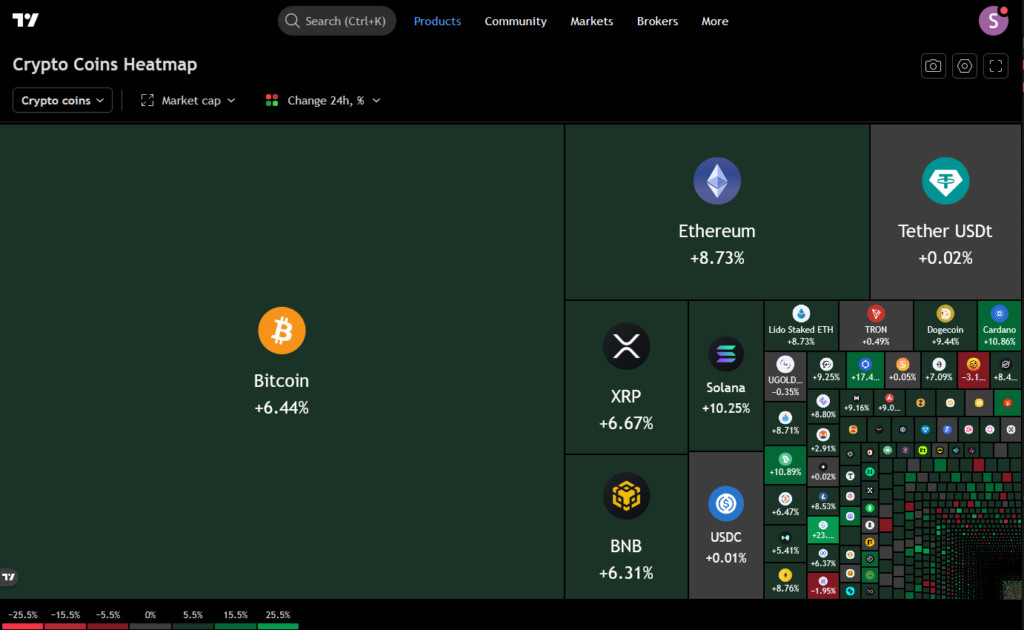
Visual Representation of Trading Activity
Bitcoin heatmaps use color intensity to show transaction density or trade volume at various price points over predetermined time periods. Lighter hues suggest periods when there was less trading activity, whereas darker or more intense colors typically indicate locations where significant trading activity had occurred.
Without carefully examining numerical data tables, investors can quickly determine price points that drew substantial market involvement thanks to this visual method. Heatmaps are especially useful for identifying patterns in large datasets since the human brain absorbs visual information significantly more effectively than lists of numbers.
Different heatmap types employ different color schemes; some utilize single-color intensity fluctuations, while others employ temperature-based gradients that transition from cool blues to warm reds. The basic idea remains the same, regardless of the particular color selections: activity levels are correlated with color intensity.
Identifying Key Support and Resistance Zones
Identifying support and resistance levels that prices have historically found difficult to overcome is one of the most useful applications of Bitcoin heatmaps. Areas with strong color concentration represent price levels where significant trading activity occurred, indicating that these zones have technical or psychological significance for market players.
When Bitcoin approaches a price point that used to see a lot of trading activity, it frequently encounters support as buyers recognize value, or resistance as sellers who missed earlier opportunities try to sell.
Heatmaps display actual transaction density, indicating where real money was exchanged rather than just where prices peaked or bottomed, in contrast to traditional support and resistance identification, which relies on drawing lines across chart highs and lows.

Tracking Large Investor and Institutional Movement
Large-scale investor or institutional activity is frequently indicated by significant color intensity clusters on Bitcoin heatmaps, as substantial capital deployment results in concentrated trade volumes at specific price points. Individual retail transactions are hardly visible on heatmaps, but the scale and planned execution of cumulative institutional orders leave noticeable signatures.
Instead of placing market orders that would cause prices to rise immediately, these large players typically employ complex tactics, building positions gradually at desired price levels. These distribution or accumulation zones are visible on heatmaps, which indicate the locations of smart money.
Investors can assume that comparable participants may defend those levels once more or take profits if the initial positions prove beneficial when Bitcoin returns to price levels where prior institutional action focused.
Understanding Liquidity Distribution Across Price Level
Heatmaps are a useful way to depict the distribution of liquidity, which refers to the ease with which assets can be bought or sold without producing substantial price fluctuations. Liquidity varies dramatically across different Bitcoin price levels.
Because prior trade created participant interest at such levels, price zones with high heatmap activity usually offer more liquidity. On the other hand, price ranges with low color intensity indicate liquidity deserts, where comparatively few market players are eager to do business.
Planning trade executions is made much easier by this liquidity mapping, as attempting to buy or sell large quantities in low-liquidity zones carries the risk of significant slippage when actual execution prices deviate substantially from anticipated levels. Furthermore, because there are fewer participants to absorb buying or selling pressure,
Bitcoin tends to pass through low-liquidity zones more quickly, making an understanding of liquidity distribution useful for forecasting price behavior.
Analyzing Time-Based Trading Patterns
Many Bitcoin heatmaps provide time dimensions in addition to showing activity across price levels, indicating when trade activity is most concentrated over the course of days, weeks, or months. Global market participation across time zones gives rise to these temporal patterns, with activity often increasing when key financial centers are active simultaneously.
Investors can identify when markets are relatively thin and when they are most liquid by understanding these rhythms, which have an impact on both volatility expectations and execution quality. Because they believe that prices during these windows may not correctly reflect genuine value and so present opportunities, some traders intentionally target low-activity periods that are evident on time-based heatmaps.
On the other hand, conservative investors may prefer to do business during periods of high activity, as liquidity ensures effective execution.

Detecting Market Sentiment Shifts
Before price charts explicitly show these changes, changes in heatmap patterns over time can indicate changing market sentiment. The heatmap shows increasing positive mood as traders voluntarily transact at higher prices when trading activity starts to concentrate at ever higher price levels.
On the other hand, activity clustering at lower levels indicates a predominance of bearish mood. More subtle changes can also convey information. For example, when an activity that was previously centered in small ranges suddenly spreads across wider price bands, it suggests that market participants are becoming less convinced or disagreeing about fair value.
By offering a new viewpoint on market psychology, these mood signals supplement conventional technical and fundamental analysis.
Recognizing Manipulation and Wash Trading
Bitcoin markets can occasionally be manipulated through wash trading, a practice in which participants simultaneously buy and sell to create fictitious volume appearances, particularly on exchanges with less stringent regulation. Heatmaps can occasionally be used to identify suspicious patterns, although this application requires a high level of skill.
While controlled activity may result in abnormally uniform or repeating patterns, genuine organic trading usually yields somewhat irregular heatmap patterns reflecting a variety of participant decisions. However, it can be challenging to distinguish between genuine trade and manipulation; therefore, investors should exercise caution when making such interpretations.
The most useful application is recognizing that high heatmap activity on some exchanges may not indicate true price discovery if those venues have a dubious reputation. Heatmap patterns that are consistent across several reliable exchanges are likely indicative of genuine market activity, whereas isolated intensity on a single exchange may raise concerns.
Conclusion
Bitcoin heatmaps show institutional activity patterns, support zones, and liquidity distribution by converting complicated trade data into easily understood visual information. Despite their strength, these tools perform best when incorporated into larger analytical frameworks, rather than being used separately.
Heatmaps can help bitcoin investors make better decisions without oversimplifying complex markets if they are aware of both their advantages and disadvantages.